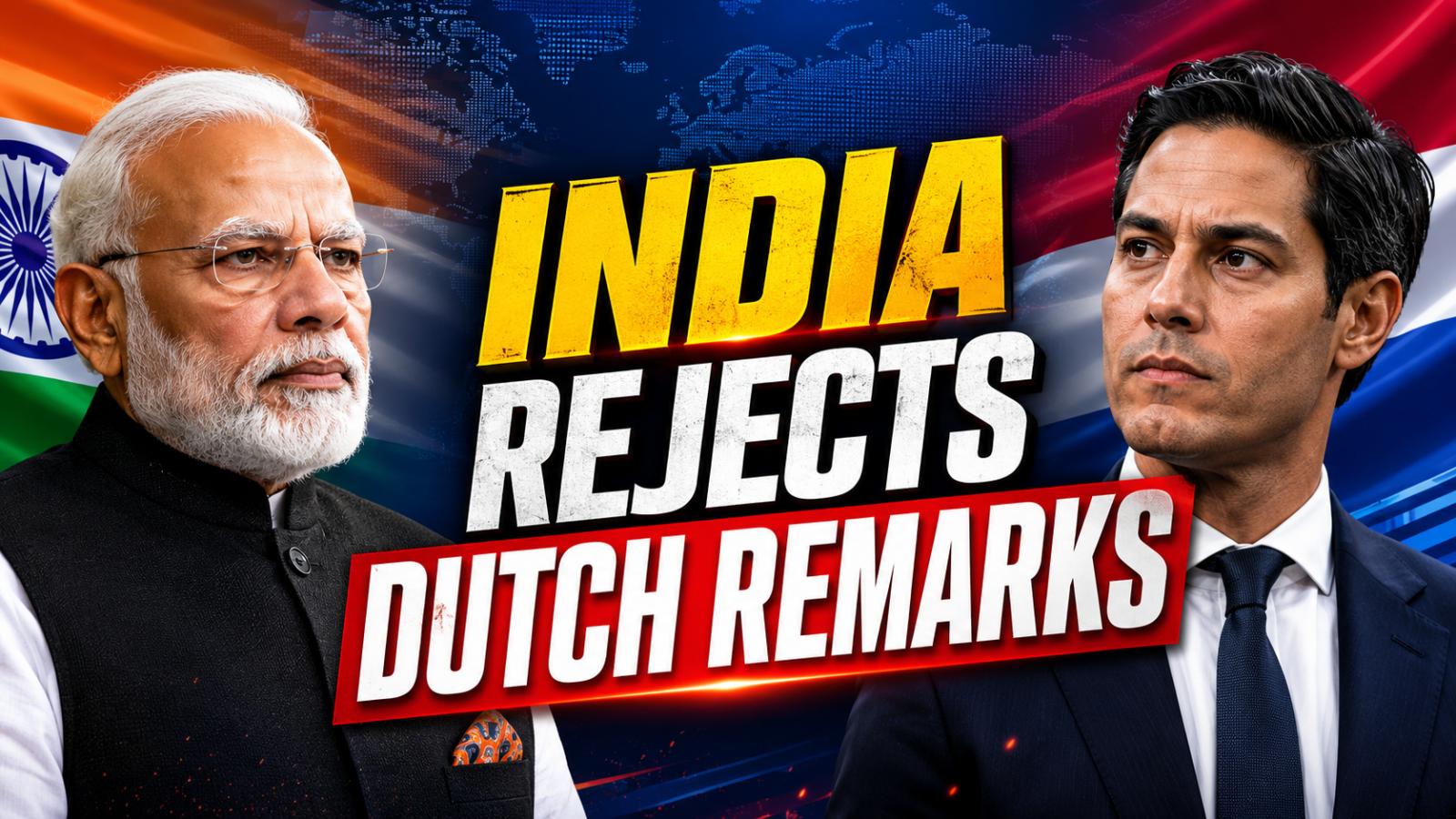
India has strongly rejected reported comments made by Dutch Prime Minister Rob Jetten on press freedom and minority rights, saying such remarks do not reflect a proper understanding of India’s democratic system, social diversity and constitutional values.
The response came during Prime Minister Narendra Modi’s visit to the Netherlands. Speaking in The Hague, MEA Secretary West Sibi George defended India’s record on democracy, elections, minority rights and development, making it clear that New Delhi does not accept narrow judgments about the country.
India Says Democracy Cannot Be Judged Narrowly
Sibi George said India is home to 1.4 billion people and has a civilisation that goes back more than 5,000 years. He said a country of this size, history and complexity cannot be understood through a limited political lens.
He pointed out that India has many languages, faiths, cultures, food habits and traditions. According to him, this diversity is not a weakness but one of the strongest foundations of Indian democracy.
George’s message was direct: India’s democratic journey is different from that of many Western countries, and outside criticism should take into account the country’s scale, history and social structure.
MEA Highlights India’s Election System
Defending India’s democratic record, George said the country’s elections continue to show strong public participation. He said millions of people take part in the voting process across villages, towns and cities, proving that democracy remains active at the grassroots level.
He also said Indian citizens continue to debate, question, vote and participate in public life. This, according to him, shows that democracy in India is not limited to institutions alone but is also visible in everyday public engagement.
India has repeatedly presented its election system as one of the largest democratic exercises in the world. New Delhi’s response suggested that criticism of Indian democracy should not ignore the scale and regularity of its electoral process.
New Delhi Defends Minority Rights
India also rejected concerns linked to minority rights. George said minorities in India have continued to live, grow and contribute to the country’s progress.
He said the minority population was around 11 percent at the time of Independence and is now more than 20 percent. He used this figure to argue that minority communities have space to grow and remain part of India’s national life.
The MEA official said India’s diversity includes people from different religions, regions and communities living together within a democratic framework. He said this diversity has remained central to India’s identity.
India Points to Peaceful Development
George also spoke about India’s progress in reducing poverty. He said India has worked to lift people out of poverty through democratic and peaceful methods, not through violence or instability.
His remarks suggested that India’s development model is based on participation, elections and public welfare. He said this matters because India is not a small or simple country, but a large and deeply diverse nation trying to grow while preserving democratic values.
India Pushes Back Against Foreign Criticism
New Delhi’s response made it clear that India sees itself as a strong and functioning democracy. The government rejected the idea that India’s press freedom, minority rights or democratic institutions can be judged without understanding the country’s social and historical background.
George said India represents one-sixth of the world’s population but should not be treated as one-sixth of the world’s problems. His statement underlined India’s position that global discussions about democracy should include respect for India’s size, diversity and democratic experience.
The remarks also show India’s growing willingness to respond firmly when foreign leaders comment on its internal matters. For New Delhi, the message from The Hague was clear: India’s democracy is complex, diverse and deeply rooted, and outside criticism must be based on a fuller understanding of the country.