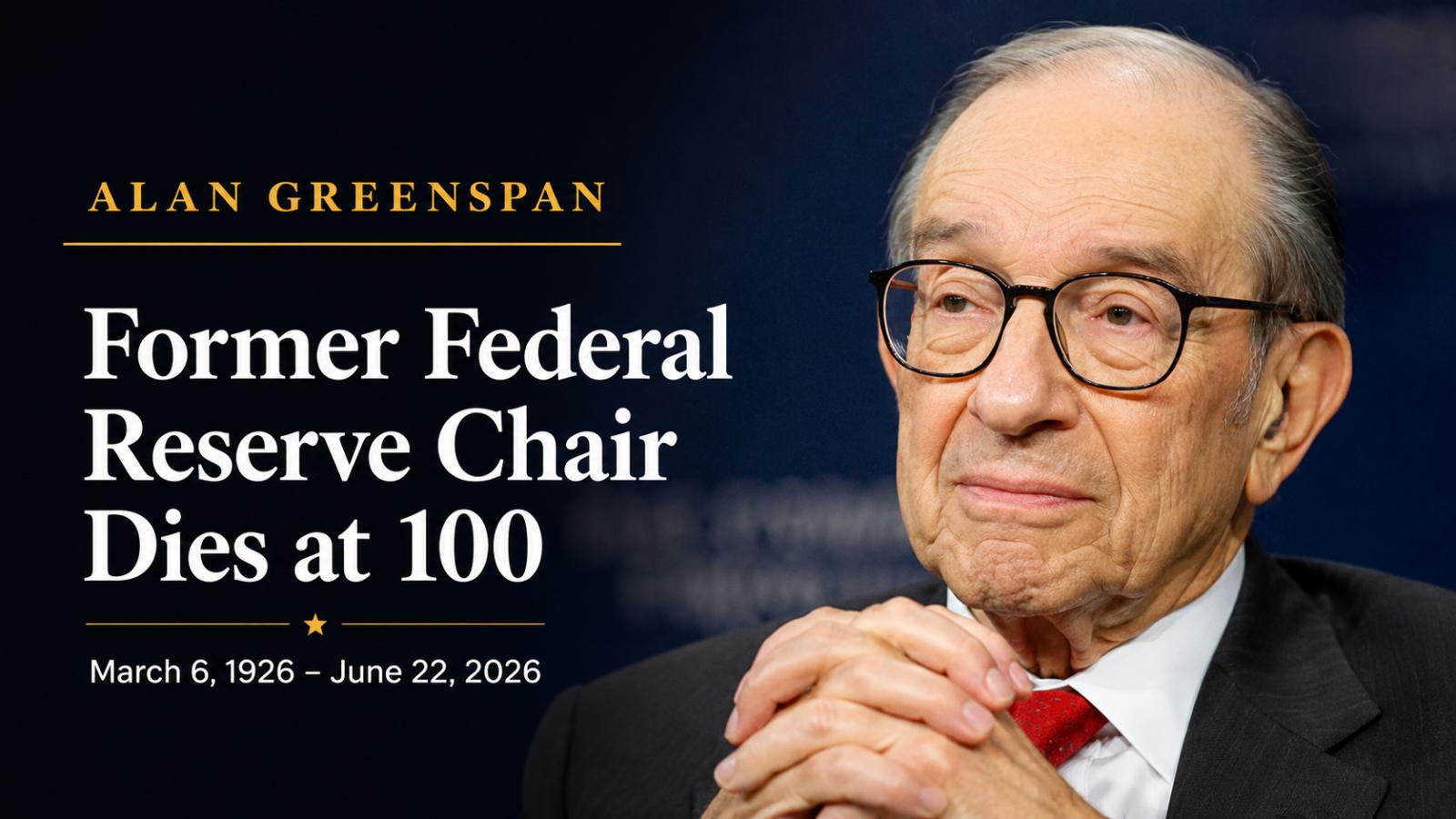
Alan Greenspan, the former Federal Reserve chair who shaped U.S. monetary policy for nearly two decades, died on Monday, June 22, 2026, at age 100.
His wife, NBC News correspondent Andrea Mitchell, said Greenspan died at their home from complications of Parkinson’s disease.
Alan Greenspan Dies After Nearly Two Decades Leading the Fed
Greenspan served as chair of the Federal Reserve from August 1987 through January 2006. Appointed by President Ronald Reagan, he remained in the position under Presidents George H.W. Bush, Bill Clinton and George W. Bush.
His tenure began shortly before the October 1987 stock market crash. He later guided the central bank through the long U.S. economic expansion of the 1990s, the dot-com collapse and the economic disruption following the September 11, 2001, terrorist attacks.
Mitchell described Greenspan as a man who helped shape the U.S. economy under presidents of both parties and who was willing to acknowledge his mistakes. She also remembered his enthusiasm for baseball, football, tennis, golf and jazz.
Federal Reserve Pays Tribute to Greenspan
For a closer look at his life, policies and influence on the U.S. economy, read our profile: Who Was Alan Greenspan? His Fed Career and Economic Legacy. In a statement issued on Monday, June 22, 2026, the Federal Reserve said Greenspan’s work left a lasting mark on monetary policy, economics and the country.
The central bank credited him with bringing analytical discipline to monetary policymaking and helping strengthen public confidence in the institution. It also extended condolences to Mitchell and Greenspan’s family.
A Celebrated but Contested Economic Legacy
Greenspan was widely praised during the 1990s for overseeing a period of sustained economic growth and relatively stable inflation. His reputation later suffered as critics examined his support for financial deregulation and the Federal Reserve’s failure to contain risks preceding the 2007–08 financial crisis.
Greenspan later acknowledged that the crisis exposed flaws in his assumptions about financial institutions’ ability to regulate themselves.
His death marks the passing of one of the most influential—and debated—figures in modern U.S. economic history. His record remains central to arguments about interest rates, financial regulation and the Federal Reserve’s responsibility during periods of economic risk.