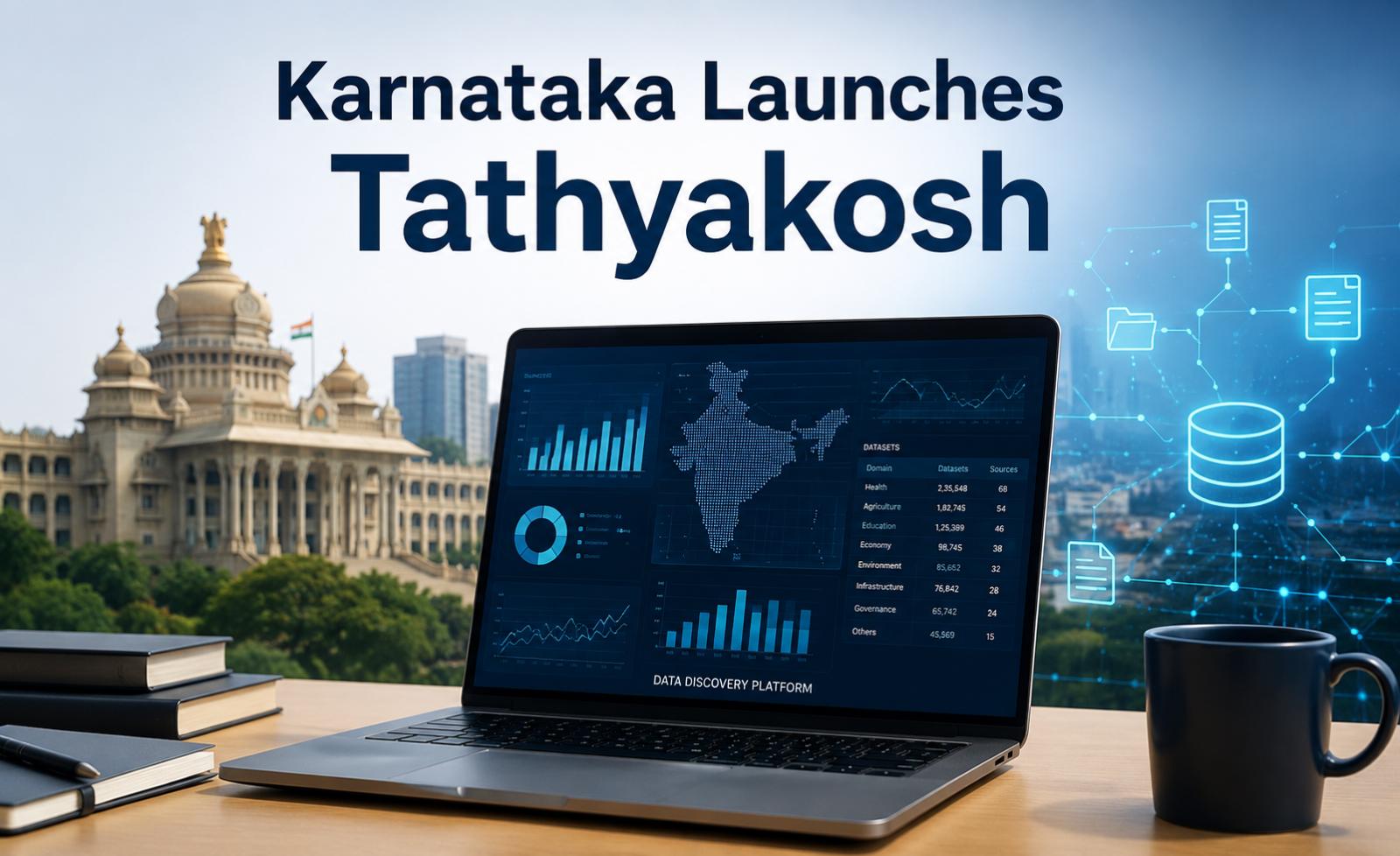
Karnataka has launched Tathyakosh.in, an open, non-commercial digital public good designed to simplify the discovery and assessment of India’s fragmented public datasets for researchers, startups, developers and policymakers.
Karnataka Launches Tathyakosh Public Data Discovery Platform
The Karnataka government’s Centre of Excellence in Artificial Intelligence, ACSEL Technology Forum, launched Tathyakosh.in in Bengaluru on August 12, 2026. Unveiled by IT-BT Minister Priyank Kharge at Vikas Soudha, the platform brings more than 1.5 million public datasets from 458 sources into one searchable interface. It aims to reduce the need to search separately across government portals, research institutions and other repositories.
1.5 Million Datasets Across 16 Key Domains
Tathyakosh covers 16 domains, including health, agriculture, education, infrastructure, environment, economy and governance. Datasets are catalogued using standardised information such as domain, geography, time period, format and access type. The platform draws on 346 Indian sources and 37 international repositories containing India-relevant data. More than 92% of the datasets are open access, while 95% are machine-readable, supporting research, analytics and AI-based applications.
Quality Scores Help Users Assess Public Data
Tathyakosh also provides a quality score to help users judge whether a dataset is suitable for their needs. The system evaluates seven dimensions: findability, accessibility, machine-readability, freshness, completeness, granularity and coverage completeness. Its historical coverage extends back to 1947. Tathyakosh does not store the underlying datasets; instead, it directs users to original sources, helping data-owning institutions retain ownership and provenance.
Strong Karnataka Focus and Support for AI
More than 50,000 Karnataka-specific datasets are already catalogued from sources including the Karnataka Open Government Data Portal, Mahiti Kanaja, KSRSAC/K-GIS, the Indian Institute of Science and the Raman Research Institute. Kharge said India’s AI ambitions depend not only on talent and computing power but also on the ability to find and use existing institutional data. The platform is expected to help researchers, universities, startups, developers and policymakers working in healthcare, agriculture, climate, legal research and financial inclusion, and can expand as more datasets are added.