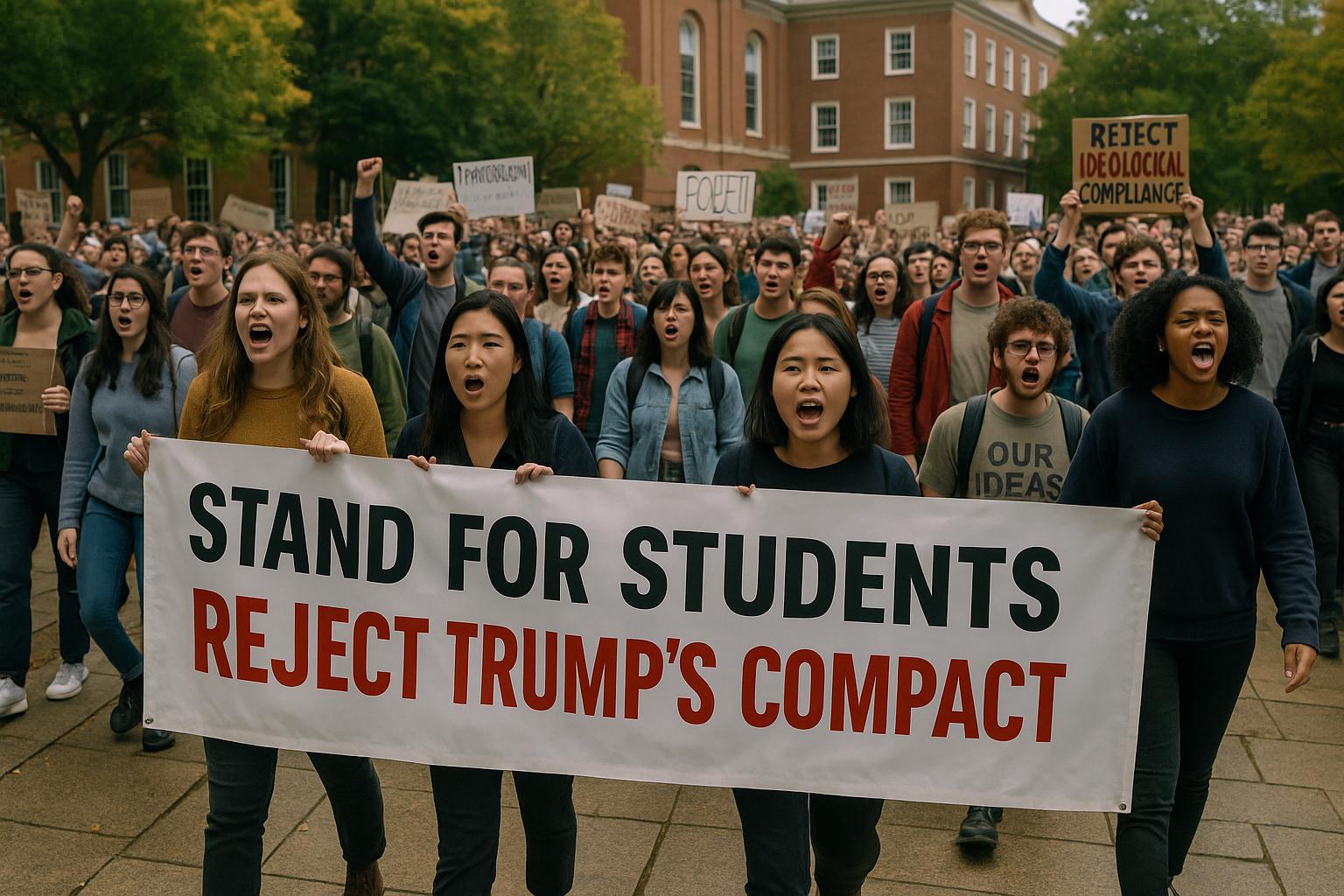
More than a hundred college campuses across the United States became centers of political activism on Friday as students, faculty, and staff joined forces to oppose what they called an unprecedented intrusion of political ideology into higher education. The coordinated demonstrations, held under the nationwide campaign “Students Rise Up,” were a direct response to the Trump administration’s proposed Compact for Academic Excellence in Higher Education, a new federal initiative that critics warn could compromise university independence.
The protests, stretching from major Ivy League institutions to public universities, represent one of the largest higher-education demonstrations in recent years. At campuses from California to New York, crowds gathered with banners declaring “Stand for Students | Reject Trump’s Compact.” Organizers described the movement as the beginning of a sustained campaign intended to defend academic freedom and resist political influence over research, teaching, and campus governance.
At the center of the controversy is the proposed Compact, announced by the Trump administration on October 1, 2025. The 10-point agreement was distributed to several major institutions, including the Massachusetts Institute of Technology (MIT), Brown University, and the University of Pennsylvania. The plan offers what the government describes as “substantial federal grants” and “increased overhead payments” to institutions willing to adopt a set of new policy conditions. These include freezing tuition for five years, ending the use of race, gender, nationality, or political views in admissions, and capping international undergraduate enrollment at 15 percent.
Supporters of the compact frame it as a reform to make higher education more affordable and politically neutral. But opponents view it as a politically motivated attempt to enforce conservative ideology on universities. They argue that the policy undermines the core principles of academic independence by tying financial benefits to ideological compliance. Seven of the nine institutions initially approached had already rejected the deal by mid-October.
Protesters also targeted billionaire financier Marc Rowan, identified by demonstrators as a major Trump donor and an alleged architect of the compact. Gatherings outside his offices in several cities demanded transparency and accountability, arguing that private donors should not dictate educational policy or curriculum design.
Beyond the ideological debate, the protests have drawn attention to a wide range of systemic issues in higher education. Demonstrators voiced demands for more affordable tuition, improved faculty contracts, better protections for international and transgender students, and institutional divestment from defense and weapons industries. At the University of Kansas, for instance, protesters urged administrators to end cooperation with Immigration and Customs Enforcement (ICE) and safeguard gender-affirming housing. At Duke University, student groups demanded a $25 hourly minimum wage for campus workers and stronger labor rights for foreign faculty and staff.
The scope of Friday’s protests was unprecedented in scale and coordination. The University of North Carolina signaled a broader institutional shift when its chancellor publicly stated that the university “will not sign the compact as written.” The statement echoed a sentiment shared across the academic community, as more than 100 university presidents earlier this year issued a joint declaration warning against political interference in higher education.
For many participating students and educators, the demonstrations were not just about opposing a single federal policy, but about preserving the principle that universities should remain spaces for free inquiry, critical debate, and diversity of thought—independent from any political or ideological influence.
Organizers of Students Rise Up have announced that Friday’s actions are only the first phase of a long-term resistance strategy. The movement plans to escalate with coordinated student and worker strikes in May 2026, eventually building toward a general strike in 2028 if the administration continues to pursue the compact.
The protests have placed universities in a difficult position. Institutions are now faced with the choice of accepting the compact’s conditions, maintaining neutrality, or openly joining the resistance—a decision that could have significant implications for funding, reputation, and internal stability. The consequences of non-compliance remain ambiguous, though many fear potential cuts to federal support and research grants.
As the debate intensifies, the landscape of American higher education faces a moment of profound uncertainty. Students considering study in the United States, along with faculty from abroad, are watching closely as policies evolve. Whether the outcome leads to renewed independence or deeper politicization, the coming months are likely to shape not just the future of universities, but the very definition of academic freedom in America.