What did the Supreme Court decide on Louisiana’s voting map? A 6–3 ruling limits race-based districts
Supreme Court redefines limits on race in redistricting
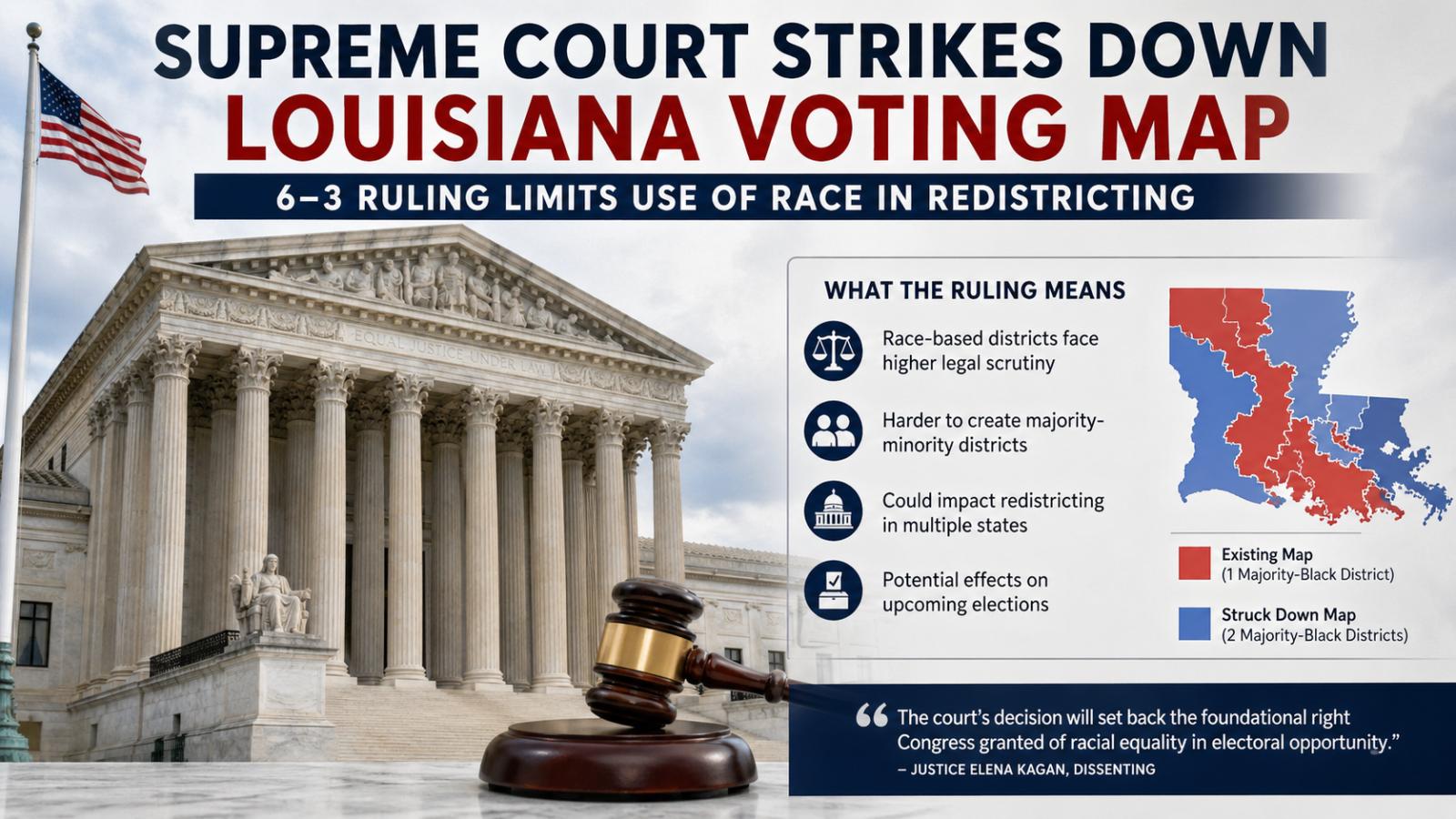
The Supreme Court of the United States issued a 6–3 ruling on Wednesday, April 29, 2026, striking down Louisiana’s congressional voting map and finding that lawmakers had improperly used race in drawing a second majority-Black district. In the majority opinion, Justice Samuel A. Alito Jr. stated that while the Voting Rights Act of 1965 remains intact, the map violated the Constitution’s Equal Protection Clause.
New legal standard raises bar for challenges
The ruling updates decades-old legal standards, requiring challengers to prove that states intentionally disadvantaged minority voters because of race. Justice Alito emphasized that cases unable to separate racial considerations from political factors would likely fail. He also noted that minority voter participation has significantly increased, suggesting earlier frameworks may no longer fully apply.
Strong dissent warns of weakened protections
In dissent, Justice Elena Kagan warned the decision could undermine fundamental voting protections, arguing it makes race-conscious districting nearly impossible. She described the ruling as a setback for equal electoral opportunity and took the unusual step of reading her dissent aloud in court.
Political and legal ripple effects nationwide
The case, Louisiana v. Callais, stems from disputes following the 2020 census. Louisiana lawmakers had attempted to create a second majority-Black district after earlier maps were challenged. Critics, including Representative Troy Carter, said the decision threatens progress made under federal civil rights law. Meanwhile, states like Florida moved quickly to adjust maps, signaling broader political consequences.
Ongoing litigation and future elections at stake
The ruling could reshape redistricting battles ahead of upcoming elections, as any new maps eliminating majority-minority districts are likely to face legal challenges. Lawmakers previously argued that political considerations, including protecting figures like Mike Johnson, influenced district boundaries. Advocacy groups, including the NAACP Legal Defense and Educational Fund, had urged the court to uphold existing protections.
Wednesday’s decision marks another significant moment in the evolving interpretation of voting rights law, with implications that could influence electoral maps and minority representation across the U