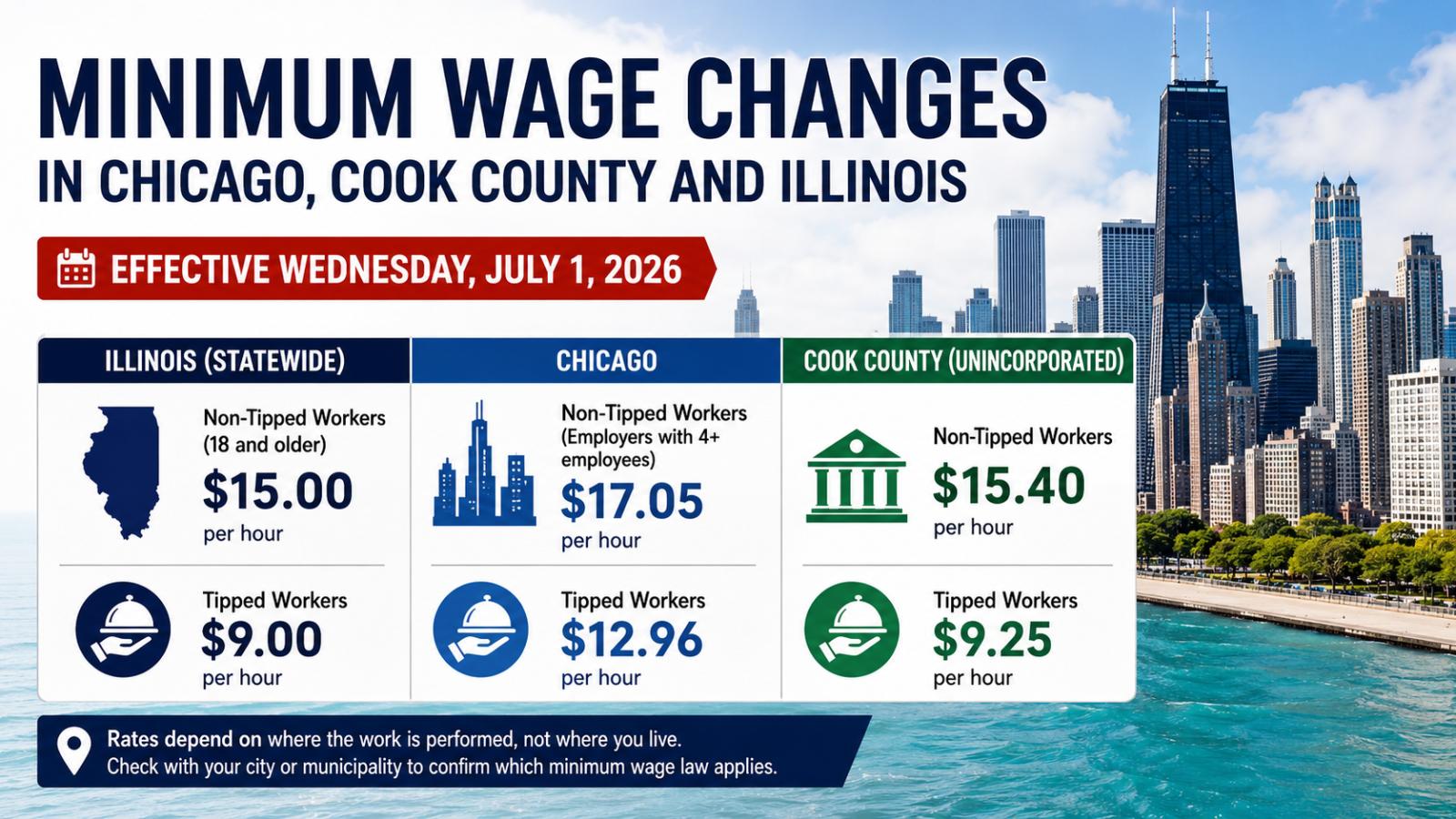
Workers and employers across the Chicago area will face different minimum wage rates beginning Wednesday, July 1, 2026, depending on the location of the job.
Illinois’ statewide minimum wage will remain $15 per hour for workers age 18 and older, while the base rate for tipped employees will stay at $9 per hour. The statewide increases required under a 2019 law ended after those rates took effect on Wednesday, January 1, 2025.
Chicago Minimum Wage Rises to $17.05
Chicago will raise its minimum wage to $17.05 per hour for employers with four or more employees. The city adjusts its rate annually, keeping it above the Illinois statewide minimum.
The Chicago minimum wage for tipped workers will rise to $12.96 per hour under the city’s 2026 labor standards. Employers must ensure that tipped employees receive at least the full applicable minimum wage when hourly pay and tips are combined.
Cook County Minimum Wage Rises to $15.40
Cook County will increase its minimum wage to $15.40 per hour for non-tipped workers and $9.25 per hour for tipped employees on Wednesday, July 1, 2026.
The county calculates its rate using the highest applicable benchmark among the federal minimum wage, the Illinois minimum wage and a county formula tied to inflation and unemployment conditions.
What This Means for NRI and Foreign Workers
Illinois, Chicago and Cook County do not set a separate minimum-wage rate for NRIs or other foreign workers. Covered employees are generally entitled to the applicable wage based on where they perform their work, regardless of nationality. However, foreign nationals must follow the employment rules attached to their visa or work authorization. Some visa categories, including H-1B, may also require employers to pay an applicable prevailing or actual wage that is higher than the local minimum wage.
Which Minimum Wage Applies?
The Cook County rate does not apply in every municipality. Chicago follows its own ordinance, while some Cook County cities, villages and townships have separate rules or have opted out of the county ordinance.
Workers and employers should verify the law covering the specific job location rather than relying on a worker’s home address or a company’s headquarters. Checking the relevant municipal rules is especially important because local participation in the county ordinance can change.