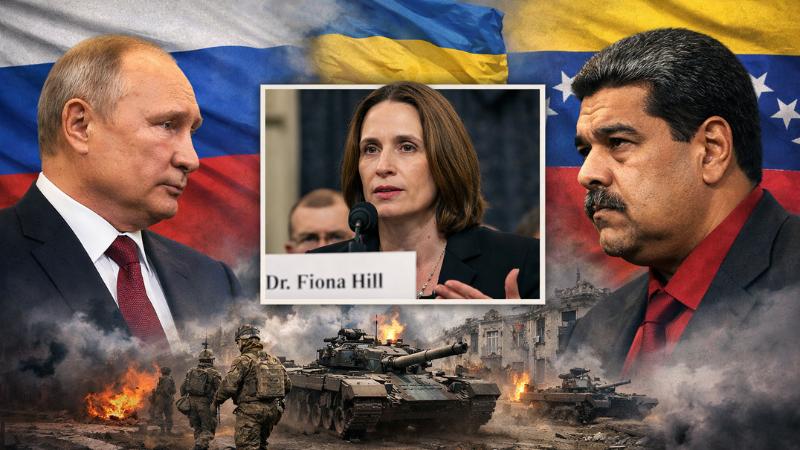
A resurfaced claim from 2019 by former White House national security adviser Fiona Hill has drawn renewed global attention after a high-profile U.S. operation in Venezuela. Hill told a U.S. congressional hearing in 2019 that senior Russian officials informally signaled they would consider reducing Moscow’s support for Venezuelan President Nicolás Maduro if Washington granted Russia greater latitude regarding Ukraine. The suggestion, described by Hill as a “very strange swap arrangement,” is now circulating widely on social media following the recent capture of Maduro by U.S. forces and his subsequent transfer to the United States to face charges. AP News
Hill’s remarks were made during testimony before the House Intelligence Committee when she served as Donald Trump’s senior adviser on Russia and Europe. According to her account, Russian officials repeatedly hinted at such an exchange through indirect diplomatic channels and coverage in Russian media, framing the concept in terms of geopolitical balance. The idea, Hill recounted, loosely referenced elements of the Monroe Doctrine, a U.S. policy dating to the 19th century that sought to limit European influence in the Western Hemisphere. Moscow’s commentary, she said, suggested that if the United States asserted influence in Latin America, Russia should enjoy similar freedom of action in Eastern Europe. AP News
Hill emphasized that no formal proposal was ever delivered and that she was dispatched to Moscow in April 2019 to reiterate U.S. policy: that issues concerning Ukraine and Venezuela were separate and not subject to linkage. “Ukraine and Venezuela are not related to each other,” she said she told Russian counterparts at the time. In 2019, U.S. policy recognized Venezuelan opposition leader Juan Guaidó as the interim president, aligning with several Western allies and opposing Maduro’s contested leadership. AP News
The renewed focus on Hill’s testimony comes after U.S. special operations forces executed a covert mission to detain Maduro in Caracas in early January 2026, a development described by the administration as lawful enforcement against an indicted foreign official. Maduro, who has denied all charges, was moved to New York where he faces federal narcotics and related offenses. The operation, and subsequent political developments in Venezuela, have generated intense international debate over U.S. foreign policy, legal justification for such actions, and the broader implications for global diplomatic norms. CBS News
Russian reactions to Maduro’s removal have included official statements condemning external intervention and affirming their long-standing support for Venezuelan sovereignty. Moscow has rejected characterization of its involvement as transactional, insisting that its diplomatic posture is rooted in respect for international law and noninterference, even as analysts note the broader geopolitical context of Russia’s ongoing conflict in Ukraine. Reuters
Geopolitical experts argue that the resurfaced 2019 testimony highlights enduring tensions between major powers over spheres of influence and strategic interests. While Hill’s account underscores a moment of informal signaling rather than formal negotiation, it sheds light on how global powers may have attempted to leverage complex conflicts for diplomatic advantage. Observers caution that such dynamics complicate efforts to navigate an already volatile international landscape marked by war in Ukraine, shifting alliances, and renewed emphasis on regional dominance. AP News
The implications of the alleged suggestion for a Venezuela-Ukraine swap extend beyond historical curiosity. They intersect with present-day debates on the legitimacy of foreign interventions, the influence of great power rivalry in sovereign affairs, and the future of U.S. engagement in Latin America. As Maduro’s capture continues to reverberate internationally, Hill’s testimony serves as a reminder of how past diplomatic overtures, even informal ones, can resurface under new geopolitical circumstances and shape public discourse on international relations.