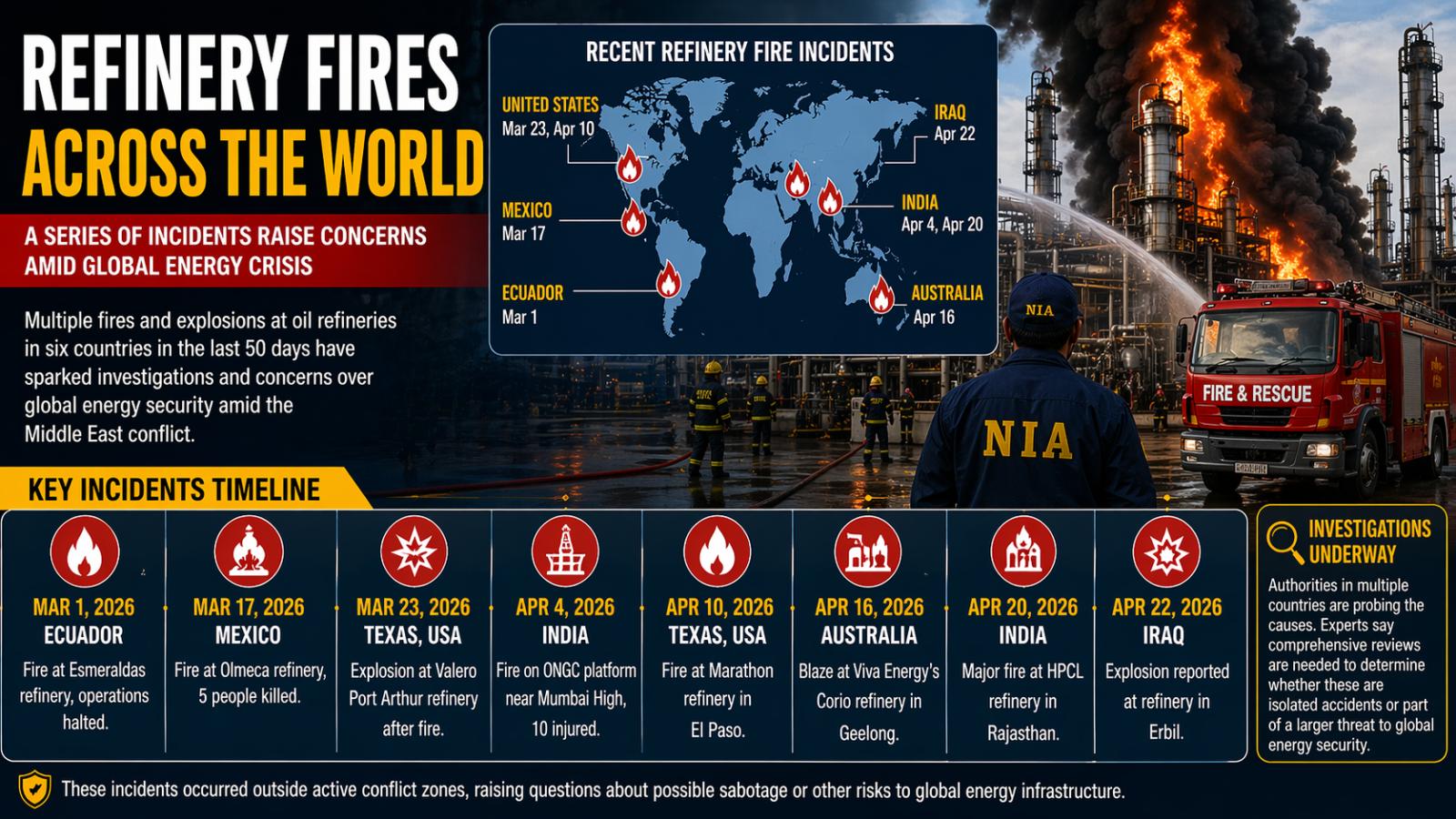
In India, a major fire broke out at the Hindustan Petroleum Corporation Limited refinery in Pachpadra, Rajasthan, on Monday, April 20, 2026, just one day before its scheduled inauguration. Authorities said an initial internal assessment pointed to a hydrocarbon leak in a heat exchanger circuit as the likely cause. A team from the National Investigation Agency, India’s primary counterterrorism body, arrived at the site on Wednesday, April 22, 2026, to conduct a detailed review. The agency typically becomes involved when there are concerns about potential sabotage or external threats. Officials confirmed the facility remains structurally safe, though a timeline for operations has not been announced.
The latest international incident occurred on Wednesday, April 22, 2026, when an explosion was reported at a refinery in Erbil, the capital of Iraq’s Kurdistan region. Authorities have not yet determined the cause or extent of damage. Notably, these events have taken place outside active conflict zones, adding to uncertainty about whether the incidents are coincidental or part of a broader pattern.
Earlier in the United States, a fire at the Valero refinery in Port Arthur, Texas, on Sunday, March 23, 2026, triggered an investigation after a diesel processing unit caught fire. Another blaze occurred at Marathon Petroleum’s refinery in El Paso, Texas, on Thursday, April 10, 2026, reportedly due to technical issues. In Mexico, a deadly fire at the Olmeca refinery on Monday, March 17, 2026, resulted in five fatalities.
Additional incidents include a fire at Ecuador’s Esmeraldas refinery on Saturday, March 1, 2026, and a blaze at Viva Energy’s Corio refinery in Geelong, Australia, on Wednesday, April 16, 2026, which raised concerns about regional fuel supply. Romania also reported a fire at a thermal plant in Bucharest on Monday, April 20, 2026.
In India, a separate fire on ONGC’s offshore platform near Mumbai High on Saturday, April 4, 2026, injured ten workers, though it was quickly contained. Authorities have not disclosed the cause.
While officials in multiple countries have attributed incidents to technical failures or operational issues, the frequency and geographic spread have drawn attention. Investigations are ongoing, and experts say only comprehensive reviews will determine whether the events are isolated accidents or indicative of broader risks to global oil infrastructure.