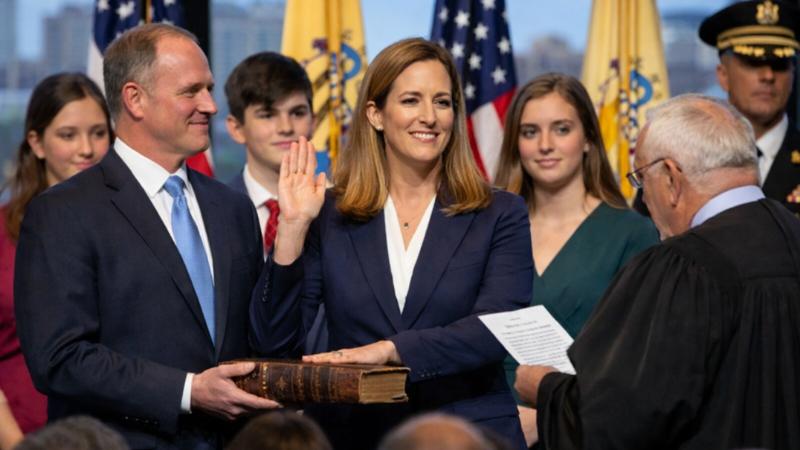
Mikie Sherrill was inaugurated Tuesday as New Jersey’s 57th governor, marking a historic transition of leadership following a campaign that centered on rising costs, energy policy, and opposition to President Donald Trump’s economic agenda. The 54-year-old former Navy helicopter pilot and four-term congresswoman becomes only the second woman to serve as governor of the state, which is home to nearly 9.5 million residents.
Sherrill secured a decisive victory in November over a Republican opponent endorsed by Trump, framing the election as a referendum on federal policies that she argued were driving up everyday expenses. Throughout her campaign, she placed particular emphasis on the impact of tariffs on consumer prices and pledged immediate action to address escalating utility rates. That promise was reflected in her first official acts as governor, as she signed executive orders declaring a freeze on utility rates and initiating steps to expand electricity production, including investments in solar and nuclear energy.
Speaking at the New Jersey Performing Arts Center in Newark, Sherrill invoked the state’s role in the Revolutionary War and referenced grievances from the Declaration of Independence, drawing a sharp comparison between those historic complaints and her criticism of the current administration. She accused the president of overstepping constitutional authority through trade policies that, she said, benefited a narrow few while increasing costs for families and businesses. Sherrill emphasized that public office should be rooted in service to the public, a theme that resonated with supporters who formed the backbone of her winning coalition in urban centers such as Newark.
Sherrill took the oath of office on a copy of the Constitution once owned by New Jersey’s first governor, underscoring the symbolic weight of the ceremony. While past inaugurations have featured artillery salutes along the Delaware River near the statehouse in Trenton, this year’s event included a ceremonial gun salute and a military helicopter flyover, reflecting both tradition and Sherrill’s own military background.
She succeeds outgoing Democratic Governor Phil Murphy, who leaves office after two terms marked by a series of progressive policy initiatives. During his tenure, Murphy raised taxes on high-income earners, increased the minimum wage, expanded early childhood education, and fully funded the state workers’ pension system after years of underfunding. In his final news conference, Murphy said he had been in close contact with Sherrill during the transition and described his administration as having delivered on its campaign promises.
However, Sherrill inherits a state budget that has grown significantly over the past several years, raising concerns about potential shortfalls if revenues decline. The budget also includes an ongoing commitment to a property tax relief program that remains unfunded beyond its initial phase, presenting an early fiscal challenge for the new administration.
With Democrats maintaining control of both the governorship and the Legislature, Sherrill is expected to have a relatively favorable environment for advancing her agenda. Her inauguration coincides with a broader political moment, as attention begins to shift toward upcoming midterm elections. Party leaders hope that continued dissatisfaction with federal policies will influence key races across the country.
An inaugural ball is scheduled for later Tuesday evening at the American Dream megamall in East Rutherford, concluding a day that formally ushers in a new chapter in New Jersey’s political leadership.


 Joyful
0%
Joyful
0%
 Cool
0%
Cool
0%
 Thrilled
0%
Thrilled
0%
 Upset
0%
Upset
0%
 Unhappy
0%
Unhappy
0%