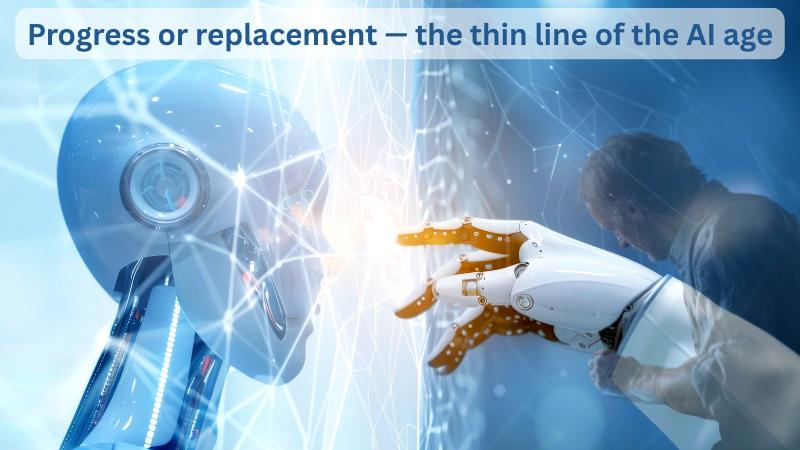
When researcher Kevin Cantera from Las Cruces, New Mexico, began experimenting with ChatGPT at the education technology firm where he worked, he believed he was future-proofing his career. Encouraged by his supervisors, he adopted artificial intelligence as a daily assistant to streamline his writing, research, and communication tasks. His results were exceptional, and he quickly became one of the company’s most productive employees.
But only months later, Cantera was unexpectedly laid off — replaced, ironically, by the very technology he had mastered. After nearly 17 years with the company, he was informed that his role would now be handled by an advanced language model. The move stunned him and his peers, who had been assured that automation would not threaten their positions.
Cantera described his experience as both empowering and unsettling. The AI system had been, in his words, “an incredible tool for me as a writer.” He had invested time learning how to refine prompts, verify information, and reduce the common inaccuracies known as “hallucinations.” By embracing technology instead of resisting it, he had seen his efficiency soar. “My productivity was off the charts,” he said, reflecting on the period when he felt most confident about his professional future.
The irony was not lost on him. The very expertise that made him valuable ended up making his position expendable. “It’s surreal,” Cantera said, “that the system I learned to use so well is now doing my job.”
His story underscores a growing paradox across industries — workers are increasingly encouraged to use AI tools like ChatGPT to increase output, yet the same tools are beginning to replace them. Businesses are cutting staff and redistributing tasks to automated systems that can generate text, analyze data, and even draft marketing material at a fraction of the cost.
Behind the efficiency gains, however, lies a more complicated reality. Many organizations have discovered that while AI can automate content creation, it often struggles with accuracy, creativity, and ethical nuance. Employees like Cantera, who once acted as human filters for quality control, are finding their expertise undervalued as companies prioritize speed over precision.
Recent research suggests that the economic benefits of automation may not be as significant as anticipated. Studies indicate that the majority of businesses integrating AI tools have not seen meaningful revenue growth, despite the promise of reduced labor costs. Meanwhile, errors and inconsistencies generated by AI systems are forcing some companies to rehire human workers to edit and verify the automated material — a phenomenon critics have labeled “AI slop.”
For Cantera, the experience raises questions about the future of work and the ethical responsibility of employers. He expressed concern that his former company may now rely too heavily on machine-generated content without adequate human oversight. “It is absolutely terrifying to think they could be depending on the model’s output without any true subject-matter expert review,” he said.
The layoffs that followed his departure affected several of his long-time colleagues, leaving gaps in institutional knowledge that automated tools cannot easily fill. For many in the workforce, this shift highlights a troubling reality: the same innovation that promises liberation from routine work can also erase the need for human experience.
Cantera’s situation mirrors a dilemma faced by professionals across industries. Should employees resist adopting AI tools to protect their roles, or embrace them to stay competitive, even if that means hastening their own obsolescence? The question remains unanswered as workplaces continue to evolve.
In the end, Cantera’s story reflects a broader transformation — one in which human adaptability meets technological acceleration. His journey illustrates both the potential and the peril of a world where artificial intelligence increasingly defines productivity, and where the line between human contribution and machine capability continues to blur.