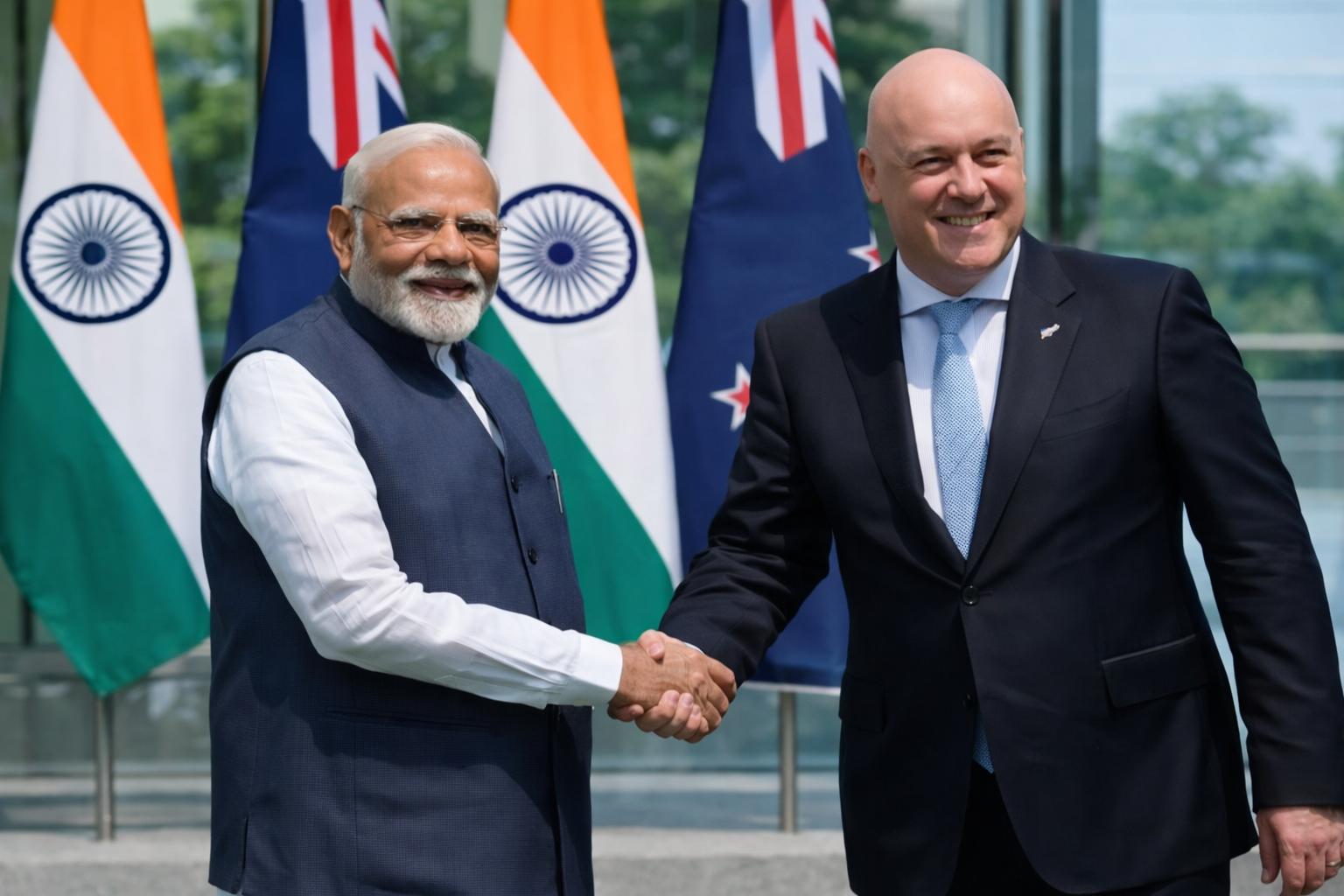
India and New Zealand are expected to sign a Free Trade Agreement (FTA) on Thursday, April 24, 2026, in India, marking a significant step toward strengthening bilateral trade and economic cooperation. The agreement, which follows the conclusion of negotiations announced on Sunday, December 22, 2025, is expected to provide tariff-free access for Indian exporters to the New Zealand market while attracting an estimated $20 billion in investment over the next 15 years.
According to officials familiar with the development, the signing ceremony is anticipated to take place at Bharat Mandapam, a major convention venue in India. The agreement is designed to expand trade ties between the two nations, with a target of doubling bilateral trade to $5 billion within the next five years.
Under the terms of the deal, India is set to receive zero-duty market access for 100 percent of its exports to New Zealand. In return, India will eliminate or reduce tariffs on approximately 95 percent of New Zealand’s exports, covering goods such as wool, coal, wood, wine, avocados, and blueberries. However, India has maintained protective measures for sensitive sectors, choosing not to offer duty concessions on dairy products, including milk, cream, whey, yogurt, and cheese, as well as key agricultural items like onions, sugar, spices, edible oils, and rubber, in an effort to safeguard domestic farmers and industries.
The agreement also includes provisions for enhanced cooperation in the services sector. New Zealand will introduce a temporary employment entry visa pathway for Indian professionals in skilled occupations, allowing up to 5,000 visas annually with a maximum stay of three years. This initiative is expected to support workforce mobility across sectors such as information technology, engineering, healthcare, education, and construction, as well as specialized fields including AYUSH practices, yoga instruction, culinary arts, and music education.
Trade between the two countries has shown steady growth in recent years. Bilateral merchandise trade reached approximately $1.3 billion in the 2024–25 period, while total trade in goods and services stood at about $2.4 billion in 2024. Services trade alone accounted for $1.24 billion, driven largely by travel, IT, and business services, underscoring the growing importance of cross-border service exchanges in the partnership.