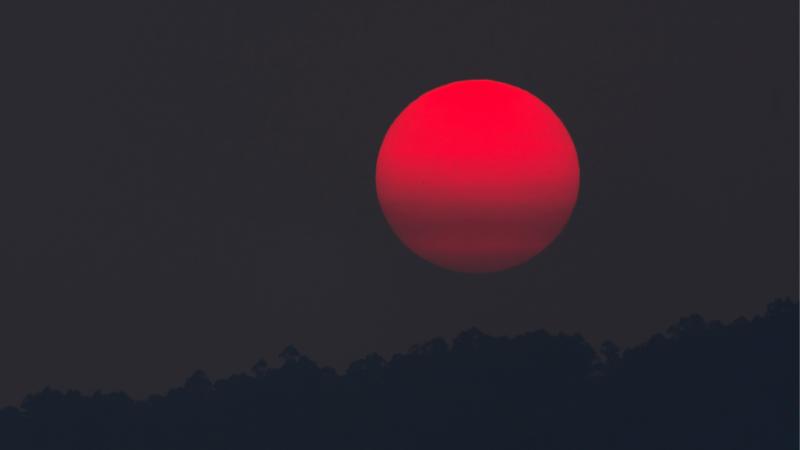
A remarkable celestial event is set to unfold on the night of September 7-8, 2025. The total lunar eclipse, commonly known as the "Blood Moon," will provide an awe-inspiring display for skywatchers across the globe. As Earth positions itself perfectly between the Sun and the Moon, it will cast its shadow on the lunar surface, creating a striking reddish-orange glow that has fascinated observers for centuries. This type of lunar eclipse, known for its eerie red hue, is expected to be one of the longest of the decade, lasting a full 1 hour and 22 minutes during the totality phase.
Why Is It Called a "Blood Moon"?
The phenomenon of a "Blood Moon" occurs when the Earth’s shadow falls on the Moon during a total lunar eclipse. When sunlight passes through Earth's atmosphere, it scatters shorter blue wavelengths, leaving longer red wavelengths to reach the Moon. This causes the Moon to appear red or coppery in color. The deep red tone is the result of Rayleigh scattering, which is the same atmospheric effect that causes sunsets to appear red.
During this eclipse, the Moon will appear a vibrant reddish hue, leading to the popular nickname "Blood Moon." While the event is entirely safe to view with the naked eye, its significance has also made it a symbol in various cultures, often associated with unique predictions and interpretations.
Where to Watch the Blood Moon in India
This lunar eclipse will be visible across a vast portion of the Earth, with nearly 85% of the world's population able to witness at least some part of the event. In India, the eclipse will be observable from virtually every part of the country, from North to South and East to West.
Key cities where you can enjoy a perfect view of the eclipse include:
-
North India: Delhi, Chandigarh, Jaipur, Lucknow
-
West India: Mumbai, Ahmedabad, Pune
-
South India: Chennai, Bengaluru, Hyderabad, Kochi
-
East India: Kolkata, Bhubaneswar, Guwahati
-
Central India: Bhopal, Nagpur, Raipur
With the Moon rising high in the sky, the eclipse will be visible from most open spaces. To get the best view, it’s recommended to find locations away from city lights where there’s minimal light pollution, such as rooftops, terraces, parks, or fields.
Timings of the Total Lunar Eclipse
The total lunar eclipse will unfold over several hours, with the most spectacular phase—totality—lasting 82 minutes. The timings of the eclipse for India are as follows:
-
Eclipse Begins: 8:58 PM IST (September 7)
-
Totality (Blood Moon Phase): 11:00 PM IST to 12:22 AM IST
-
Eclipse Ends: 2:25 AM IST (September 8)
During the totality phase, the Moon will appear in its full red glory. This is the ideal time for photography and observation. It’s the longest total lunar eclipse in recent years, so it’s definitely worth setting aside time to experience it.
How to Watch the Blood Moon
One of the best aspects of lunar eclipses is that they can be viewed safely with the naked eye, unlike solar eclipses, which require special protective eyewear. All you need is clear skies and a good spot to watch the event. For those looking to enhance the experience, binoculars or telescopes can provide a closer look at the Moon's surface and the stunning red gradient.
If you're into astrophotography, this eclipse presents a great opportunity to capture some stunning shots. To photograph the eclipse, use a DSLR or smartphone mounted on a tripod. You’ll want to use manual focus and adjust your camera settings for long exposure (1-2 seconds) and a mid-range ISO setting (400–800). This will help you capture the full beauty of the event, including the changing colors and the progression of the eclipse. A time-lapse video of the entire event can also provide a unique perspective.
Best Viewing Tips
To get the best experience:
-
Choose a dark location: Light pollution from city lights can obscure your view, so it’s best to find a quiet, dark spot to watch the eclipse.
-
Use apps for guidance: Astronomy apps like Stellarium or SkySafari can help you locate the Moon in the sky and follow its progress during the eclipse.
-
Capture the event: For photography, use manual settings, keep the camera steady on a tripod, and use long exposures to capture the full range of the eclipse.