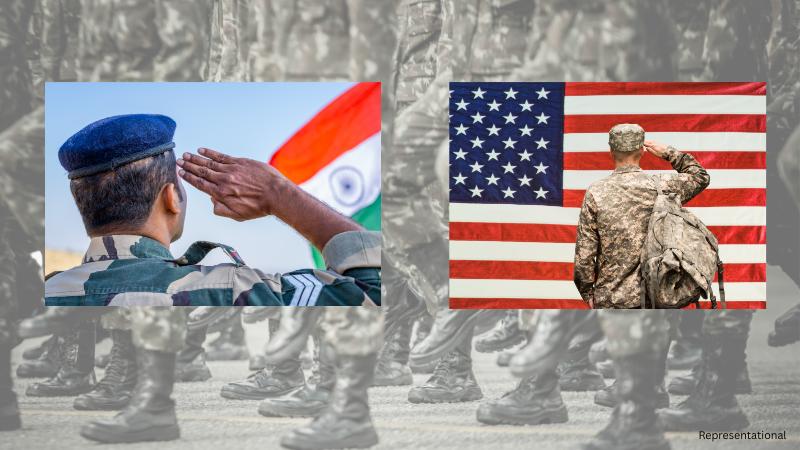
The 21st edition of Exercise Yudh Abhyas, the annual joint military drill between the Indian Army and the United States Army, commenced on September 1 at Fort Wainwright in Alaska. The two-week exercise will run until September 14, bringing together soldiers from both nations to sharpen interoperability, strengthen defence cooperation, and enhance preparedness in multi-domain operations.
An Indian Army contingent, drawn from the Madras Regiment, arrived in Alaska to join American troops from the 1st Battalion, 5th Infantry Regiment, popularly known as the “Bobcats.” This regiment forms part of the Arctic Wolves Brigade Combat Team under the 11th Airborne Division. A photograph released showed Indian soldiers standing in front of a C-17 Globemaster III aircraft, marking the symbolic beginning of the exercise. Defence officials highlighted that Yudh Abhyas remains one of the largest and most significant bilateral military engagements between India and the US.
The Ministry of External Affairs confirmed the arrival of Indian troops and outlined the scope of the drills. Soldiers from both nations will participate in heliborne operations, mountain warfare, unmanned aerial systems (UAS) and counter-UAS practices, as well as joint tactical drills. The focus remains on improving readiness for United Nations peacekeeping operations and strengthening multi-domain capabilities, which include land, air, and electronic warfare integration. Experts from both sides are scheduled to conduct detailed sessions on UAS, counter-UAS, communication systems, information warfare, and logistics to provide a knowledge exchange platform.
Over the course of the two weeks, the drills will include practical training on casualty evacuation, combat medical aid, artillery support, and aviation integration. The scope of the exercise ensures that the troops are trained not only in conventional combat but also in modern warfare techniques involving surveillance, drones, and counter-drone systems. This blend of traditional and advanced tactics is aimed at preparing soldiers for evolving battlefield challenges.
The exercise will conclude with large-scale joint tactical manoeuvres, featuring live-fire drills and high-altitude warfare simulations. These final drills are designed to replicate real-world scenarios that soldiers may face in difficult terrains and conflict zones. By simulating such conditions, both sides seek to improve coordination and ensure rapid decision-making during combat operations.
Despite the ongoing trade tensions following the announcement of a 25 percent reciprocal tariff by the United States on India over its oil trade with Russia, officials on both sides have underlined that defence ties remain unaffected. The two countries continue to build upon a strategic partnership that has steadily grown over the last two decades. Defence cooperation has become the cornerstone of this partnership, with exercises like Yudh Abhyas, as well as upcoming naval drills such as Malabar with Quad partners, showcasing the depth of military engagement.
For India, participation in such exercises is an opportunity to expose its soldiers to advanced technologies, modern training methodologies, and diverse terrains. Training in Alaska, known for its extreme cold and rugged conditions, prepares Indian soldiers for high-altitude warfare and strengthens their operational capabilities in diverse environments. For the United States, it provides an avenue to work closely with one of its most important strategic partners in the Indo-Pacific region, building trust and aligning tactics for future challenges.
As Yudh Abhyas 2025 progresses, the focus will remain on achieving seamless coordination between the two armies and fostering mutual understanding that goes beyond equipment and tactics. The exercise stands as a reminder that even amid economic disagreements, defence cooperation continues to thrive, emphasizing the long-term commitment of both nations to peacekeeping, security, and regional stability.