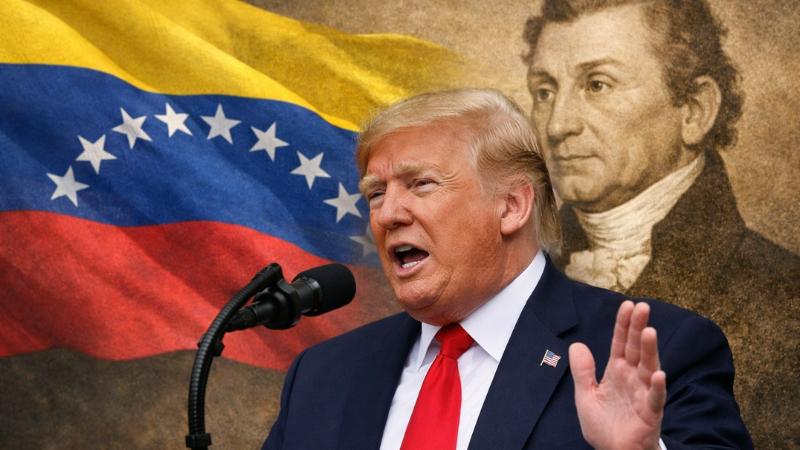
US President Donald Trump has repeatedly referred to a 19th-century foreign policy principle while addressing media questions about recent US actions in Venezuela, drawing renewed attention to the Monroe Doctrine and its historical significance. Speaking on Saturday, Trump described the reported capture of Venezuelan President Nicolas Maduro as a modernized extension of the doctrine first articulated in 1823. He characterized the move as an assertion of American authority in the Western Hemisphere and suggested the United States would temporarily oversee the country until a transition process was completed.
According to Trump, the United States would “run the country” until what he described as a safe, proper, and judicious transfer of power could take place. During his remarks, he referred to the Monroe Doctrine as a foundational policy that had since been expanded and reinterpreted over time. He went on to describe his approach as an updated version, adding that American dominance in the region would not be challenged. The comments immediately prompted public discussion about the doctrine’s origins and why it has resurfaced in the context of the Venezuela crisis.
The Monroe Doctrine was first outlined by President James Monroe on December 2, 1823, during his seventh annual address to Congress. At the time, the doctrine was intended to define spheres of influence, particularly as newly independent nations emerged across North and South America. Monroe warned European powers against further interference or colonization in the Americas, stating that such actions would be considered a direct threat to US security. While the policy later took his name, it was not formally labeled the Monroe Doctrine until years after his presidency.
In exchange for European non-interference in the Western Hemisphere, Monroe pledged that the United States would avoid involvement in European political affairs and would not challenge existing colonies. However, he made it clear that the era of new European colonization in the Americas had ended. The doctrine effectively sought to preserve the political balance of the region while limiting external influence, reinforcing the idea that the Western Hemisphere and Europe should remain separate in matters of governance and expansion.
The doctrine evolved significantly in the early 20th century when President Theodore Roosevelt introduced the Roosevelt Corollary in 1904. This expansion asserted the right of the United States to intervene in Latin American countries to prevent European involvement, particularly in cases of financial instability or unpaid foreign debts. The corollary was applied during the Venezuelan crisis of 1902–1903, when European nations sought repayment after Venezuela defaulted on its obligations.
Over subsequent decades, the Monroe Doctrine and its interpretations were used to justify US interventions in countries such as Haiti, Nicaragua, and the Dominican Republic. During the Cold War, the policy took on an ideological dimension, particularly under President Ronald Reagan, whose administration pursued aggressive strategies in Central America. These actions included support for anti-communist forces and governments, a period that critics described as imperialistic.
Cuba also became a focal point of US pressure following the revolution led by Fidel Castro, resulting in decades of sanctions and diplomatic isolation. Against this historical backdrop, Trump’s remarks suggest a continuation of earlier approaches to US foreign policy in Latin America. By invoking the Monroe Doctrine, he placed current actions within a long-standing framework that has repeatedly shaped Washington’s involvement in the region, underscoring how a nearly two-century-old policy continues to influence modern geopolitical debates.