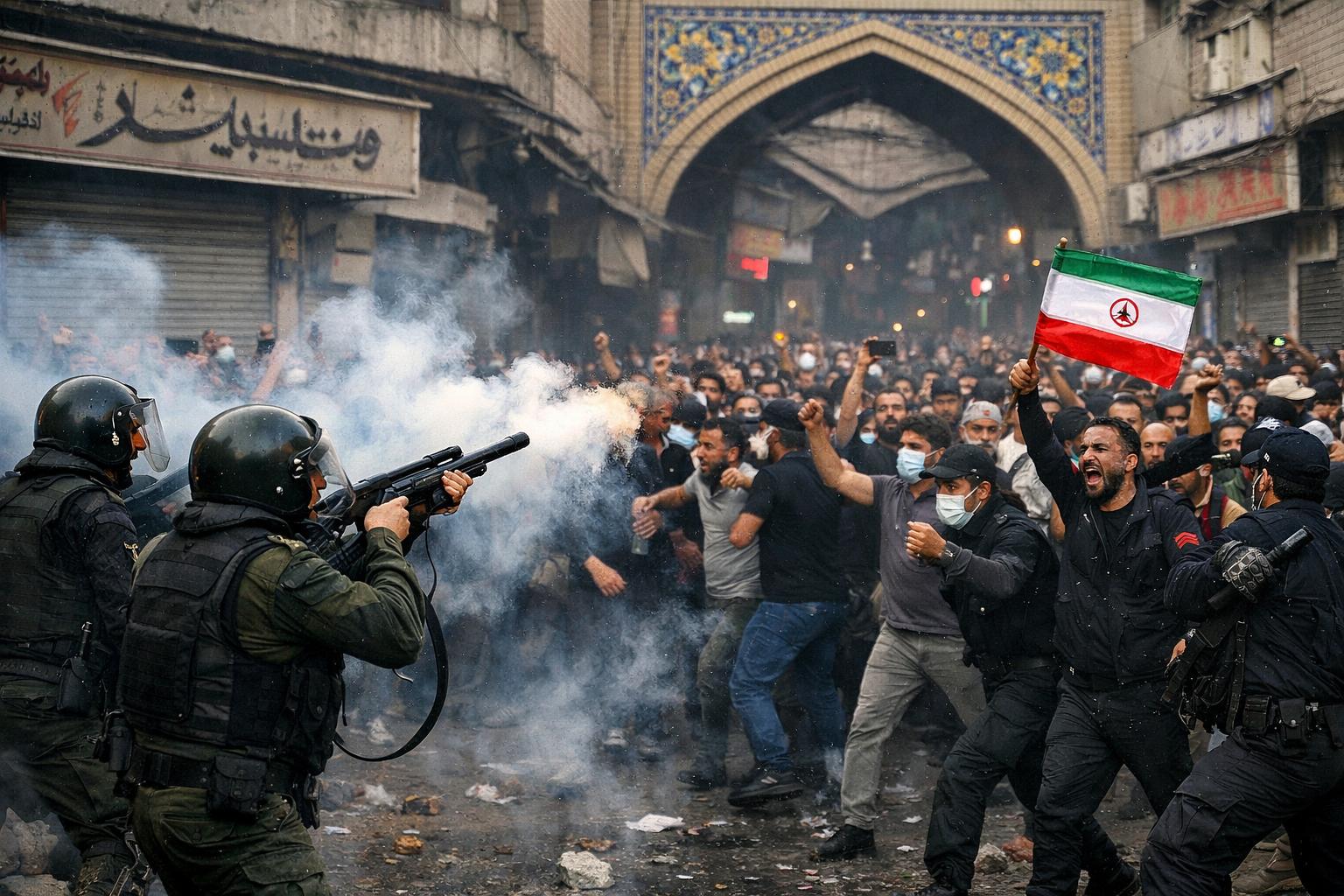
Violent clashes broke out at Tehran Bazar on Tuesday as Iranian security forces confronted demonstrators in one of the most significant flashpoints of a protest movement that has spread across the country over the past 10 days. The unrest, driven largely by public anger over worsening economic conditions, has left at least 27 people dead, according to estimates released by a human rights organization monitoring developments inside the country.
The confrontation in the capital came as tensions continued to rise nationwide, with reports also confirming that a police officer was shot and killed in western Iran on the same day. The incident underscored the increasingly volatile nature of the protests, which have shifted from scattered demonstrations into sustained and often violent confrontations between protesters and state security forces.
The latest wave of unrest was triggered by growing frustration over the rising cost of living and the continued decline of the Iranian rial. On Tuesday, the national currency fell to another record low against major foreign currencies, deepening concerns among businesses and households already struggling with inflation and reduced purchasing power. Merchants at Tehran Bazar, long considered an economic and symbolic center of the country, were among the first to take action, calling for a shutdown on December 28 that helped ignite the broader protest movement.
As demonstrations gathered momentum, security forces moved to disperse crowds in key locations. At Tehran Bazar, authorities deployed tear gas in an effort to break up large gatherings of protesters, many of whom chanted slogans criticizing the country’s leadership and calling for sweeping political change. Videos circulating on social media showed demonstrators invoking the return of the pre-revolutionary monarchy and openly calling for the removal of the current supreme leader, reflecting a level of dissent rarely expressed so publicly in recent years.
According to Iran Human Rights, a Norway-based organization, at least 27 protesters have been killed since the demonstrations began in late December. The group reported that five of those killed were minors under the age of 18. While Iranian authorities have not released comprehensive casualty figures, officials have maintained that security forces are responding to what they describe as riots rather than peaceful protests.
In an attempt to calm public anger, the government of President Masoud Pezeshkian announced modest monthly payments aimed at easing the financial burden on lower-income households. The measures, however, have done little to stem the unrest, with critics arguing that temporary assistance cannot address the deeper structural problems facing the Iranian economy. At the same time, the head of the judiciary issued a stern warning, stating that there would be no leniency for those accused of participating in violent acts during the protests.
Demonstrations have spread beyond the capital, with significant activity reported in western regions of the country that are home to Kurdish and Lor minority populations. These areas have historically experienced tensions with the central government, and the latest unrest has added to long-standing grievances over economic neglect and political marginalization.
Observers note that the current movement represents the most serious challenge to the authorities since the nationwide protests of 2022 and 2023, which were sparked by the death of a young woman in custody following her arrest over an alleged dress code violation. While the immediate triggers differ, both movements reflect deep-rooted dissatisfaction with economic conditions, governance, and social restrictions, raising questions about how the government will respond as pressure continues to mount.