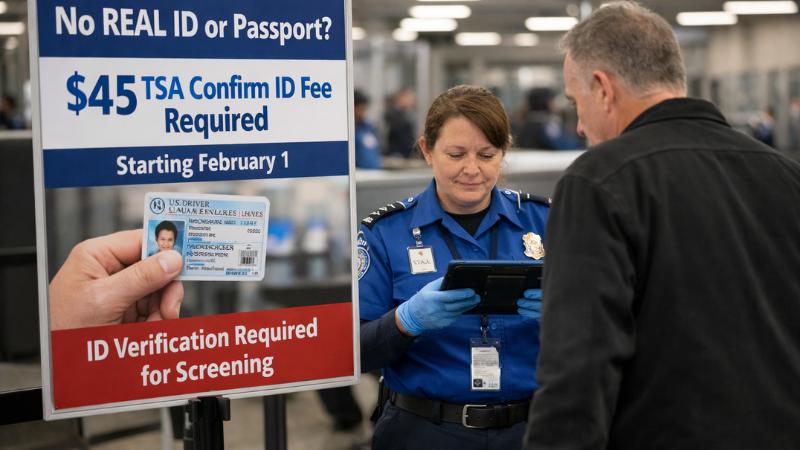
Air travelers who arrive at airport security checkpoints without a REAL ID-compliant driver’s license or a valid passport will soon face an additional cost to proceed through screening. Beginning Feb. 1, the Transportation Security Administration will assess a $45 fee for passengers who rely on an alternative identity verification process to board domestic flights.
Under the new policy, travelers who lack an acceptable form of identification will have the option to verify their identity through the TSA’s alternative system, known as Confirm ID. The process allows passengers to confirm their identity using personal information and records when standard identification is unavailable. While the option provides a pathway for travelers to continue their journey, the agency has confirmed that use of the system will now come with a mandatory fee.
Passengers may complete the verification form and submit payment online through pay.gov before arriving at the airport, or they can complete the process in person at designated airport security lines. Once approved, the identity verification will remain valid for a period of 10 days. Travelers who take additional trips after that window without obtaining a REAL ID or passport will be required to repeat the process and pay the fee again.
According to the Department of Homeland Security, the confirmation process typically takes between 10 and 15 minutes, though it may extend to 30 minutes or longer in some cases. The total time depends on verification requirements, passenger volume, and airport security wait times. Officials have advised travelers to plan accordingly and arrive earlier than usual if they expect to use the alternative verification system.
The $45 charge marks a significant increase from an earlier proposal. In November, the TSA published a notice in the Federal Register outlining plans for an $18 fee to support what it described as a “modernized alternative identity verification program.” However, federal officials later stated that additional analysis revealed higher-than-anticipated costs associated with operating the Confirm ID system. The revised fee is intended to cover operational, technological, and administrative expenses required to verify traveler identities securely.
The change comes as enforcement of the REAL ID Act moves forward after years of delays. The law, which was signed in 2005, establishes federal standards for state-issued driver’s licenses and identification cards. Although compliance deadlines were postponed multiple times, enforcement began earlier this year. As a result, travelers flying within the United States are now required to present a REAL ID-compliant license or another approved form of identification at TSA checkpoints.
Federal officials continue to emphasize that the fee does not replace the requirement for acceptable identification. Instead, it offers a temporary option for travelers who have not yet updated their credentials. TSA representatives have encouraged passengers to obtain a REAL ID or carry a passport to avoid delays and additional costs.
In addition to a REAL ID-compliant driver’s license, several other forms of identification remain acceptable for domestic air travel. These include U.S. passports and passport cards, Department of Defense identification cards, permanent resident cards, trusted traveler program cards such as Global Entry and NEXUS, and certain tribal and foreign government-issued documents. Canadian provincial driver’s licenses, Transportation Worker Identification Credentials, and Veteran Health Identification Cards are also among the approved options.
With the new fee set to take effect, transportation officials advise travelers to review identification requirements well before their departure date. Ensuring compliance with federal ID rules can help avoid longer wait times, unexpected expenses, and potential travel disruptions as airport security procedures continue to evolve.