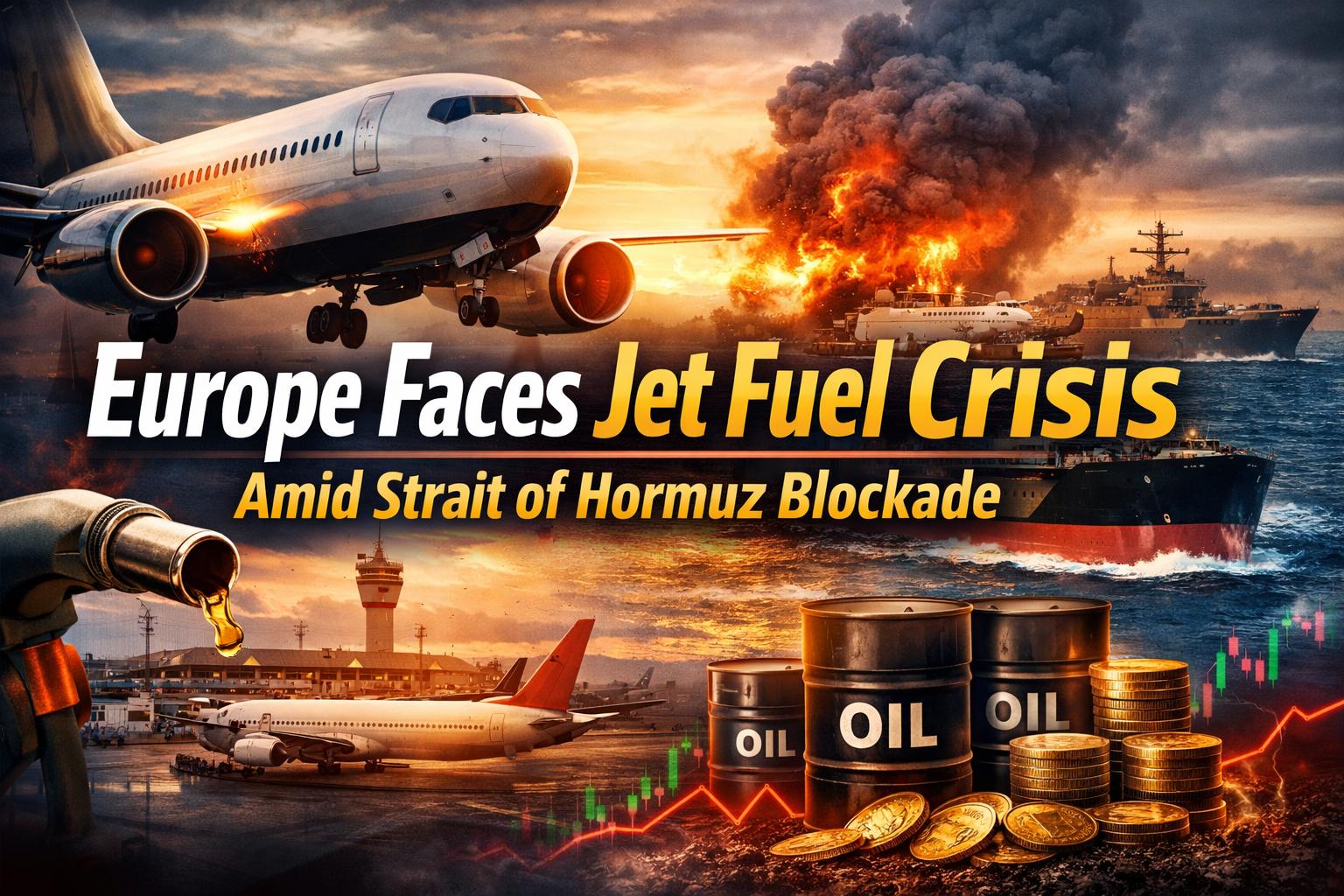
Europe’s airline industry is facing the risk of a widespread jet fuel shortage within weeks as disruptions in the Strait of Hormuz continue to strain global oil supply chains, according to energy analysts and aviation experts. The situation has intensified following escalating tensions involving the United States, Iran, and Israel, raising concerns about significant flight reductions across the region during the upcoming peak travel season.
Claudio Galimberti, chief economist at Rystad Energy, warned on Tuesday, April 2, 2026, that the severity of the crisis depends heavily on how much oil continues to pass through the strategically critical waterway. He noted that if supply constraints persist, the issue could become systemic within three to four weeks, potentially forcing airlines to implement major flight cuts beginning in May and June.
The disruption began after Iran shut down traffic through the Strait of Hormuz during its conflict with the United States and Israel, halting a key artery for global oil shipments and triggering a sharp rise in oil prices. Following the collapse of peace negotiations over the weekend prior to Tuesday, April 2, 2026, the United States imposed a naval blockade targeting vessels entering and leaving Iranian ports, further tightening supply.
Rico Luman, senior economist at ING, said supply shortages are becoming increasingly likely as shipments from the Middle East decline. He emphasized that replacement supplies will be necessary to stabilize the market, noting that the global nature of fuel distribution is already causing ripple effects beyond the region.
Industry group ACI Europe has cautioned that shortages could emerge within three weeks, threatening Europe’s summer travel season, which generates nearly $1 trillion in annual economic activity and supports approximately 14 million jobs. Similar constraints have already been observed in parts of Asia, including Vietnam and Thailand, underscoring the interconnected nature of global fuel markets.
The conflict, which began on Friday, February 28, 2026, has driven oil prices above $100 per barrel, significantly increasing operational costs for airlines. Data from the International Air Transport Association showed jet fuel prices surged more than 100% month-over-month as of March. In the United States, prices nearly doubled from $2.50 per gallon on Thursday, February 27, 2026, to $4.88 per gallon on Wednesday, April 2, 2026.
Airlines across Europe are already responding by cutting flights, raising ticket prices, and revising profit expectations. Carriers including SAS and Ryanair have announced cancellations and potential capacity reductions, while others warn of lasting financial impacts if fuel costs remain elevated.
Analysts caution that even if geopolitical tensions ease, prolonged disruption to global energy markets may continue to affect airline operations and travel costs for months, signaling a challenging period ahead for both carriers and passengers.
Claudio Galimberti, chief economist at Rystad Energy, warned on Tuesday, April 2, 2026, that the severity of the crisis depends heavily on how much oil continues to pass through the strategically critical waterway. He noted that if supply constraints persist, the issue could become systemic within three to four weeks, potentially forcing airlines to implement major flight cuts beginning in May and June.
The disruption began after Iran shut down traffic through the Strait of Hormuz during its conflict with the United States and Israel, halting a key artery for global oil shipments and triggering a sharp rise in oil prices. Following the collapse of peace negotiations over the weekend prior to Tuesday, April 2, 2026, the United States imposed a naval blockade targeting vessels entering and leaving Iranian ports, further tightening supply.
Rico Luman, senior economist at ING, said supply shortages are becoming increasingly likely as shipments from the Middle East decline. He emphasized that replacement supplies will be necessary to stabilize the market, noting that the global nature of fuel distribution is already causing ripple effects beyond the region.
Industry group ACI Europe has cautioned that shortages could emerge within three weeks, threatening Europe’s summer travel season, which generates nearly $1 trillion in annual economic activity and supports approximately 14 million jobs. Similar constraints have already been observed in parts of Asia, including Vietnam and Thailand, underscoring the interconnected nature of global fuel markets.
The conflict, which began on Friday, February 28, 2026, has driven oil prices above $100 per barrel, significantly increasing operational costs for airlines. Data from the International Air Transport Association showed jet fuel prices surged more than 100% month-over-month as of March. In the United States, prices nearly doubled from $2.50 per gallon on Thursday, February 27, 2026, to $4.88 per gallon on Wednesday, April 2, 2026.
Airlines across Europe are already responding by cutting flights, raising ticket prices, and revising profit expectations. Carriers including SAS and Ryanair have announced cancellations and potential capacity reductions, while others warn of lasting financial impacts if fuel costs remain elevated.
Analysts caution that even if geopolitical tensions ease, prolonged disruption to global energy markets may continue to affect airline operations and travel costs for months, signaling a challenging period ahead for both carriers and passengers.