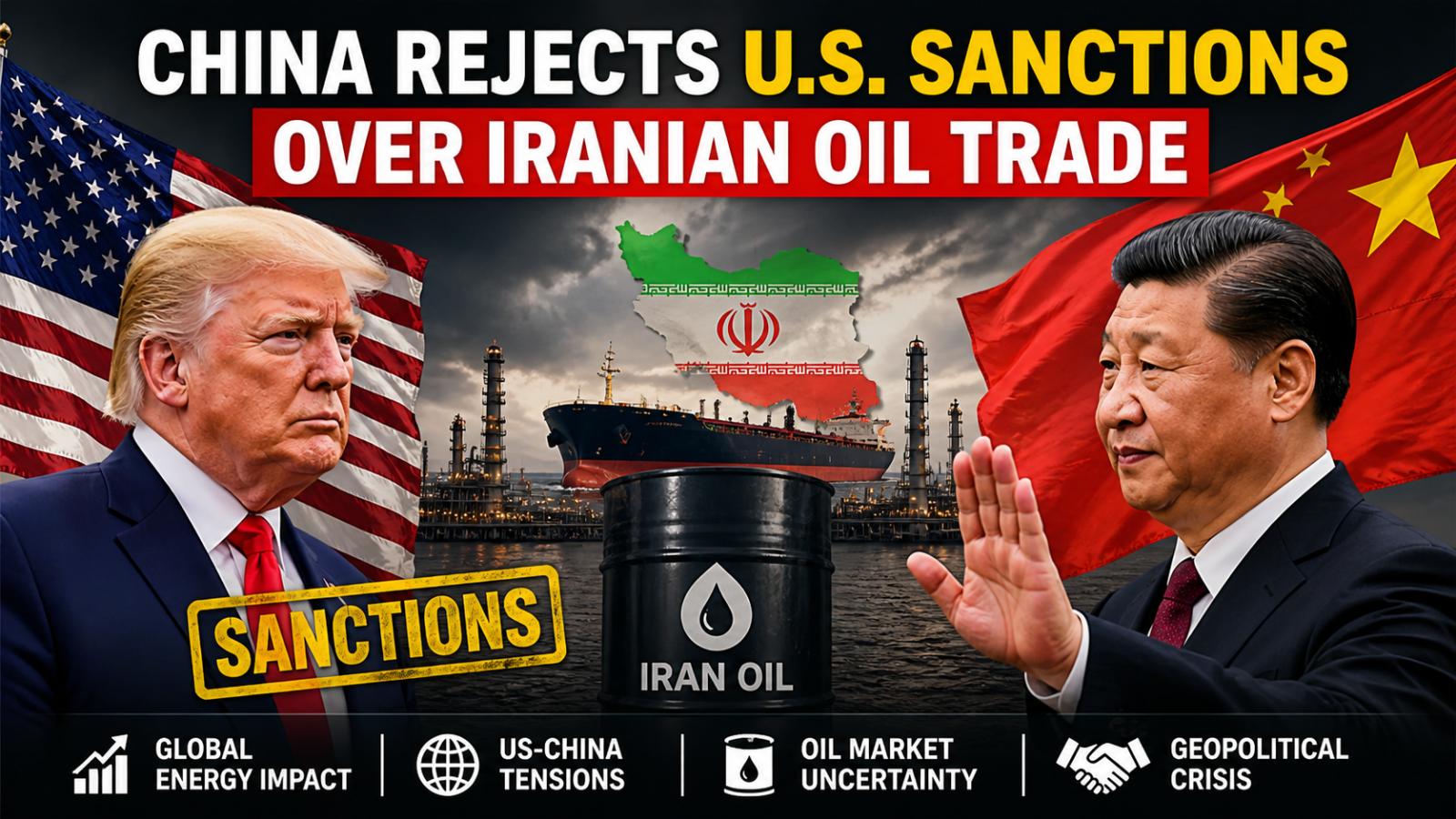
China has strongly rejected new sanctions imposed by the United States on Chinese firms accused of purchasing Iranian oil, calling the measures “unlawful” and a violation of international trade norms. The move marks a fresh escalation in tensions between China and Washington, with potential ripple effects across global energy markets.
In a statement released on May 2, 2026, China’s commerce ministry said the sanctions lack legal basis under international law and instructed domestic companies not to comply.
Why Did the US Sanction Chinese Firms?
The United States has expanded its sanctions framework targeting Iran’s oil exports, aiming to cut off a key source of revenue for Tehran. Officials in Washington allege that several Chinese companies have continued importing Iranian crude despite restrictions.
By targeting these firms, the US hopes to tighten pressure on Iran’s economy and limit its ability to fund strategic and military activities.
Which Chinese Companies Are Targeted?
The sanctions primarily affect independent refiners and petrochemical firms, including:
- Shandong Jincheng Petrochemical Group
- Shandong Shouguang Luqing Petrochemical
- Shandong Shengxing Chemical
- Hengli Petrochemical (Dalian) Refinery
- Hebei Xinhai Chemical Group
These companies are part of China’s so-called “teapot refineries,” many of which operate in Shandong province and rely heavily on discounted Iranian crude to remain competitive. Additionally, Washington recently sanctioned Qingdao Haiye Oil Terminal Co., Ltd., accusing it of importing millions of barrels of Iranian oil.
How China Responded to the Sanctions
Beijing dismissed the sanctions as unilateral and not authorized by global institutions. Officials argued that such actions:
- Violate international trade principles
- Interfere with legitimate economic activity
- Undermine global supply chain stability
China reiterated its long-standing opposition to sanctions that are not backed by the United Nations, emphasizing that businesses should be free to engage in lawful trade with third countries.
What This Means for Global Oil Markets
China remains one of the largest buyers of Iranian oil, often purchasing crude at discounted rates. Any disruption to this trade could have significant consequences, including:
- Increased volatility in global oil prices
- Supply chain disruptions in Asia
- Greater uncertainty in energy markets
The sanctions could also push Chinese refiners to seek alternative suppliers or develop workarounds, potentially reshaping global oil flows.
Impact on US–China Relations in 2026
This dispute adds another layer of complexity to already strained relations between the two economic superpowers. Trade tensions, technology restrictions, and geopolitical disagreements have already defined much of the relationship in recent years. The issue is expected to feature prominently in upcoming talks between Donald Trump and Xi Jinping, scheduled later in May 2026.
Analysts believe the sanctions could:
- Intensify the ongoing trade dispute
- Complicate diplomatic negotiations
- Influence broader geopolitical alignments in Asia
Expert Analysis: What Happens Next?
If both sides maintain their positions, the standoff could evolve into a broader economic confrontation. Key possibilities include:
- China strengthening alternative energy partnerships
- The US expanding sanctions to additional sectors
- Increased fragmentation in global trade systems
At the same time, energy markets will closely watch how enforcement unfolds and whether exemptions or negotiations emerge.
China’s rejection of US sanctions on Iranian oil trade signals a deepening divide between two of the world’s most powerful economies. As geopolitical tensions rise, the outcome of this dispute could shape not only energy markets but also the future of global trade and diplomacy.