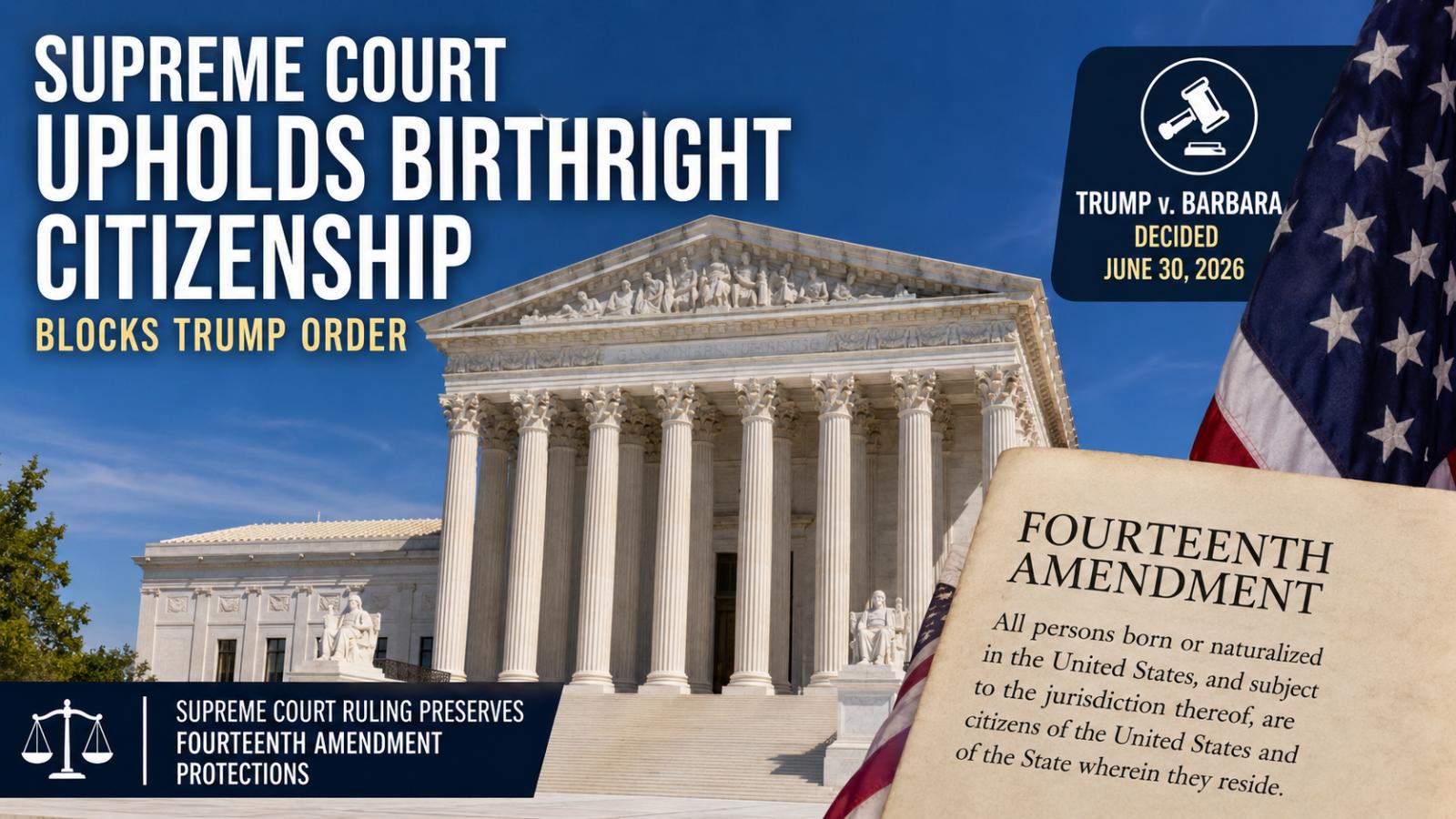
The Trump v. Barbara ruling preserved automatic U.S. citizenship for nearly all children born on American soil. In a 6-3 decision issued Tuesday, June 30, 2026, the Supreme Court affirmed a lower-court judgment blocking President Donald Trump’s executive order.
What the Trump v. Barbara ruling decided
Chief Justice John Roberts wrote the court’s principal opinion, joined by Justices Sonia Sotomayor, Elena Kagan, Amy Coney Barrett and Ketanji Brown Jackson.
The majority concluded that children born in the United States to parents who are unlawfully or temporarily present are subject to U.S. jurisdiction and therefore qualify as citizens at birth under the Fourteenth Amendment’s Citizenship Clause.
Justice Brett Kavanaugh agreed that the executive order could not stand, giving the judgment its sixth vote. However, he relied on federal citizenship law rather than concluding that the order violated the Fourteenth Amendment. Justices Clarence Thomas, Samuel Alito and Neil Gorsuch dissented.
Why the Supreme Court blocked Trump’s order
Trump’s directive instructed federal agencies not to recognize citizenship for certain U.S.-born children when neither parent was a U.S. citizen or lawful permanent resident.
The administration argued that the Citizenship Clause did not cover children of undocumented immigrants or parents temporarily living in the country. The court rejected that interpretation, relying partly on the 1898 precedent United States v. Wong Kim Ark.
What the decision means
The ruling leaves the longstanding birthright citizenship rule in place and prevents Trump’s executive order from taking effect.
The decision matters beyond immigration policy because it places a significant limit on a president’s ability to narrow citizenship protections through executive action. Any future attempt to change birthright citizenship would face substantial constitutional and legislative barriers.