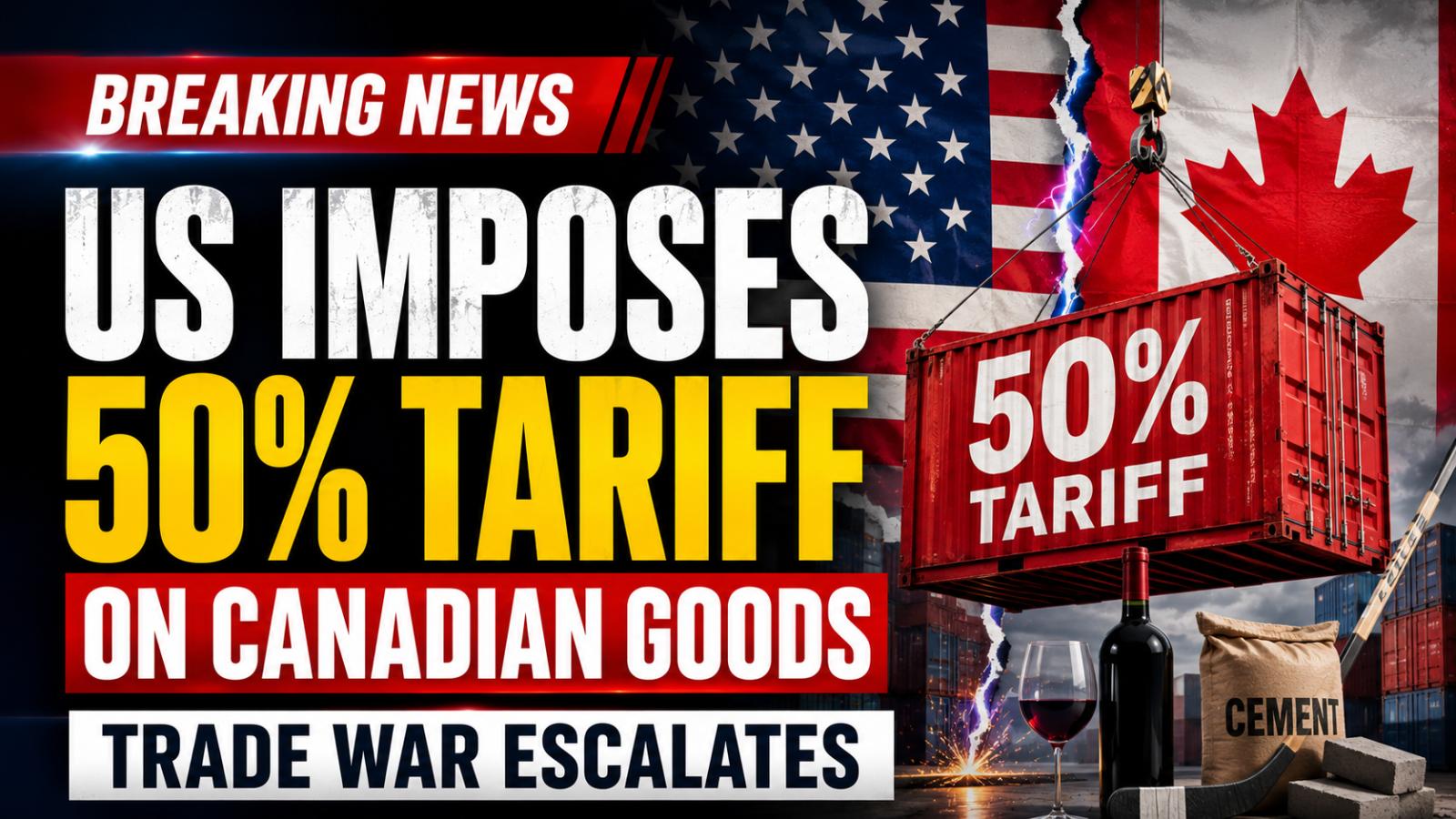
US imposes 50% tariff on Canadian goods as the Trump administration escalates trade tensions with its northern neighbour. The new duties target products including hockey sticks, wine and cement, while Washington cites unfair trade practices and retaliatory Canadian policies as the reason for the move.
US Imposes 50% Tariff on Canadian Goods Amid Trade Dispute
Background: US-Canada Tariff Escalation
Trade friction between the United States and Canada has intensified despite the Canada-United States-Mexico Agreement (CUSMA). Washington argues that Canadian policies on dairy, motor vehicles and other sectors disadvantage American exporters, while Ottawa maintains its measures comply with the trade agreement. The latest tariff announcement marks another escalation as both countries continue negotiations over their broader economic relationship.
Also read: Mark Carney Responds to US 50% Tariffs
Trump Canada Trade Dispute
The United States has announced a new round of tariffs on Canadian imports, introducing an additional 50% duty on selected goods beginning next month. The decision marks a significant escalation in trade tensions between the two neighbouring countries and expands the Trump administration's efforts to address what it describes as unfair Canadian trade practices.
According to the US administration, the tariffs will apply to a range of products including hockey sticks, wine and cement. Officials argue that Canada's policies have placed American exporters at a disadvantage while allowing domestic industries to receive preferential treatment. The move represents another step in an increasingly strained economic relationship between two of North America's largest trading partners.
Section 338 Tariff Act
The new tariffs will be imposed under Section 338 of the Tariff Act of 1930, a legal authority that has never previously been used. Administration officials described the measure as a direct response to what Washington views as discriminatory treatment of American products entering the Canadian market.
Officials stated that the action is separate from the wildfire smoke-related tariff proposal previously mentioned by President Donald Trump. However, they confirmed that those additional options remain under consideration as the administration continues reviewing broader trade measures involving Canada.
The decision highlights the administration's willingness to rely on rarely used trade laws to strengthen its negotiating position while increasing pressure on key trading partners.
Canada US Trade Tensions
US officials said Canada is one of only two countries, alongside China, that responded with retaliatory measures following earlier American tariff actions. They pointed to decisions by several Canadian provinces to remove American liquor products from store shelves, arguing that these actions unfairly targeted US businesses.
The administration also criticised Canada's automotive policies, claiming they favour domestic manufacturing at the expense of American producers. In addition, officials renewed longstanding concerns over Canada's dairy regulations, arguing that existing rules provide European cheese exporters with advantages over US suppliers seeking access to the Canadian market.
Washington maintains that these policies justify stronger trade action aimed at protecting American manufacturers and exporters.
Canadian Export Tariffs
The latest announcement follows President Trump's warning last week that further tariffs on Canada remained possible. At that time, he cited the economic impact of wildfire smoke drifting into parts of the United States as one of several issues affecting bilateral relations.
Trade analysts say the additional duties could increase costs for importers and businesses that rely on Canadian products while adding further uncertainty to North American supply chains. Industries connected to construction materials, consumer goods and agricultural products may be among those monitoring the new measures most closely.
Although both countries remain major economic partners under existing trade agreements, the latest tariff decision demonstrates that disputes over market access, domestic regulations and retaliatory actions continue to shape the relationship. Whether negotiations can reduce tensions remains uncertain, but businesses on both sides of the border are expected to closely watch developments before the new tariffs take effect next month.