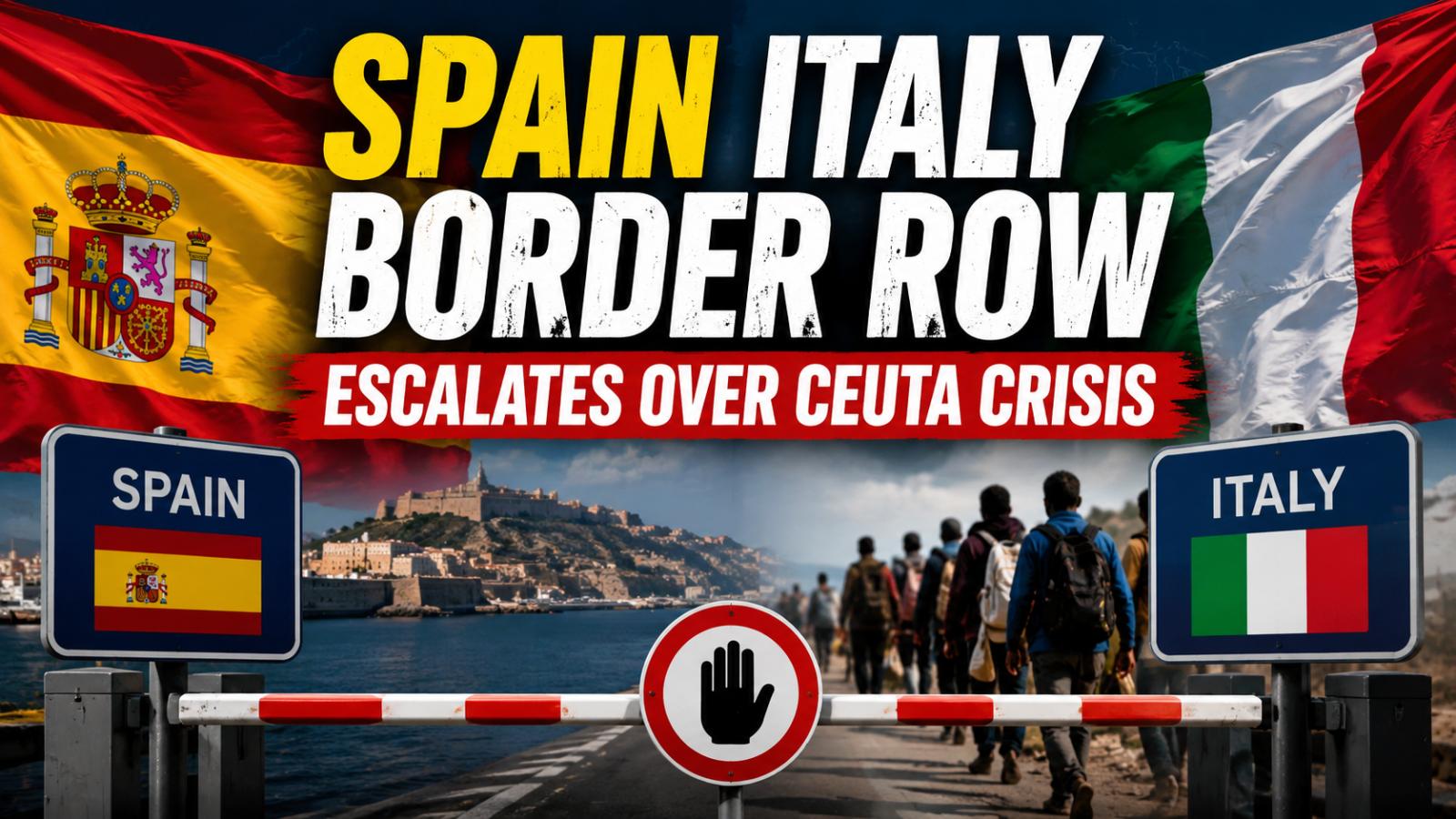
Spain’s temporary checks on arrivals from Italy have intensified the Spain Italy border row triggered by the Ceuta migration crisis. The dispute now touches Schengen rules, EU migration policy and relations between Madrid and Rome as both governments defend their border measures.
Ceuta
The confrontation began after tens of thousands of people crossed from Morocco into Spain’s North African territory of Ceuta. Ceuta’s regional authorities estimated that roughly 60,000 people entered during the extraordinary surge, close to the enclave’s population of about 80,000. Spain responded by deploying police, troops, boats and drones to reinforce security and manage the arrivals.
Most of those who entered later returned to Morocco, while authorities reported dozens of deaths linked to the crossings. The scale of the episode quickly became a broader European concern.
Italy checks
Italy reacted by introducing temporary controls on travellers arriving from Spain, arguing that the measures were needed to protect national security. Italian Interior Ministry information indicated that the checks were aimed mainly at third-country nationals travelling from Spain rather than ending normal visa-free movement for Spanish or other EU citizens.
Madrid strongly objected. Spanish officials said the restrictions were disproportionate and risked damaging free movement inside Europe. Foreign Minister José Manuel Albares urged Rome to reverse the checks, while Spain warned that it could adopt proportionate countermeasures if Italy refused.
Spain checks
Spain then announced temporary checks on travellers arriving from Italy. The measures were due to begin at midnight on Saturday and remain in force until September 7. Madrid said the move followed Italy’s refusal to withdraw its controls and reflected the continuing dispute over migration and border security.
The reciprocal controls have created an unusual rift between two EU and NATO allies. Although both governments describe their measures as temporary, the dispute has raised questions about how countries should respond to sudden migration pressure without undermining free movement.
Schengen
Schengen normally removes routine checks at internal borders while allowing governments to temporarily reintroduce controls. Spain’s Interior Ministry describes the system as combining open internal borders with common rules for managing external frontiers.
The latest dispute shows the tension between that principle and the ability of individual governments to introduce security measures during exceptional circumstances.
EU migration
The Spain Italy border row now extends beyond a bilateral disagreement. It highlights the political pressure facing European governments when migration surges occur at external borders and shows how quickly national security measures can become disputes over travel, migration policy and EU coordination.
How Madrid and Rome resolve the confrontation could also influence the wider European debate over Schengen rules, irregular migration and the balance between free movement and national border security.