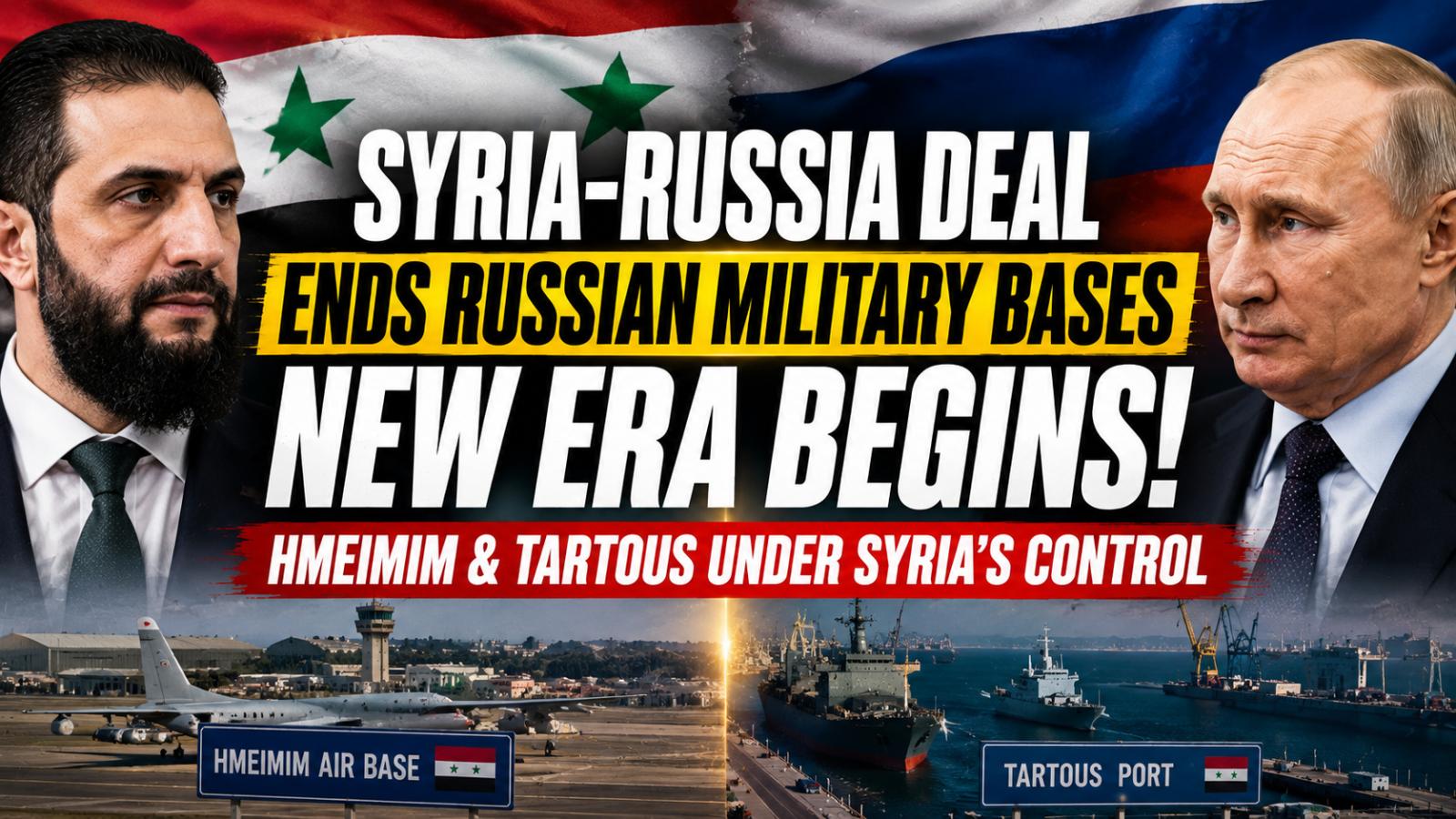
The Syria Russia bases deal will return key facilities at Hmeimim and Tartous to Syrian management while former Russian military sites become joint training centers. The agreement marks a major restructuring of Moscow’s strategic presence on Syria’s Mediterranean coast.
Syria Russia Bases Deal Reshapes Coastal Presence
Syria and Russia have signed a memorandum of understanding redefining the future of Moscow’s long-standing military facilities at Hmeimim and Tartous after about 18 months of negotiations, according to Syria’s Foreign Ministry.
Under the agreement, Syria will take over management of facilities designated for civilian use, including Hmeimim Airport and the fourth commercial berth at Tartous Port. These facilities will gradually become part of Syria’s civilian administration.
Military installations at both locations will not simply close. Instead, they will be transformed into joint Syrian-Russian training and qualification centers under new arrangements intended to protect the interests of both countries.
Hmeimim and Tartous Return to Syrian Management
Hmeimim air base near Latakia and Russia’s naval facility at Tartous were among Moscow’s most strategically important military positions outside the former Soviet Union.
Russia used both locations extensively after intervening militarily in Syria in 2015 to support former President Bashar Assad during the civil war.
Under the new framework, Damascus will regain direct control over civilian infrastructure at the sites, while the remaining military functions will be reorganized around training and capacity building rather than operating as traditional Russian-controlled outposts.
The transition is expected to be completed within three months, according to Syrian authorities.
Russian Military Bases Become Joint Training Centers
The change represents a significant reduction in Moscow’s independent military footprint in Syria, but it does not amount to a complete Russian withdrawal.
Syria’s Foreign Ministry said the agreement represents a reorganization of the Russian presence along the Mediterranean coast. Russian personnel are therefore expected to retain a role through joint training arrangements rather than through fully Russian-operated military bases.
This distinction matters because Tartous has long provided Russia with strategic naval access to the Mediterranean, while Hmeimim served as the operational center for Russian air activity during the Syrian conflict.
Assad’s Fall Changed Russia-Syria Relations
The agreement follows the fall of Bashar Assad’s government in December 2024. Russia had been Assad’s most important international military supporter, but Moscow did not intervene decisively during the final rebel offensive that removed him from power.
Assad and his family later received asylum in Russia.
Since taking power, Syrian President Ahmad al-Sharaa has sought to rebuild relations with several countries while maintaining ties with Moscow. He has also held talks with Russian President Vladimir Putin as both governments negotiated the future of the coastal bases.
At the same time, Syria has expanded engagement with the United States, European governments and Arab states, giving Damascus greater room to balance competing international relationships.
Moscow Keeps Influence but Loses Exclusive Control
The new arrangement significantly changes Russia’s position in Syria. Moscow retains military cooperation and training access, but Syria gains much stronger control over strategic infrastructure.
For Damascus, the agreement restores sovereignty over key coastal facilities without cutting ties with Russia completely. For Moscow, it preserves some strategic influence while accepting a much smaller and more limited role than it held during the Assad era.
The result is not a full Russian exit, but a transition from exclusive military control toward a negotiated partnership shaped by Syria’s new political leadership.