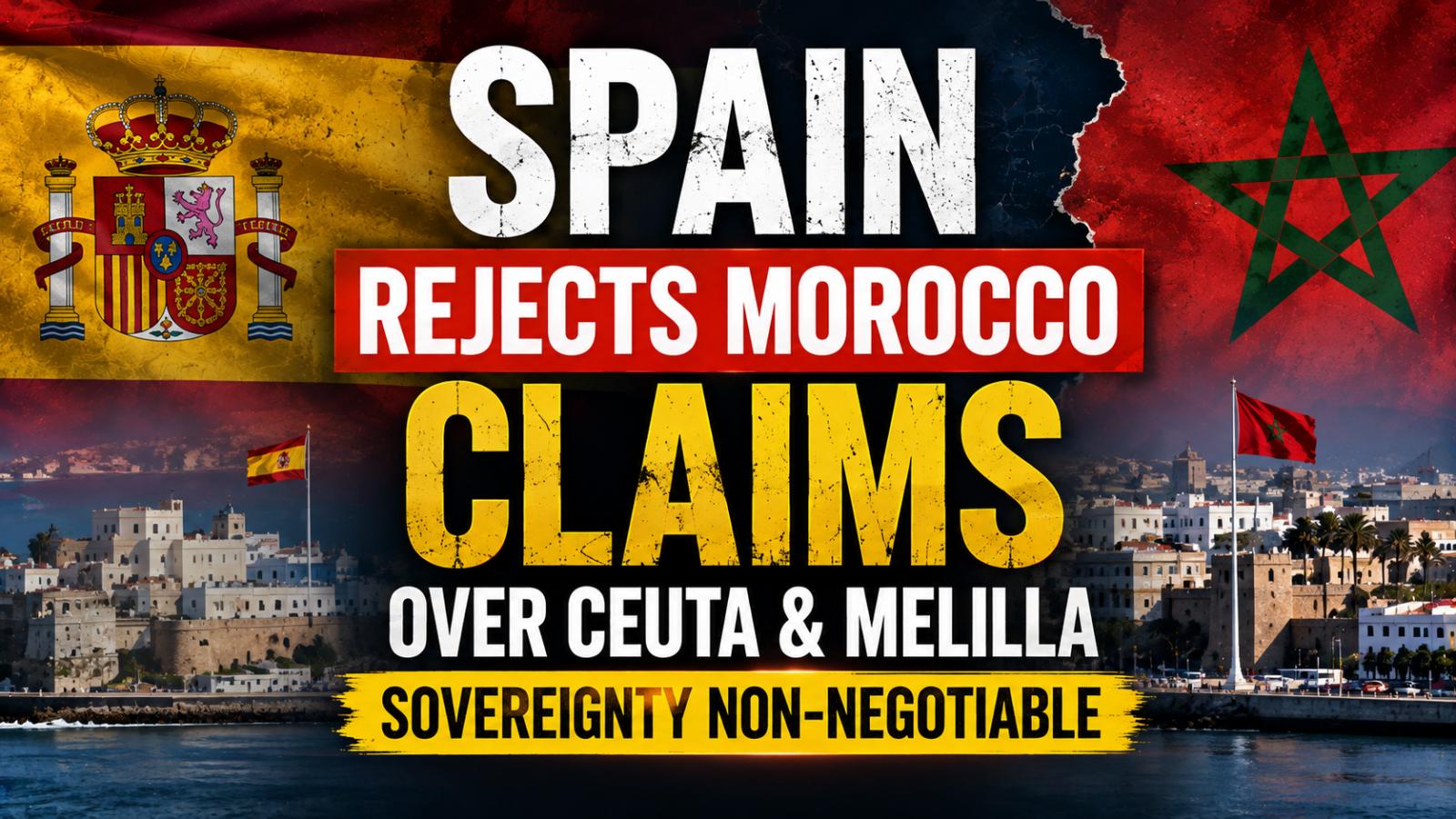
Spain has firmly rejected Morocco's renewed sovereignty claims over Ceuta and Melilla, declaring that the status of its two North African enclaves is not open to negotiation. The dispute has resurfaced only weeks after a massive migrant crossing into Ceuta intensified tensions along the Spain-Morocco border.
Spain sovereignty stance rules out negotiations
Spain's Foreign Ministry responded after Moroccan Justice Minister Abdellatif Ouahbi reiterated Rabat's claim over Ceuta and Melilla. Madrid said Spain's territorial integrity had not been, and would never be, discussed with another country.
Spanish Defence Minister Margarita Robles delivered an equally forceful message during a visit to Ceuta, describing both territories as inseparable from Spain and warning that an attack on either city would amount to an attack on the country as a whole.
The comments mark a renewed public disagreement between two neighbouring countries that otherwise cooperate extensively on migration, security and trade.
Morocco claim revives Ceuta Melilla dispute
Morocco has long disputed Spanish sovereignty over Ceuta and Melilla and considers the territories remnants of European colonialism. Spain rejects that position and maintains that the cities are integral parts of Spanish territory.
Melilla came under Spanish control in 1497, while Ceuta passed from Portuguese to Spanish sovereignty in the 17th century. Today, both are autonomous Spanish cities and form the European Union's only land borders with Africa.
Ouahbi's intervention is notable because it represents one of Rabat's most prominent recent public assertions of its sovereignty claim, despite improved cooperation between the Spanish and Moroccan governments.
Ceuta crisis puts border security under pressure
The diplomatic exchange follows an extraordinary migration crisis in late July, when an estimated 72,000 people crossed into Ceuta from Morocco within a short period. Spanish authorities reported dozens of deaths during the chaotic movement, while the sudden influx overwhelmed local infrastructure and emergency services.
Spanish and Moroccan authorities have said false information circulating on social media contributed to the crisis by encouraging people to believe the border had become easier to cross.
The scale of the incident has placed migration management at the centre of bilateral relations. Despite their sovereignty dispute, Madrid has continued to acknowledge Morocco's importance in controlling irregular migration toward Spanish and European territory.
Morocco boosts security before August 15
Morocco has now increased security around the borders of Ceuta and Melilla following online calls for another mass crossing attempt on August 15. Moroccan authorities warned that organisers and participants could face prosecution and urged people not to respond to misleading social-media campaigns.
Security personnel, riot-control equipment and emergency resources have been deployed near the border as authorities seek to prevent a repeat of July's deadly events.
The renewed security measures underline how sovereignty and migration have become intertwined in Spain-Morocco relations. Madrid needs Rabat's cooperation to control irregular crossings, while the two governments continue to disagree fundamentally over the political status of the enclaves.
For now, neither government's core position has changed. Morocco continues to claim Ceuta and Melilla, while Spain insists their sovereignty cannot be negotiated. The latest confrontation therefore does not necessarily signal a breakdown in bilateral relations, but it demonstrates that the territorial dispute remains capable of resurfacing even during periods of close cooperation.