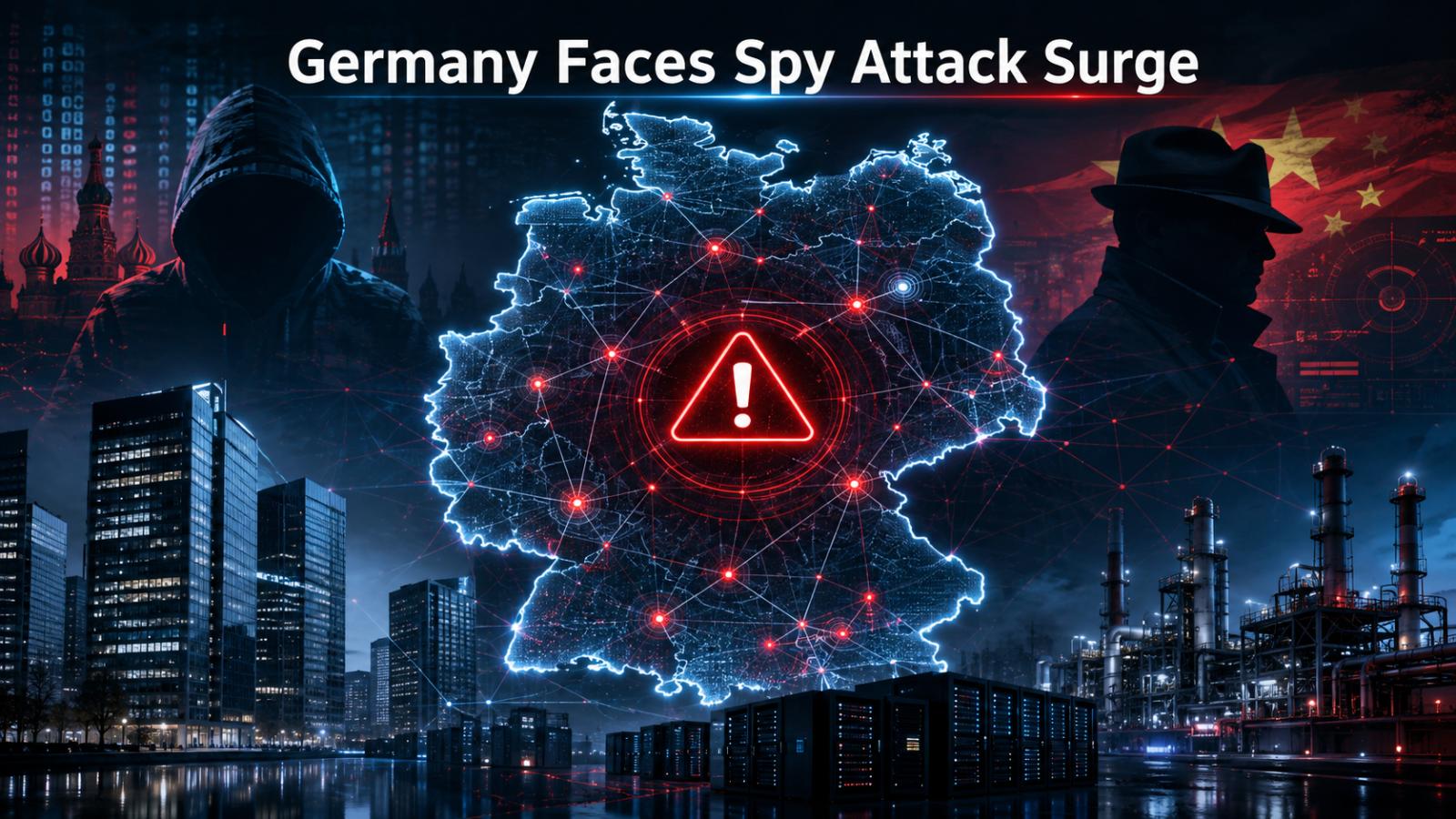
Germany’s cyber threat has intensified, with foreign intelligence services playing a much larger role in attacks on businesses. A new Bitkom study says 37% of affected companies linked at least one incident to a foreign intelligence service, up sharply from 28% last year and just 7% in 2023.
Foreign spies target more German companies
Bitkom’s 2026 economic protection survey shows that foreign intelligence agencies have become the second most frequently identified attacker group behind organised crime.
Among companies hit by data theft, industrial espionage or sabotage, 37% attributed at least one attack to a foreign intelligence service. Organised crime remained the leading category at 62%, although that figure declined from 68% a year earlier.
Bitkom President Ralf Wintergerst said foreign services are becoming more professional and harder to detect, while artificial intelligence is also giving less sophisticated attackers new capabilities.
China attacks lead identified foreign origins
China was the most commonly identified foreign origin among companies that could trace attacks, cited by 52% of affected firms. Russia followed closely at 49%, while attacks linked to Iran reached 9%, more than double the 4% recorded a year earlier.
Those figures do not mean every attack originating from those countries was directed by a government. Bitkom separately measures geographic origin and attacker type, making that distinction important when reporting the findings.
The survey covered 1,003 German companies with at least 10 employees and annual revenue of at least €1 million. It was conducted between calendar weeks 16 and 23 of 2026 and is described by Bitkom as representative.
Cybercrime causes most economic damage
Cyberattacks now account for 76% of the total financial losses associated with data theft, espionage and sabotage, up from 70% last year.
Bitkom estimates overall damage to Germany’s economy at between €211 billion and €270.8 billion. Cyber-related losses alone were estimated at €160.4 billion to €205.8 billion.
This is an important correction to the dollar figures sometimes cited in reports. Bitkom’s official study presents the estimate in euros, not as a fixed $246 billion to $316 billion total.
AI attacks make detection more difficult
Artificial intelligence is increasingly changing how cyberattacks are carried out. Bitkom found rising damage linked to automated calls and deepfakes, while 82% of companies believe attackers are making greater use of AI.
The bigger concern may be what companies cannot detect. While 96% said they had either experienced or suspected an attack, only 67% could confirm one with certainty. The share of companies that suspected attacks but could not prove them jumped from 10% to 29%.
BfV warns defence industry is a prime target
Sinan Selen, president of Germany’s domestic intelligence agency BfV, said the results fit the country’s current high-threat environment. He warned that foreign intelligence services have intensified hybrid activities against German businesses, with the security and defence sector particularly attractive to hostile actors.
The findings show that Germany’s challenge is no longer limited to traditional cybercrime. Companies now face a mix of state-linked espionage, organised crime, sabotage and AI-assisted attacks, while supply-chain effects mean a breach at one business can disrupt many others.
For internal linking, this article fits naturally with Cybersecurity, Technology, Germany, Europe, Artificial Intelligence and Russia-China coverage.