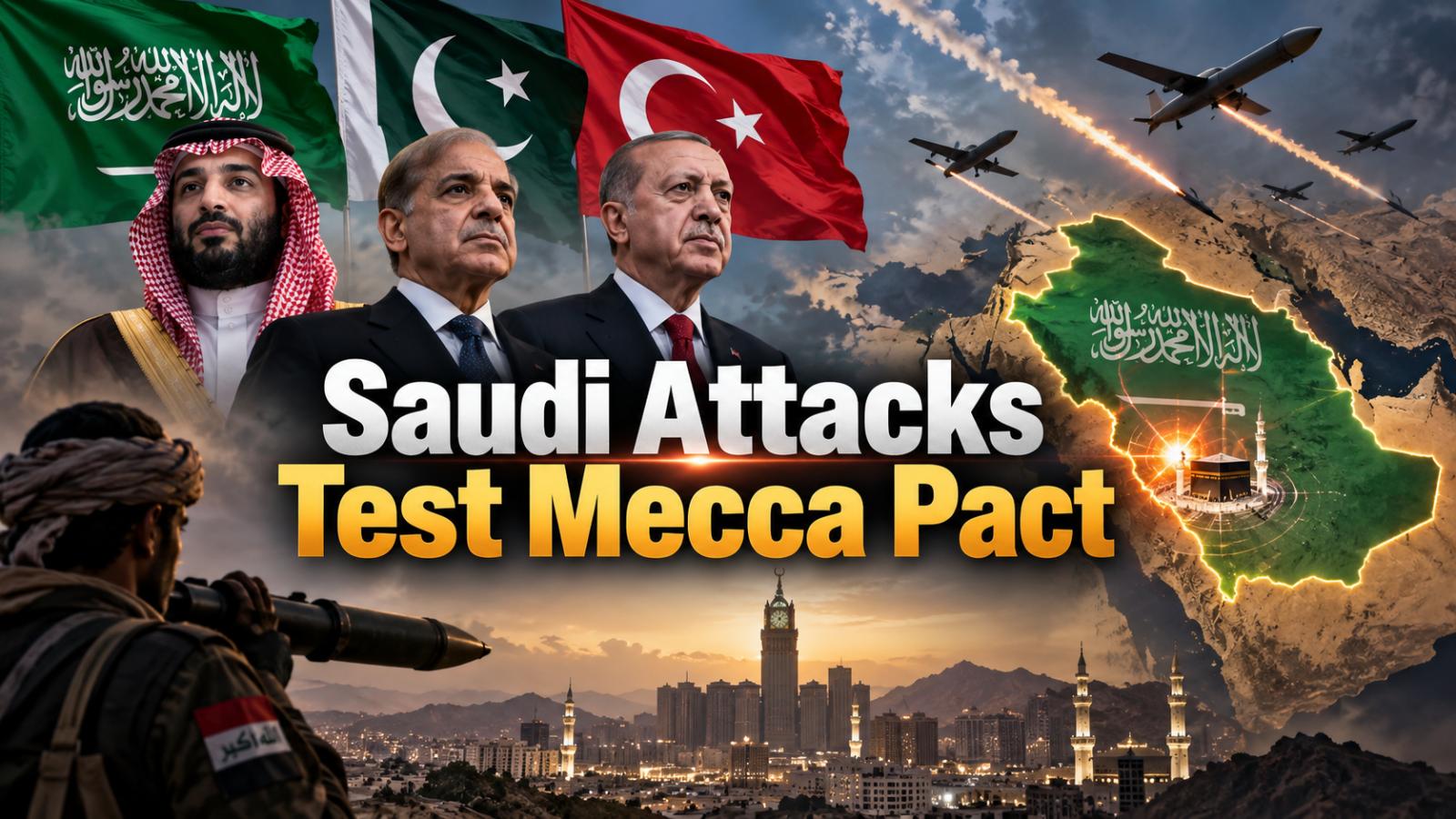
The Mecca Defence Pact is facing its first major test as Saudi Arabia comes under repeated Houthi missile and drone attacks. Pakistan and Turkiye have backed Riyadh diplomatically, but neither has launched a direct military response, raising questions about how the pact’s collective-defence clause works in practice.
Mecca Defence Pact promises collective defence
Saudi Arabia, Pakistan and Turkiye signed the Makkah Joint Defence Agreement on August 7, 2026. The official text says an armed attack on any one of the three countries “shall be regarded as an attack against them all” and frames the pact as a collective-deterrence arrangement under the right of self-defence.
The three governments have since begun building an institutional structure around the agreement. On August 31, their foreign and defence ministers and military chiefs agreed to establish a secretariat in Saudi Arabia and develop greater military coordination, defence-industry cooperation and joint capabilities. That suggests the pact is still moving from a political commitment toward a more operational framework.
Houthi strikes test Saudi security commitments
The challenge became immediate after the Houthis intensified attacks on Saudi territory. Saudi Arabia confirmed a ballistic missile attack targeting Riyadh on September 19, while other Houthi claims involved drones, missiles and attacks on energy infrastructure. Riyadh has also sought defensive support from several partners as pressure on its air-defence system increases.
Pakistan has condemned the attacks and says it remains committed to the Mecca pact. Defence Minister Khawaja Asif has said that unprovoked aggression against Saudi Arabia could activate the agreement. However, Pakistan’s Foreign Ministry later said no military response had yet been discussed under the pact.
That distinction matters. The pact contains a broad collective-defence promise, but its public text does not spell out an automatic military response, command structure or specific trigger mechanism.
Pakistan and Turkiye favour caution so far
Turkiye has also signalled support for Saudi Arabia, with Foreign Minister Hakan Fidan saying Ankara could help meet Saudi military needs under the agreement. At the same time, Turkiye has continued to support diplomatic efforts aimed at de-escalation.
Pakistan has similarly focused on diplomacy, including urging Iran to use its influence to restrain Houthi attacks. Reports indicate Islamabad has warned that it may be compelled to assist Saudi Arabia if Riyadh formally invokes the pact, but Saudi Arabia has not publicly triggered such a request.
The current situation therefore does not prove that the pact has failed. It does show that the agreement’s strongest language has not yet translated into automatic military action.
Afghanistan strikes add another layer of scrutiny
Pakistan’s regional security policy is also facing criticism after Pakistani airstrikes inside Afghanistan on September 21. Islamabad said the strikes targeted militant hideouts and killed 28 militants. Afghan authorities and the United Nations, however, reported that three civilians — a man, a woman and a girl — were killed and four others were injured.
That contrast has added to debate over Pakistan’s defence priorities: Islamabad argues that cross-border action is necessary against militants it says operate from Afghanistan, while Kabul says such strikes violate Afghan sovereignty.
For the Mecca Defence Pact, the key question is now operational rather than rhetorical. If Houthi attacks continue or intensify, the three members may have to clarify what constitutes activation, whether military support requires a formal Saudi request, and what level of assistance each country is actually obligated to provide.