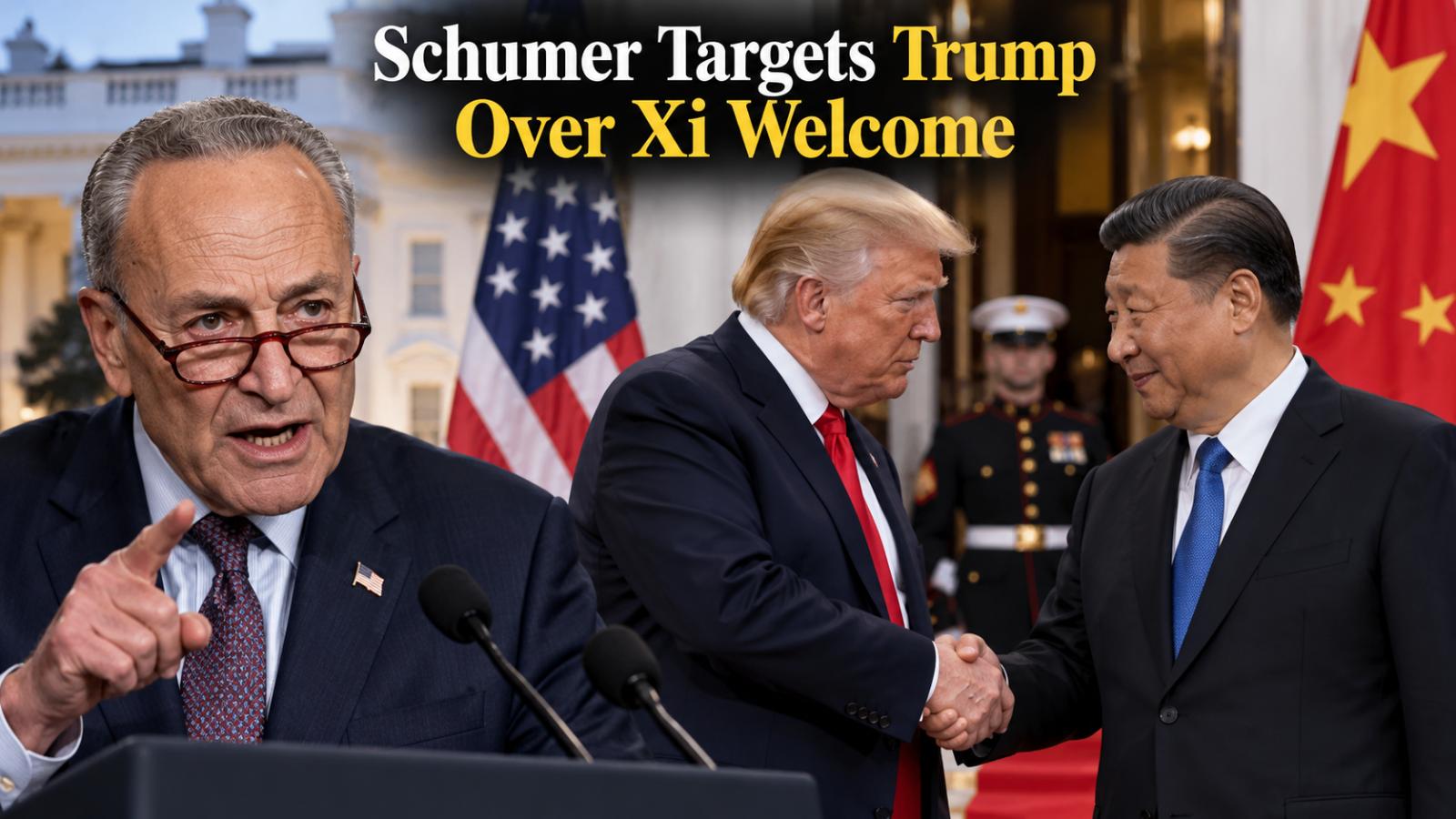
Senate Democratic Leader Chuck Schumer sharply criticized President Donald Trump’s handling of Chinese President Xi Jinping’s Washington visit, arguing that the ceremonial welcome showed excessive deference to the Chinese leader. Schumer also pressed the administration to maintain restrictions on advanced US artificial intelligence technology headed to China.
Xi welcome draws Schumer criticism
Trump personally greeted Xi at Joint Base Andrews on September 23 as the Chinese president arrived for a high-profile state visit. Reuters reported that the airport greeting was the first by a US president for a foreign leader at Joint Base Andrews since Barack Obama welcomed Pope Francis in 2015. That makes the original claim that such a greeting had not happened for more than six decades inaccurate.
Speaking on the Senate floor the following day, Schumer described Trump’s approach toward Xi in strongly critical terms and compared the airport welcome with Trump’s reception of Russian President Vladimir Putin in Alaska the previous year. Those descriptions reflected Schumer’s political assessment of Trump’s foreign-policy style rather than an independent factual characterization.
AI chips become a central policy dispute
Schumer also focused on AI chips and semiconductor manufacturing equipment. He has urged the administration to prevent China from obtaining the most advanced US technology, arguing that tighter export controls are necessary to preserve America’s position in artificial intelligence. Senate Democrats have backed legislation aimed at restricting advanced chip and equipment exports to China.
The issue has become a major part of the broader technology competition between Washington and Beijing, alongside concerns over semiconductor supply chains and the development of advanced AI systems.
US-China summit focuses on trade and technology
Trump welcomed Xi to the White House on September 24 for talks covering trade, artificial intelligence, Taiwan and other security issues. Trump emphasized what he called his strong personal relationship with Xi, while Xi said competition between the two countries should remain healthy and called for regular military dialogue.
Reuters reported that the talks produced no immediate breakthrough on several of the countries’ largest disputes. The leaders nevertheless sought to maintain stability in a relationship shaped by trade tensions, technology restrictions and strategic competition.
Senate concerns span both parties
Concerns surrounding Xi’s visit were not limited to Democrats. Republican senators also urged the administration to press Beijing on Taiwan and other security issues. Senate Armed Services Committee Chairman Roger Wicker questioned the decision to give Xi such an elaborate welcome, while other Republican senators pushed for continued US military support for Taiwan.
The bipartisan criticism highlighted a wider congressional debate over how Washington should balance diplomacy with competition and security concerns involving China.
State dinner caps high-profile visit
The White House visit concluded with a state dinner attended by senior technology executives. Reuters reported that executives including Tim Cook, Jeff Bezos, Sundar Pichai, Sam Altman, Elon Musk and Jensen Huang were among the guests.
The ceremony underscored the economic stakes surrounding US-China relations, particularly in technology and artificial intelligence. At the same time, Schumer and other lawmakers continued pressing the administration to ensure diplomatic engagement does not weaken US export controls or broader strategic priorities.