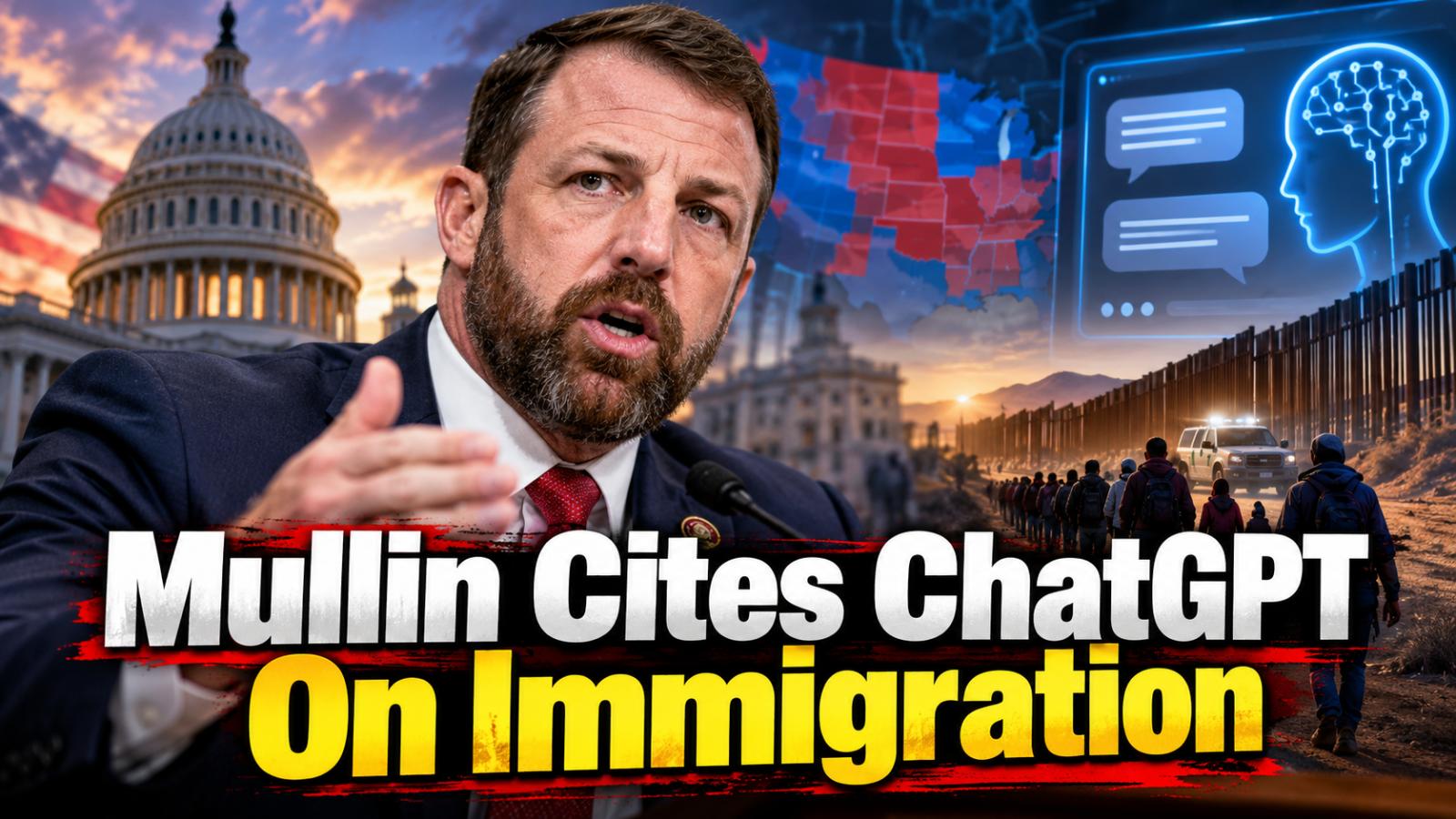
The Mullin ChatGPT claim has drawn attention after DHS Secretary Markwayne Mullin used an AI response while arguing that immigration could change the politics of Republican states. His immigration claim also included undocumented migrant estimates significantly above recent Pew and MPI figures.
Immigration claim
Homeland Security Secretary Markwayne Mullin accused Democrats of pursuing immigration policies that he said could change the political makeup of the United States. During a television interview on October 5, Mullin argued that Democrats wanted to move the country toward socialism and would need to change its demographics to accomplish that goal. He did not provide evidence establishing that immigration is part of a coordinated Democratic strategy to alter states' partisan alignment.
Mullin also suggested that the undocumented population had reached about 23 million during the Biden administration and could be substantially higher when earlier administrations were considered. Those figures exceed major independent demographic estimates.
ChatGPT answer
Mullin said he asked ChatGPT shortly before the interview how a Republican-leaning state could become Democratic and cited changing voter demographics as part of the response.
An AI-generated answer, however, does not establish that a political party is deliberately using immigration to change election outcomes. Political realignment can result from several forces, including domestic migration, population growth, age, education, urbanisation, turnout, candidate strength and changing voter priorities.
ChatGPT responses can also vary depending on how a question is phrased and the context supplied. For that reason, an AI response should not be treated as independent evidence for a political allegation.
Migrant data
Available research does not support Mullin's highest population estimates. Pew Research Center estimated that the US unauthorized immigrant population reached a record 14 million in 2023, an increase of 3.5 million over two years.
The Migration Policy Institute later estimated 15.8 million unauthorized immigrants were living in the United States by mid-2024. MPI attributed much of the increase to high border arrivals and expanded humanitarian parole, asylum and other temporary-protection pathways.
Those estimates show a significant increase but remain well below the 23 million figure cited by Mullin.
Voting rules
Immigration numbers should also be separated from voting eligibility. US citizenship is required to vote in federal elections, while states set their own voter qualifications and some municipalities have adopted limited rules allowing certain noncitizens to participate in local contests.
The legal landscape is also under scrutiny. On October 1, a federal judge ruled in one Florida case that Congress lacked constitutional authority to criminalize noncitizen voting under the statute used in that prosecution. The ruling does not mean noncitizens broadly gained a right to vote in federal elections and is not binding on every court.
Amnesty stance
Mullin also rejected the possibility of a broad immigration amnesty under President Donald Trump and Republican leadership, reinforcing the administration's restrictive approach to unauthorized immigration.
The controversy highlights a broader challenge in political debate: demographic trends, immigration policy and election outcomes are related subjects, but one does not automatically prove the others. Claims about deliberate partisan demographic engineering require evidence beyond population estimates or an AI-generated response.