Tesla Roadster flying car demo uses SpaceX thrusters in a dramatic Texas demonstration that showed the electric sports car lifting off, hovering and performing controlled aerial manoeuvres. Elon Musk says the Roadster combines Tesla engineering with SpaceX technology, but the airborne version is not yet intended for everyday road use.
SpaceX thrusters power Roadster
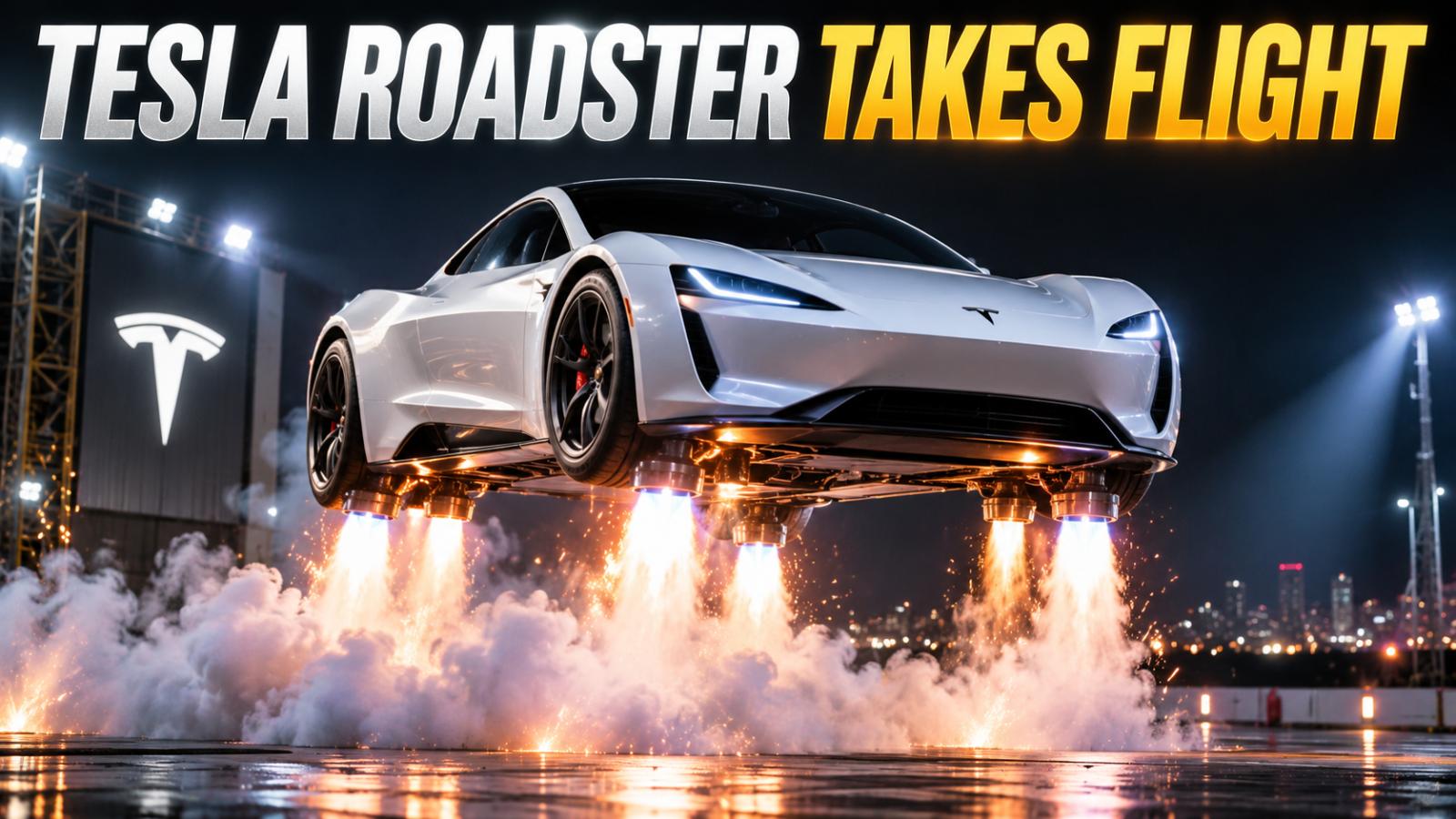
Tesla has reignited interest in its long-delayed Roadster after demonstrating a specialised version at SpaceX's McGregor facility in Texas. Video shared by Elon Musk showed a white Roadster leaving the ground, hovering and carrying out unusual manoeuvres during a controlled presentation.
Musk described the project as a collaboration between Tesla and SpaceX. The demonstration vehicle reportedly combines thruster technology with additional systems intended to generate and control short periods of lift. The spectacle gives new meaning to Musk's years-old promises that the next-generation Roadster would offer capabilities far beyond those of a conventional electric sports car.
However, the event should not be confused with the unveiling of a conventional aircraft-style flying car. The prototype demonstrated controlled stunts in a prepared environment rather than routine point-to-point flight.
Tesla Roadster 0-60 claim
Tesla says the latest Roadster configuration can accelerate from zero to 60 mph in approximately 0.81 seconds. If achieved in a production vehicle, that would place it among the quickest accelerating cars ever offered to customers.
The company attributes part of that extraordinary performance to its SpaceX-inspired technology. Musk has previously discussed using cold-gas thrusters to improve acceleration, braking and handling.
The demonstration also showed the car moving through unusual orientations and clearing parked vehicles, highlighting the engineering ambitions behind the Rocket version.
Tesla Roadster production timeline
Tesla first revealed the second-generation Roadster in 2017, with production originally expected around 2020. The project has since experienced repeated delays as Tesla focused on higher-volume models and other technology programmes.
The company now expects Roadster production to begin in 2028. Final pricing, specifications and availability have not yet been fully detailed, meaning the demonstration remains a preview rather than confirmation of the exact vehicle customers will eventually receive.
The long development timeline means performance claims will ultimately need to be judged against the final production specification.
Rocket version road legality
Tesla is presenting the Roadster in more than one configuration. The specialised Rocket version is intended to use advanced thruster technology, while another configuration is focused more directly on conventional road performance.
Musk acknowledged that the most extreme version may not comply with road rules in every jurisdiction. He also said the vehicle is not necessarily designed primarily around safety optimisation, an unusual admission for a product intended to push performance boundaries.
Regulatory approval could therefore become as important as engineering capability if Tesla plans to offer such technology to customers.
Flying car demo limitations
The Roadster demonstration is technically striking, but calling it a fully practical flying car would be premature. The prototype performed controlled airborne manoeuvres rather than sustained transportation through public airspace.
Questions also remain about range, passenger safety, noise, reliability, regulatory approval and how the thruster system would operate outside a controlled facility.
Still, the demonstration gives Tesla one of its most attention-grabbing technology showcases in years. If the Roadster enters production with even part of the capability shown in Texas, it could blur the traditional line between high-performance electric vehicles and experimental aerospace engineering.