






















#hinducalendar
Adhika Masa 2026: Dates, Rituals, Timings and Significance
Adhik Maas 2026 will be observed from Sunday, May 17, 2026, to Monday, June 15, 2026, according to commonly followed India-based Panchang listings. Also called Purushottam Maas, it is an extra lunar month in the Hindu calendar and is considered a sacred period for Vishnu and Krishna devotion. What Is Adhik Maas 2026? Adhik Maas is an additional lunar month added to the Hindu calendar roughly once every three years to help realign lunar months with the solar year. In 2026, the extra month is listed as Jyeshtha Adhik Maas. For devotees, the month is not viewed only as a calendar adjustment. It is traditionally used for prayer, fasting, charity, scripture reading, temple visits and simple devotional living. Why Is It Called Purushottam Maas? Adhik Maas is also known as Purushottam Maas, a name linked to Lord Vishnu, who is revered as Purushottam, or the Supreme Being. Devotional traditions describe the month as especially meaningful for worship, self-discipline and good deeds. Because Krishna is worshipped as an incarnation of Vishnu, the month also carries special importance for Krishna bhakti, especially in Mathura, Vrindavan and the wider Braj region. For deeper understanding of the month’s spiritual symbolism, read our detailed guide on Adhik Masa 2026: Meaning of 33 Gods, Daana and Vishnu Worship. Adhik Maas 2026 Dates and Panchang Details For New Delhi, Drik Panchang lists Adhika Chandra Darshana on Sunday, May 17, 2026, and Jyeshtha Adhik Maas Ends on Monday, June 15, 2026. The month includes Adhika Jyeshtha Purnima on Sunday, May 31, 2026, and Parama Ekadashi on Thursday, June 11, 2026. US-based devotees should check their local temple Panchang because tithi observance can vary by location and time zone. Mathura, Vrindavan and Braj Pilgrimage During Adhik Maas 2026, many devotees may focus on Mathura, Vrindavan and Braj Bhoomi for darshan, parikrama, kirtan, Bhagwat Katha, Bhagavad Gita recitation, vrat and daan. These practices are believed by followers to bring punya and spiritual purification during Purushottam Maas. Why It Matters Adhik Maas 2026 gives devotees a full month for spiritual realignment. For many Hindu families, Purushottam Maas is a time to slow down, simplify daily life and reconnect with devotion through prayer, service and charity.
Adhika Masa 2026: Dates, Rituals, Timings and Significance
Adhik Maas 2026 will be observed from Sunday, May 17, 2026, to Monday, June 15, 2026, according to commonly followed India-based Panchang listings. Also called Purushottam Maas, it is an extra lunar month in the Hindu calendar and is considered a sacred period for Vishnu and Krishna devotion. What Is Adhik Maas 2026? Adhik Maas is an additional lunar month added to the Hindu calendar roughly once every three years to help realign lunar months with the solar year. In 2026, the extra month is listed as Jyeshtha Adhik Maas. For devotees, the month is not viewed only as a calendar adjustment. It is traditionally used for prayer, fasting, charity, scripture reading, temple visits and simple devotional living. Why Is It Called Purushottam Maas? Adhik Maas is also known as Purushottam Maas, a name linked to Lord Vishnu, who is revered as Purushottam, or the Supreme Being. Devotional traditions describe the month as especially meaningful for worship, self-discipline and good deeds. Because Krishna is worshipped as an incarnation of Vishnu, the month also carries special importance for Krishna bhakti, especially in Mathura, Vrindavan and the wider Braj region. For deeper understanding of the month’s spiritual symbolism, read our detailed guide on Adhik Masa 2026: Meaning of 33 Gods, Daana and Vishnu Worship. Adhik Maas 2026 Dates and Panchang Details For New Delhi, Drik Panchang lists Adhika Chandra Darshana on Sunday, May 17, 2026, and Jyeshtha Adhik Maas Ends on Monday, June 15, 2026. The month includes Adhika Jyeshtha Purnima on Sunday, May 31, 2026, and Parama Ekadashi on Thursday, June 11, 2026. US-based devotees should check their local temple Panchang because tithi observance can vary by location and time zone. Mathura, Vrindavan and Braj Pilgrimage During Adhik Maas 2026, many devotees may focus on Mathura, Vrindavan and Braj Bhoomi for darshan, parikrama, kirtan, Bhagwat Katha, Bhagavad Gita recitation, vrat and daan. These practices are believed by followers to bring punya and spiritual purification during Purushottam Maas. Why It Matters Adhik Maas 2026 gives devotees a full month for spiritual realignment. For many Hindu families, Purushottam Maas is a time to slow down, simplify daily life and reconnect with devotion through prayer, service and charity.
What causes Panchang confusion abroad? A USA-focused Vedic tool offers clarity
Why are Hindu calendar timings confusing in the USA? A new online Panchang solves it For many Indians living in the United States, following traditional Hindu practices often presents an unexpected challenge. Festivals, poojas, and important life events require precise timing, yet differences in Tithi, Nakshatra, and muhurthams across sources frequently create confusion. What appears as a simple search can quickly turn into uncertainty, especially when Indian calendar timings do not align with local US conditions. Why traditional Panchang timings do not match US locations The root of this issue lies in geography and time zones. Most Hindu calendars are calculated based on Indian Standard Time, where sunrise, sunset, and lunar positions differ significantly from those in the United States. Because Vedic calculations are location-sensitive, even a few hours’ difference can alter Tithi durations, Nakshatra transitions, and auspicious muhurthams. For NRIs, relying solely on Indian Panchang data can result in performing rituals at incorrect times, creating a growing need for location-specific accuracy. A USA-focused online Panchang addressing the gap To bridge this gap, a dedicated digital solution has emerged in the form of lagna.pravachanam.com, an online Panchang platform designed specifically for US users. Users can directly access the platform by visiting: https://lagna.pravachanam.com, where location-based Vedic timings are available instantly through a simple browser interface. Unlike traditional tools, it provides accurate Panchang details tailored to individual cities across the United States, eliminating confusion caused by time zone differences and generalized data. City-specific Tithi, Vara, and Nakshatra calculations One of the platform’s core strengths is its ability to deliver precise Panchang details based on a user’s exact US location. It calculates Tithi, Vara, and Nakshatra according to local sunrise and sunset timings, ensuring that all information reflects accurate regional conditions rather than relying on Indian Standard Time. Seven-day planning view for upcoming muhurthams The platform includes a forward-looking seven-day calendar that allows users to plan religious and personal events in advance. This feature is particularly useful for identifying suitable muhurthams for occasions such as weddings, housewarmings, and poojas, helping users make informed decisions without last-minute uncertainty. Daily Lagna charts with precise timing windows For users who follow astrology closely, the tool provides detailed Lagna charts with clearly defined start and end times. These insights help identify favorable periods for rituals and important activities, aligning traditional practices with accurate astronomical calculations. Integrated astrology insights and annual predictions Beyond daily Panchang data, the platform offers traditional astrology insights, including Rashi Phalalu, Nava Nayaka Phalalu, and Kandaya Phalalu. These features provide a broader understanding of astrological influences based on the current Hindu year, supporting both personal reflection and spiritual planning. Comprehensive festival guide and auspicious day tracking A built-in festival guide ensures users stay informed about major Hindu festivals and auspicious days throughout the year. By aligning these dates with US-based timings, the platform removes ambiguity and helps users observe traditions correctly. Simple browser-based access with user-friendly design The platform is designed for ease of use, requiring no application downloads or technical expertise. Its clean and intuitive interface allows users to quickly access relevant information, making it suitable for both regular users and those new to Panchang systems. Enabling cultural continuity with accurate Vedic timing By combining traditional Vedic principles with modern digital accessibility, platforms like https://lagna.pravachanam.com address a long-standing challenge faced by the NRI community. Accurate, location-based Hindu calendar data reduces uncertainty and supports the continuation of cultural and spiritual practices for individuals living in the United States.
What causes Panchang confusion abroad? A USA-focused Vedic tool offers clarity
Why are Hindu calendar timings confusing in the USA? A new online Panchang solves it For many Indians living in the United States, following traditional Hindu practices often presents an unexpected challenge. Festivals, poojas, and important life events require precise timing, yet differences in Tithi, Nakshatra, and muhurthams across sources frequently create confusion. What appears as a simple search can quickly turn into uncertainty, especially when Indian calendar timings do not align with local US conditions. Why traditional Panchang timings do not match US locations The root of this issue lies in geography and time zones. Most Hindu calendars are calculated based on Indian Standard Time, where sunrise, sunset, and lunar positions differ significantly from those in the United States. Because Vedic calculations are location-sensitive, even a few hours’ difference can alter Tithi durations, Nakshatra transitions, and auspicious muhurthams. For NRIs, relying solely on Indian Panchang data can result in performing rituals at incorrect times, creating a growing need for location-specific accuracy. A USA-focused online Panchang addressing the gap To bridge this gap, a dedicated digital solution has emerged in the form of lagna.pravachanam.com, an online Panchang platform designed specifically for US users. Users can directly access the platform by visiting: https://lagna.pravachanam.com, where location-based Vedic timings are available instantly through a simple browser interface. Unlike traditional tools, it provides accurate Panchang details tailored to individual cities across the United States, eliminating confusion caused by time zone differences and generalized data. City-specific Tithi, Vara, and Nakshatra calculations One of the platform’s core strengths is its ability to deliver precise Panchang details based on a user’s exact US location. It calculates Tithi, Vara, and Nakshatra according to local sunrise and sunset timings, ensuring that all information reflects accurate regional conditions rather than relying on Indian Standard Time. Seven-day planning view for upcoming muhurthams The platform includes a forward-looking seven-day calendar that allows users to plan religious and personal events in advance. This feature is particularly useful for identifying suitable muhurthams for occasions such as weddings, housewarmings, and poojas, helping users make informed decisions without last-minute uncertainty. Daily Lagna charts with precise timing windows For users who follow astrology closely, the tool provides detailed Lagna charts with clearly defined start and end times. These insights help identify favorable periods for rituals and important activities, aligning traditional practices with accurate astronomical calculations. Integrated astrology insights and annual predictions Beyond daily Panchang data, the platform offers traditional astrology insights, including Rashi Phalalu, Nava Nayaka Phalalu, and Kandaya Phalalu. These features provide a broader understanding of astrological influences based on the current Hindu year, supporting both personal reflection and spiritual planning. Comprehensive festival guide and auspicious day tracking A built-in festival guide ensures users stay informed about major Hindu festivals and auspicious days throughout the year. By aligning these dates with US-based timings, the platform removes ambiguity and helps users observe traditions correctly. Simple browser-based access with user-friendly design The platform is designed for ease of use, requiring no application downloads or technical expertise. Its clean and intuitive interface allows users to quickly access relevant information, making it suitable for both regular users and those new to Panchang systems. Enabling cultural continuity with accurate Vedic timing By combining traditional Vedic principles with modern digital accessibility, platforms like https://lagna.pravachanam.com address a long-standing challenge faced by the NRI community. Accurate, location-based Hindu calendar data reduces uncertainty and supports the continuation of cultural and spiritual practices for individuals living in the United States.
Bhai Dooj 2025: Date, Tilak Time, Story, Rituals, and Significance Explained
Date: Thursday, 23 October 2025 Tilak Muhurat (Auspicious Time): 1:13 PM to 3:28 PM (IST) Dwitiya Tithi Begins: 22 October 2025 at 8:16 PM Dwitiya Tithi Ends: 23 October 2025 at 10:46 PM What is Bhai Dooj? Bhai Dooj (also known as Bhaiya Dooj, Bhau Beej, or Bhai Phota) is
Bhai Dooj 2025: Date, Tilak Time, Story, Rituals, and Significance Explained
Date: Thursday, 23 October 2025 Tilak Muhurat (Auspicious Time): 1:13 PM to 3:28 PM (IST) Dwitiya Tithi Begins: 22 October 2025 at 8:16 PM Dwitiya Tithi Ends: 23 October 2025 at 10:46 PM What is Bhai Dooj? Bhai Dooj (also known as Bhaiya Dooj, Bhau Beej, or Bhai Phota) is
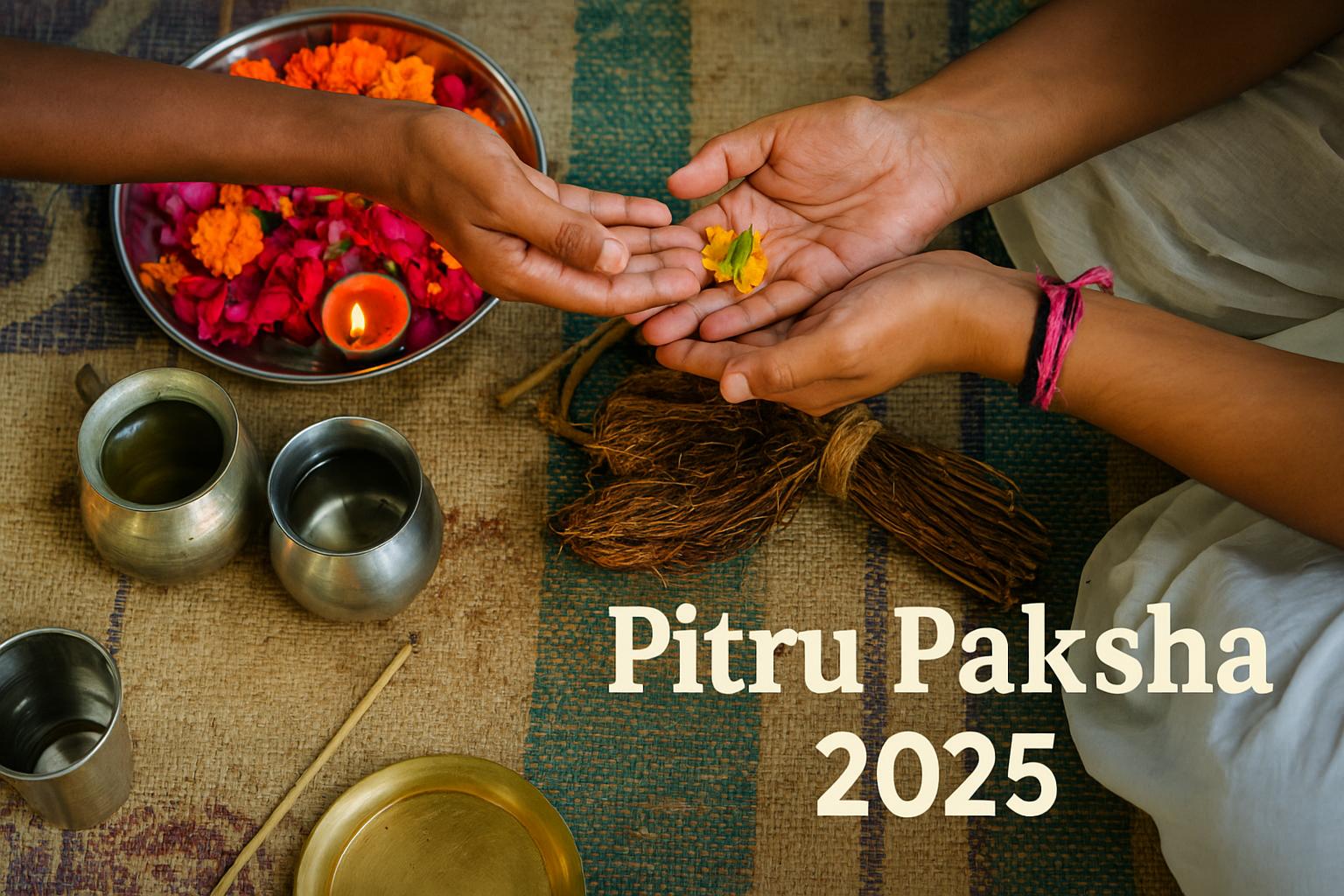
Pitru Paksha 2025 dates and Shraddha rituals from September 7 to 21
Pitru Paksha is one of the most sacred observances in the Hindu calendar, dedicated to remembering ancestors and seeking their blessings. In 2025, Pitru Paksha will begin on September 7 and conclude on September 21, starting with Bhadrapada Purnima and ending with Sarva Pitru Amavasya, also known as Mahalaya Amavasya. This sixteen-day period holds immense spiritual importance because it is believed that ancestors descend to the earthly realm during this time. By performing Sh
Pitru Paksha 2025 dates and Shraddha rituals from September 7 to 21
Pitru Paksha is one of the most sacred observances in the Hindu calendar, dedicated to remembering ancestors and seeking their blessings. In 2025, Pitru Paksha will begin on September 7 and conclude on September 21, starting with Bhadrapada Purnima and ending with Sarva Pitru Amavasya, also known as Mahalaya Amavasya. This sixteen-day period holds immense spiritual importance because it is believed that ancestors descend to the earthly realm during this time. By performing Sh
Sravana Masam 2025: Start Date, Key Festivals, Varalakshmi Vratam, Rakhi, and Puja Significance
Sravana Masam 2025, one of the most spiritually powerful months in the Hindu calendar, begins on Friday, July 25, 2025, and ends on Saturday, August 23, 2025. It is considered highly sacred for performing various vratams, pujas, and devotional practices. The month is devoted to both Lord Shiva and Goddess Lakshmi, with devotees performing rituals with great faith and discipline. Women, in particular, observe multiple vratams d
Sravana Masam 2025: Start Date, Key Festivals, Varalakshmi Vratam, Rakhi, and Puja Significance
Sravana Masam 2025, one of the most spiritually powerful months in the Hindu calendar, begins on Friday, July 25, 2025, and ends on Saturday, August 23, 2025. It is considered highly sacred for performing various vratams, pujas, and devotional practices. The month is devoted to both Lord Shiva and Goddess Lakshmi, with devotees performing rituals with great faith and discipline. Women, in particular, observe multiple vratams d


