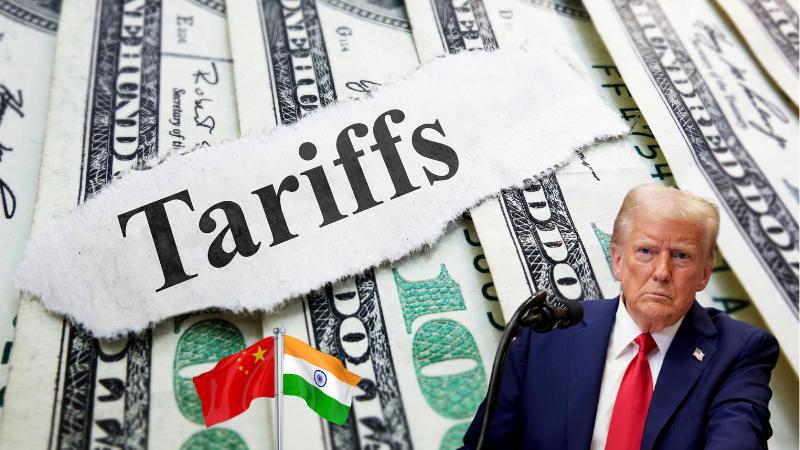
US President Donald Trump has once again turned his attention toward India, accusing New Delhi of exploiting the United States through what he described as a “one-sided disaster” in trade relations. His remarks come as Prime Minister Narendra Modi attends the Shanghai Cooperation Organisation summit in China, where he is seen engaging with leaders such as Xi Jinping and Vladimir Putin in a show of strategic camaraderie.
Trump, writing on his social platform, argued that while India conducts substantial business with the United States, Washington does little in return. He claimed that India has now offered to reduce its tariffs on US goods to zero, but insisted that such a move should have come years earlier. His words followed the breakdown of efforts to advance a bilateral trade agreement, frustrating both the White House and Indian officials.
Earlier this year, Trump unveiled his “Liberation Day” tariffs, targeting dozens of trading partners including India. The measures included a 25 per cent tariff on Indian goods and a further penalty for India’s continued purchases of crude oil from Russia. New Delhi sharply criticized the move, labeling the tariffs as unjust and damaging to fair trade.
The numbers provide important context. In 2025, the United States imported $56.3 billion worth of goods from India, while exporting $22.1 billion in return, creating a $34.3 billion surplus in India’s favor. Total bilateral trade reached $212.3 billion in 2024, an 8.3 per cent increase over the previous year. India is currently America’s largest bilateral trading partner, even as Washington ranks as India’s 10th largest.
The United States imports a wide range of products from India including pharmaceuticals, gems and jewellery, textiles, electronics, petroleum products, rice, and leather goods. In contrast, India’s purchases from the US consist primarily of crude oil, coal, diamonds, machinery, aircraft parts, and gold. Goods trade between the two countries was valued at $128.9 billion in 2024, with the US sending $41.5 billion in exports to India and importing $87.3 billion in return, producing a trade deficit of $45.8 billion for Washington.
In services, however, the balance is far closer. The total services trade reached $83.4 billion in 2024, with both sides exporting nearly equal amounts of $41.8 billion and $41.6 billion respectively. This parity suggests that while goods trade tilts heavily in India’s favor, services trade reflects a more even partnership, particularly in sectors such as IT, software, and professional services.
Trump’s rhetoric often focuses on trade deficits, a theme that has shaped his economic outlook since his first term. He has previously referred to India as the “tariff king” and described the country’s economy as stagnant, remarks that have been contradicted by rising growth figures. Yet despite his sharp words, Trump has also maintained personal rapport with Modi. Earlier in the year, both leaders pledged to double bilateral trade to $500 billion by 2030, with Modi even adapting Trump’s slogan into “Make India Great Again,” highlighting the potential for synergy between the two nations.
Still, recent developments suggest a more complicated picture. Analysts warn that Trump’s latest tariff policies could directly affect up to 60 per cent of Indian exports to the United States, particularly in sectors such as textiles, gems and jewellery, chemicals, electrical equipment, leather, and seafood. India also faces tougher competition from countries like Bangladesh and Vietnam, which are subject to lighter tariff burdens and therefore could attract more US buyers.
Trade is only one dimension of the bilateral relationship. India has also been a significant purchaser of American arms and defense equipment. Since 2008, New Delhi has acquired or contracted weapons worth $24 billion from Washington, with major deals covering drones, aircraft, and other advanced systems. In 2024 alone, arms notifications exceeded $5 billion. While Russia remains India’s largest supplier, its share has been shrinking, opening space for the US, France, and others. Reports earlier this year suggested India was pausing new US defense purchases, though New Delhi officially dismissed these claims as false.
The shifting nature of India–US relations underlines the delicate balance between political rhetoric and economic interdependence. On one hand, Trump continues to attack India’s trade practices and demand concessions. On the other, both countries remain bound by shared interests in commerce, technology, and security. As tariffs, deficits, and global alignments dominate headlines, the challenge for policymakers will be to preserve cooperation without allowing disputes to overshadow decades of growing partnership.