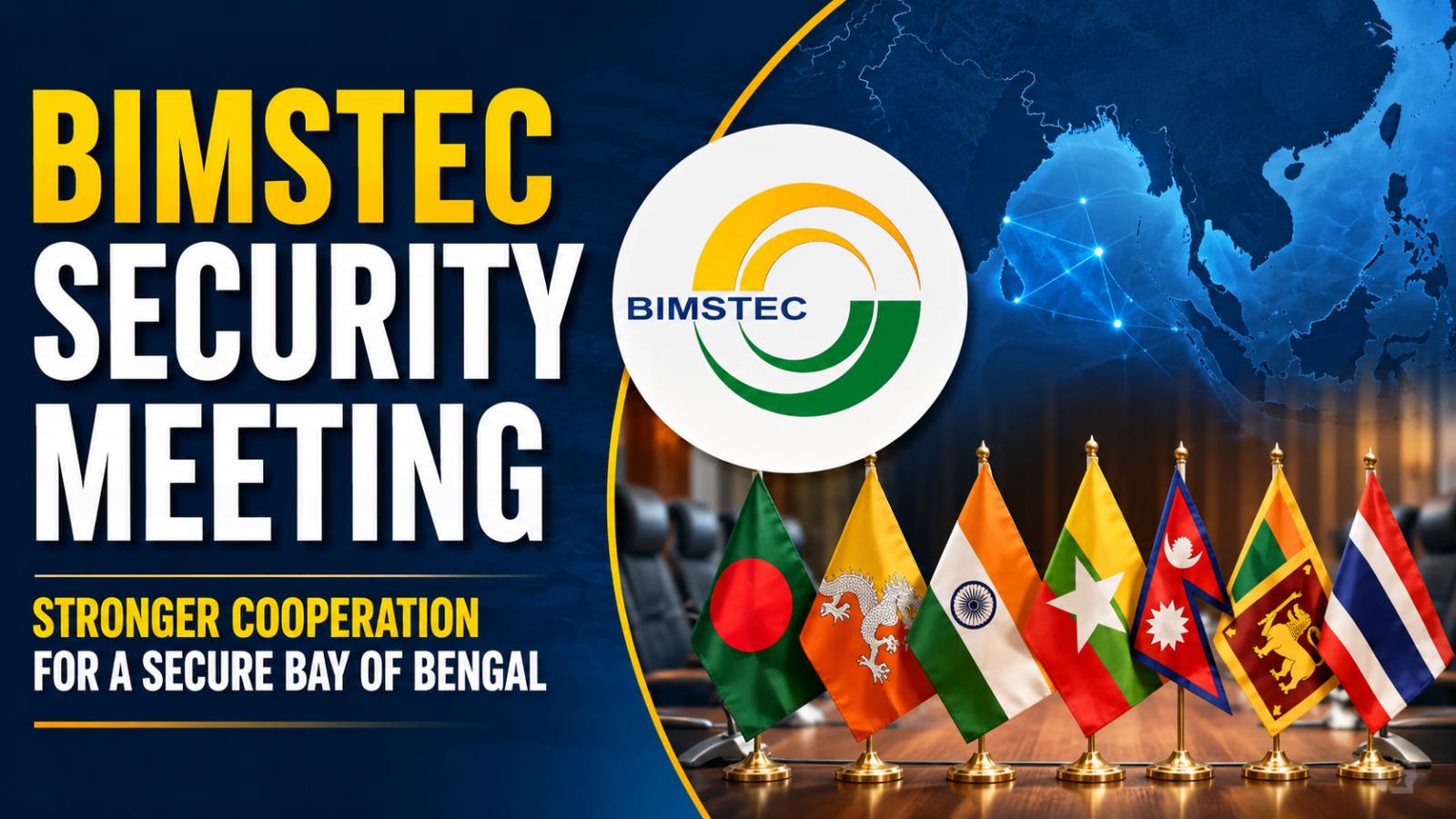
India will host the fifth BIMSTEC security meeting in New Delhi on July 16, bringing national security chiefs and advisers together to discuss counter-terrorism, intelligence sharing, maritime security, cyber threats and stronger regional coordination.
BIMSTEC Security Meeting in New Delhi
India is set to host the fifth meeting of BIMSTEC National Security Chiefs and Advisers in New Delhi on Thursday, July 16, 2026. The official BIMSTEC newsletter confirms that India will host the meeting, which forms part of the grouping’s institutional security mechanism.
India’s National Security Adviser Ajit Doval is expected to chair the discussions. The meeting comes as BIMSTEC countries face terrorism, violent extremism, cyberattacks, organised crime, human trafficking, drug smuggling and security risks across the Bay of Bengal.
The chiefs are likely to examine ways to improve intelligence sharing, strengthen cooperation between law-enforcement agencies and coordinate responses to cross-border threats. Maritime security and disaster response are also expected to receive attention because the Bay of Bengal is central to regional trade, energy movement and economic connectivity.
Regional Security and Intelligence Sharing
BIMSTEC’s National Security Chiefs’ Meeting emerged from the 2016 Goa Retreat, where leaders agreed to hold regular meetings on information and intelligence sharing. The first meeting took place in New Delhi in March 2017, followed by meetings in Dhaka and other member states. The fourth meeting, held in Myanmar in July 2024, examined terrorism, organised crime, drug trafficking, maritime security and cyber security.
The grouping also operates specialised mechanisms covering counter-terrorism, radicalisation, anti-money laundering, terrorist financing, narcotics trafficking and legal cooperation. Its anti-money-laundering subgroup has exchanged intelligence and best practices while working on measures to prevent illicit financial flows.
Unlike a military alliance, BIMSTEC focuses on practical coordination among national security, intelligence and law-enforcement institutions. This structure allows countries to cooperate on shared threats without creating collective defence commitments.
Maritime Security and Cyber Threats
Maritime security has become an important part of BIMSTEC security cooperation. The grouping’s maritime expert mechanism covers Maritime Domain Awareness, humanitarian assistance, disaster relief, oil-spill response, the Blue Economy and cooperation among maritime law-enforcement agencies.
Cyber security is another growing priority. BIMSTEC experts have discussed a five-year cyber cooperation plan, coordination between national computer emergency response teams and a framework for cooperation among cybercrime investigators.
These mechanisms matter because cybercrime, online radicalisation, financial fraud and attacks on critical infrastructure can cross borders faster than conventional security threats.
BIMSTEC History and Member Countries
BIMSTEC was established on June 6, 1997, through the Bangkok Declaration. It initially began as BIST-EC, representing Bangladesh, India, Sri Lanka and Thailand. Myanmar joined later in 1997, while Bhutan and Nepal became members in 2004.
The organisation now brings together Bangladesh, Bhutan, India, Myanmar, Nepal, Sri Lanka and Thailand. Its cooperation is organised around seven broad sectors: security; connectivity; trade, investment and development; agriculture and food security; environment and climate change; science, technology and innovation; and people-to-people contact. India leads cooperation under the security pillar.
Act East Policy and BIMSTEC’s Importance
BIMSTEC has gained strategic importance as cooperation under the South Asian Association for Regional Cooperation remains limited. By connecting South Asia with Southeast Asia, the grouping supports India’s Act East and Neighbourhood First policies.
However, BIMSTEC’s value will depend on implementation rather than declarations. Member countries must turn meetings into secure intelligence channels, operational maritime coordination, joint training and faster responses to terrorism, disasters and cyber incidents.
The New Delhi meeting offers another opportunity to move BIMSTEC from broad commitments towards measurable security cooperation across the Bay of Bengal region.