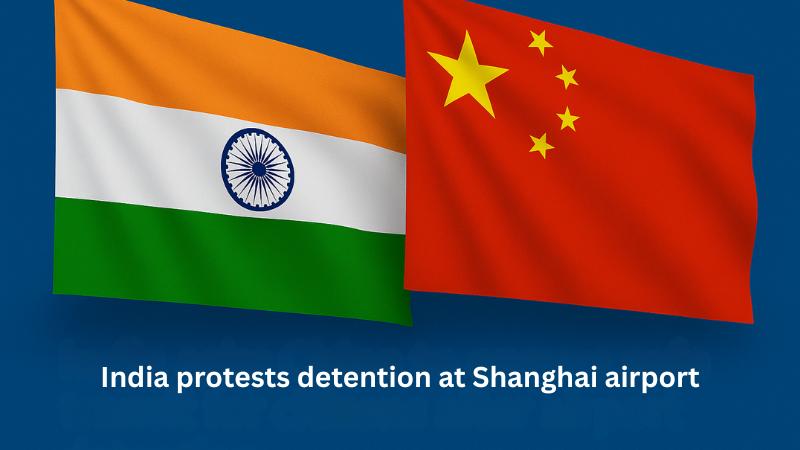
The Ministry of External Affairs issued a firm message to China after an Indian national was reportedly singled out and detained for nearly 18 hours at Shanghai airport. The statement, released on Monday, underscored India’s expectation that its citizens travelling through Chinese airports must not be selectively targeted or subjected to arbitrary detention, and urged Beijing to ensure that international air travel regulations are respected without exception. The incident has intensified diplomatic concern at a time when travel between India and China has only recently resumed following years of suspension.
MEA spokesperson Randhir Jaiswal said the government shared the widespread concern triggered by the reported treatment of the Indian traveller. He noted that India has sought assurances from Chinese authorities that such incidents will not recur and that Indian passport holders will be able to transit Chinese airports without harassment. His remarks came in response to questions about the case involving Arunachal-born UK resident Pema Wangjom Thongdok, who was detained and questioned by immigration officials upon arrival in Shanghai. According to the account provided by the traveller, Chinese officials challenged the validity of her Indian passport on the grounds that Arunachal Pradesh is considered by China as its own territory.
The ministry further advised Indian nationals travelling to or transiting through China to remain cautious and exercise discretion. Officials emphasised that travellers should stay aware of potential scrutiny during immigration checks, particularly in light of recent developments. The advisory reflects growing apprehension over what some Indian passengers describe as selective targeting by Chinese authorities, although China has publicly dismissed allegations of harassment.
Thongdok, who was travelling from London to Japan in November with a scheduled layover in Shanghai, said she was isolated, questioned extensively and confined to the transit area without adequate food or basic facilities. India lodged a strong protest soon after the episode, calling the detention arbitrary and conveying a formal demarche to China both in Beijing and New Delhi. Chinese authorities, however, rejected the allegations and said that her legal rights were protected and that no compulsory measures were taken during the questioning.
The incident comes at a sensitive juncture, as direct travel between India and China only resumed in October 2025 after a five-year freeze triggered by the Galwan border clashes and prolonged pandemic restrictions. India recently restored tourist visas for Chinese visitors, while China eased entry rules for Indian travellers. The reopening followed months of diplomatic engagement, military-level discussions and efforts to stabilise conditions along the border, signalling attempts by both countries to normalise movement, trade and broader people-to-people exchanges.
Despite signs of progress, the episode at Shanghai airport has renewed scrutiny of the travel environment and highlighted the fragility of the recent thaw. India maintains that the safety, dignity and fair treatment of its citizens abroad remain non-negotiable and expects China to ensure that international norms governing transit and immigration procedures are applied without discrimination.