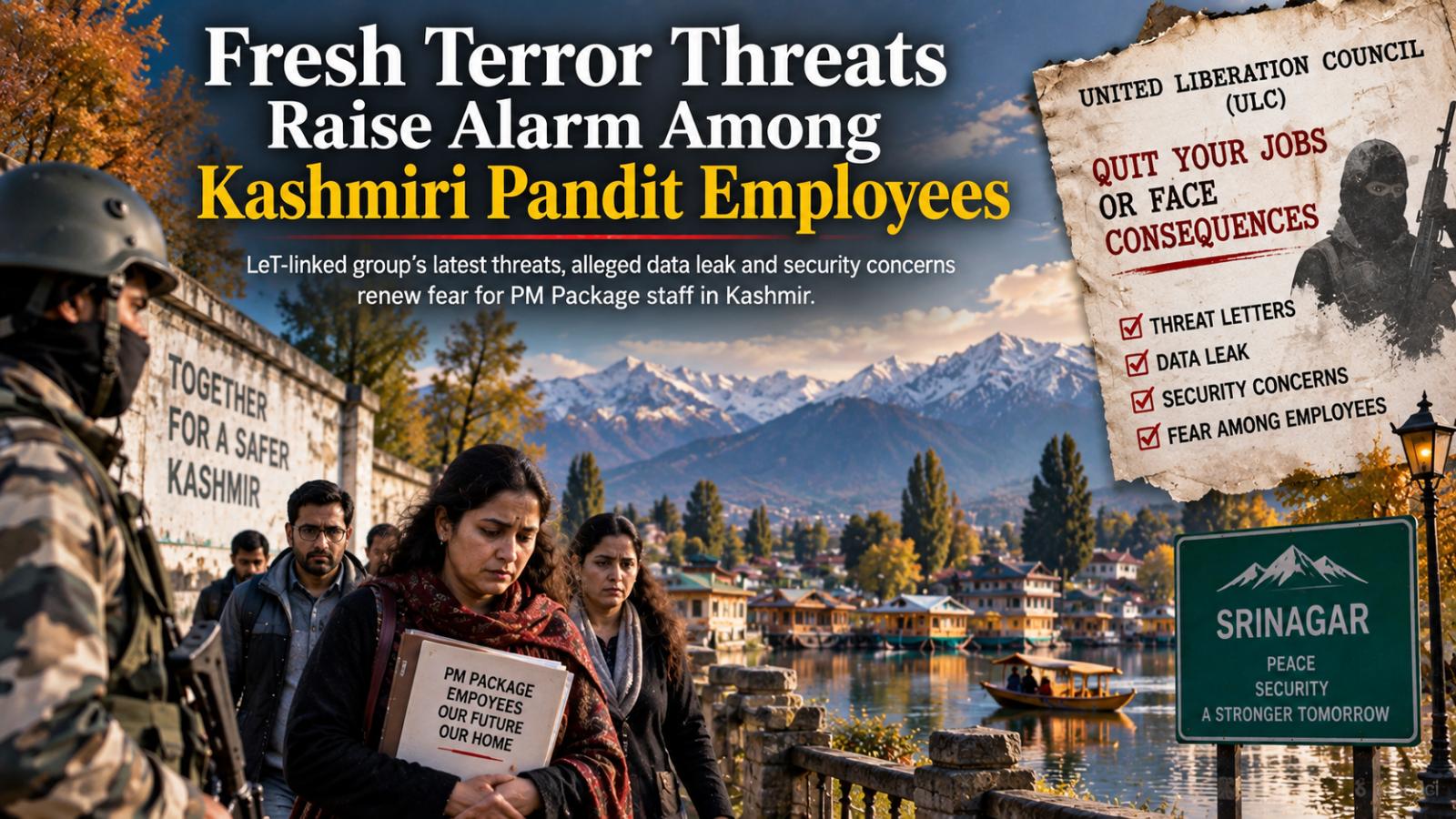
Fresh terror threats to Kashmiri Pandit employees in Kashmir have renewed concerns over employee security, an alleged data leak and the safety of PM Package employees, prompting demands for stronger protection and secure accommodation.
Fresh terror threats to Kashmiri Pandit employees in Kashmir have revived serious concerns over the safety of members of the community working in the Valley under government employment programmes.
Threat letters attributed to the United Liberation Council, which Indian security and intelligence sources have described as being linked to or functioning as a possible front for the banned Lashkar-e-Taiba, have repeatedly targeted Kashmiri Pandit employees in recent weeks. The letters reportedly warned employees of consequences while claiming access to information about their families, workplaces and locations.
The security concerns deepened after personal information connected to some Kashmiri Pandit employees was circulated. Recent threat letters have reportedly included details such as telephone numbers, residential addresses and vehicle registration information. Earlier reports also documented letters naming individual government employees and publishing sensitive information about them.
The disclosure has raised questions not only about the threat itself but also about how such personal information was obtained. Community representatives and employees have sought stronger safeguards as authorities examine the origin and authenticity of the communications.
Kashmiri Pandit employee security comes under renewed focus
Kashmiri Pandit employee security has become a major concern following the repeated threat letters. Employees recruited under the Prime Minister's Special Employment Package are among those who have been specifically mentioned in recent communications.
Reports indicate that security around migrant employee colonies has been strengthened in some areas following the threats. Employees have also called for greater protection at workplaces, transit accommodation and rented residences, particularly in locations that may be isolated or difficult to secure.
The issue goes beyond physical security. The circulation of private information has created an additional cyber-security concern, increasing demands for authorities to investigate the source of the alleged data leak and determine whether official or private databases may have been compromised.
The latest incidents are part of a series of warnings that surfaced during August and September. An August 7 letter reportedly named six Kashmiri Pandit employees and disclosed telephone numbers, while another letter dated August 23 carried more extensive personal details, including residential and vehicle information.
A further warning surfaced later in August, adding to fears within the community and prompting security agencies to examine the communications.
PM Package employees in Kashmir face rehabilitation concerns
PM Package employees in Kashmir form a key part of government efforts to support the return and rehabilitation of displaced Kashmiri Pandits. Employment opportunities and residential accommodation were designed to provide families with a pathway to return to the Valley after decades of displacement.
However, recurring terror threats have highlighted the gap between providing employment and ensuring that employees feel safe enough to live and work in the region.
For many employees, secure accommodation has therefore become as important as job placement. Concerns surrounding transit colonies, rented houses, transportation routes and workplace protection have renewed calls for comprehensive security audits rather than temporary measures after every threat.
The latest developments also underline a broader challenge facing the Kashmir rehabilitation policy. Successful rehabilitation cannot be measured only by the number of jobs offered or housing units constructed. Long-term success depends on whether employees and their families can live, travel and work without constant fear of being identified or targeted.
Political reactions have added another dimension to the issue. National Conference chief Farooq Abdullah recently questioned the circumstances surrounding the threat letters and alleged a connection to the debate over Jammu and Kashmir's statehood. The BJP rejected his allegations, while Jammu and Kashmir Chief Minister Omar Abdullah has previously stressed that threats against Kashmiri Pandits should be taken seriously and investigated by security agencies.
For Kashmiri Pandit employees, however, the immediate issue remains security rather than political debate. Their concerns include protection at residential colonies and workplaces, investigation of leaked personal information and stronger mechanisms to prevent sensitive employee data from reaching threatening groups.
Repeated threats also risk undermining confidence in rehabilitation initiatives. If employees believe their addresses, telephone numbers or family details can be exposed, even stronger physical security may not fully address their concerns.
The latest incidents therefore place pressure on authorities to pursue two tracks simultaneously: identify those responsible for issuing the threats and investigate how personal information connected to employees became accessible.
Ensuring the safety of PM Package employees will be critical not only for those currently working in Kashmir but also for the credibility of broader efforts to support the secure and sustainable return of Kashmiri Pandits to the Valley.