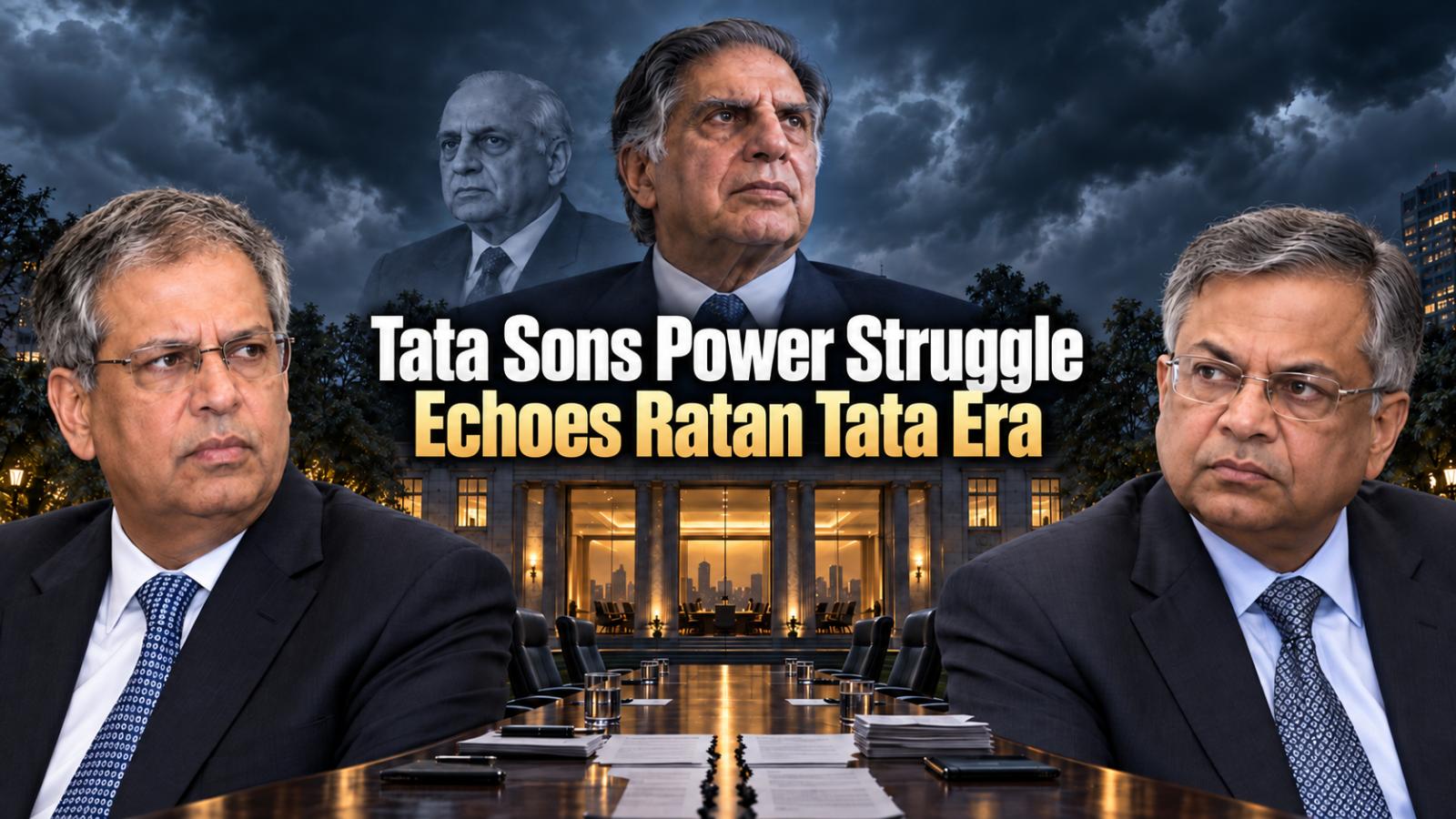
A Tata Sons leadership dispute has revived memories of Ratan Tata’s 1990s battle to centralise authority at Bombay House and reshape the group’s governance.
Chandrasekaran and Noel Tata clash
The confrontation followed the Tata Sons board’s approval of another five-year term for N Chandrasekaran and preparations for a public listing after Reserve Bank of India pressure. Noel Tata opposed both moves. Tata Trusts, which controls about 66% of Tata Sons, called the reappointment a “legal nullity”, arguing that the Articles of Association require support from its nominee directors. Tata Sons and the Trusts now face a dispute over succession, board authority and the group’s future structure. The claim of invalidity remains contested rather than legally settled.
Ratan Tata challenges the old guard
Ratan Tata inherited the Tata Sons chairmanship from JRD Tata in 1991, but companies still operated like independent empires. Russi Mody dominated TISCO, now Tata Steel; Darbari Seth held influence at Tata Chemicals and Tata Tea; and Ajit Kerkar led Indian Hotels and the Taj business. As India liberalised, Ratan Tata sought stronger central oversight, common strategy and clearer succession. That brought him into conflict with executives who had spent decades building powerful positions inside individual companies.
Retirement rules shift the balance
The most visible confrontation centred on TISCO and Mody’s succession plans, including his effort to promote his adopted son, Aditya Kashyap. At the company’s 1992 annual meeting, Mody stepped down as managing director and Jamshed J Irani replaced him. Mody left TISCO in 1993. Ratan Tata’s 1992 retirement policy introduced age limits and created a route for leadership renewal. Darbari Seth retired from senior positions in 1994, while Ajit Kerkar left Indian Hotels in 1997 during a separate governance dispute. Their departures weakened the old power centres.
Bombay House faces a defining test
Greater control by Tata Sons helped build a unified group capable of global acquisitions including Tetley, Corus and Jaguar Land Rover. The Chandrasekaran–Noel Tata dispute is not a replay of the Ratan Tata–Mody battle: today’s conflict concerns the powers of Tata Sons, its board and the charitable trusts that own it. Yet the central question is familiar—who has final authority at Bombay House? The answer could shape the group’s leadership, listing plans and distribution of power for the next generation.