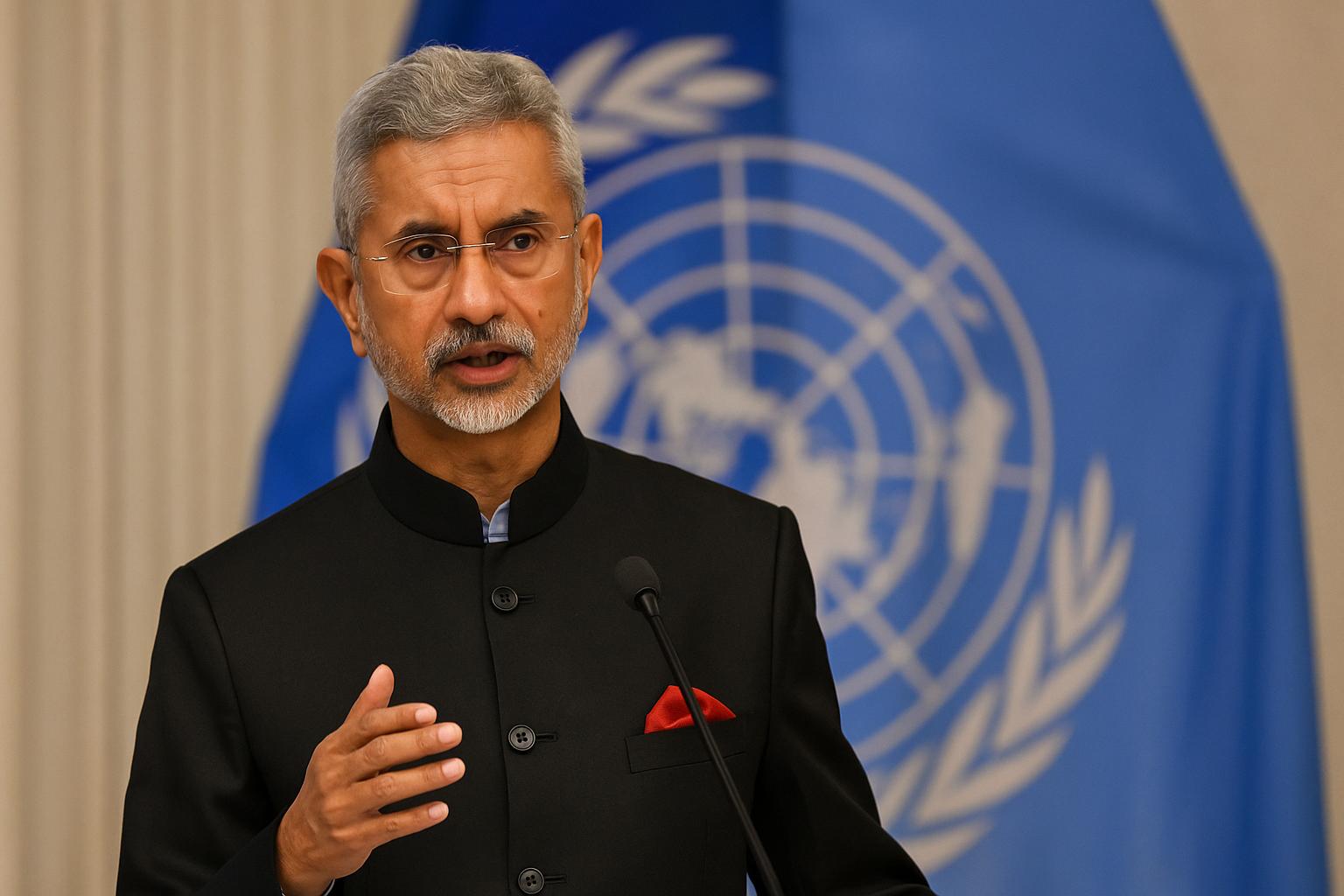
India’s External Affairs Minister S Jaishankar has sharply criticised the United Nations, saying the global body has become increasingly ineffective and paralysed by internal divisions. Speaking in New Delhi at the release of a commemorative postage stamp marking the 80th anniversary of the United Nations, Jaishankar said the organisation’s decision-making has failed to reflect the realities of its membership or the priorities of the modern world. He emphasised that meaningful reforms are being obstructed by the very mechanisms designed to enable them, creating what he described as a “visibly gridlocked” system.
In a pointed message to the international community, Jaishankar said that “all is not well” with the UN, whose debates have become “increasingly polarised.” The minister observed that many nations now see the United Nations as struggling to adapt to contemporary challenges such as terrorism, development, and socio-economic progress. The institution, he argued, is being undermined by members who use procedural rules to stall changes that could make it more representative and effective.
Without naming Pakistan directly, Jaishankar referred to the recent Pahalgam terror attack, where the militant outfit The Resistance Front (TRF), linked to Lashkar-e-Taiba, claimed responsibility. He criticised Pakistan’s move to protect the group at the UN Security Council, saying such actions have damaged the credibility of multilateralism. “When a sitting Security Council member openly protects the very organisation that claims responsibility for a barbaric terror attack such as at Pahalgam, what does it do to the credibility of multilateralism?” he asked.
Jaishankar said the practice of equating victims and perpetrators of terrorism in the name of global strategy was “deeply cynical.” He condemned attempts to shield self-proclaimed terrorists from sanctions, saying this reveals a lack of sincerity among those who claim to champion peace. The remarks come amid growing frustration in India over how some permanent members of the UN Security Council have blocked listings of known terror operatives under the UN’s sanctions regime.
Pakistan currently serves as one of the ten non-permanent members of the Security Council, which consists of fifteen members in total. The five permanent members are China, France, Russia, the United Kingdom, and the United States. During Pakistan’s chairmanship of the Council in July, it was accused of attempting to remove references to TRF from a UN statement condemning the Pahalgam attack. India has argued that such actions reflect the double standards that have long hindered global efforts to fight terrorism collectively.
Jaishankar also questioned the UN’s ability to respond effectively to global crises. He said that while maintaining international peace and security remains a stated goal, the body’s actions have often been reduced to “lip service.” He added that the stagnation within the system has had even more serious implications for development and socio-economic progress, especially in the Global South.
“The UN’s inability to respond to the world’s most urgent challenges raises difficult questions about its credibility,” Jaishankar said. He called for urgent reforms to ensure that the organisation reflects today’s geopolitical realities, particularly the rise of developing countries as key stakeholders in global decision-making.
Despite his strong critique, Jaishankar said India continues to believe in the value of multilateral cooperation. He urged the global community not to abandon the idea of collective problem-solving even when institutions fall short. “However difficult, the commitment to multilateralism must remain strong. However flawed, the United Nations must be supported in this time of crisis,” he stated.
The minister’s comments come amid India’s ongoing campaign for reforms within the UN, including its demand for permanent membership in an expanded Security Council. New Delhi has consistently argued that the Council’s current composition, rooted in the post-World War II era, no longer represents the balance of power in the 21st century.
By linking the UN’s paralysis to its handling of terrorism, Jaishankar has highlighted India’s growing impatience with what it sees as systemic bias and procedural delays. He noted that global institutions lose credibility when they allow political expediency to override moral responsibility. “If the world continues to look away when terrorists are shielded and victims are ignored, then reform becomes not just desirable but indispensable,” he said.
Marking the UN’s 80th anniversary, Jaishankar struck a note of cautious optimism, saying that while reform is an uphill task, it remains essential for the global body’s survival. “We cannot abandon hope,” he said, adding that India will continue to advocate for fairness, transparency, and accountability in global governance.
The speech reflects India’s sharper diplomatic tone in recent years, combining criticism of global inertia with a call for renewal. As geopolitical divides deepen and trust in international institutions wanes, Jaishankar’s remarks underscore India’s position that the UN must evolve—or risk irrelevance—in a world where global challenges demand faster, fairer, and more inclusive responses.