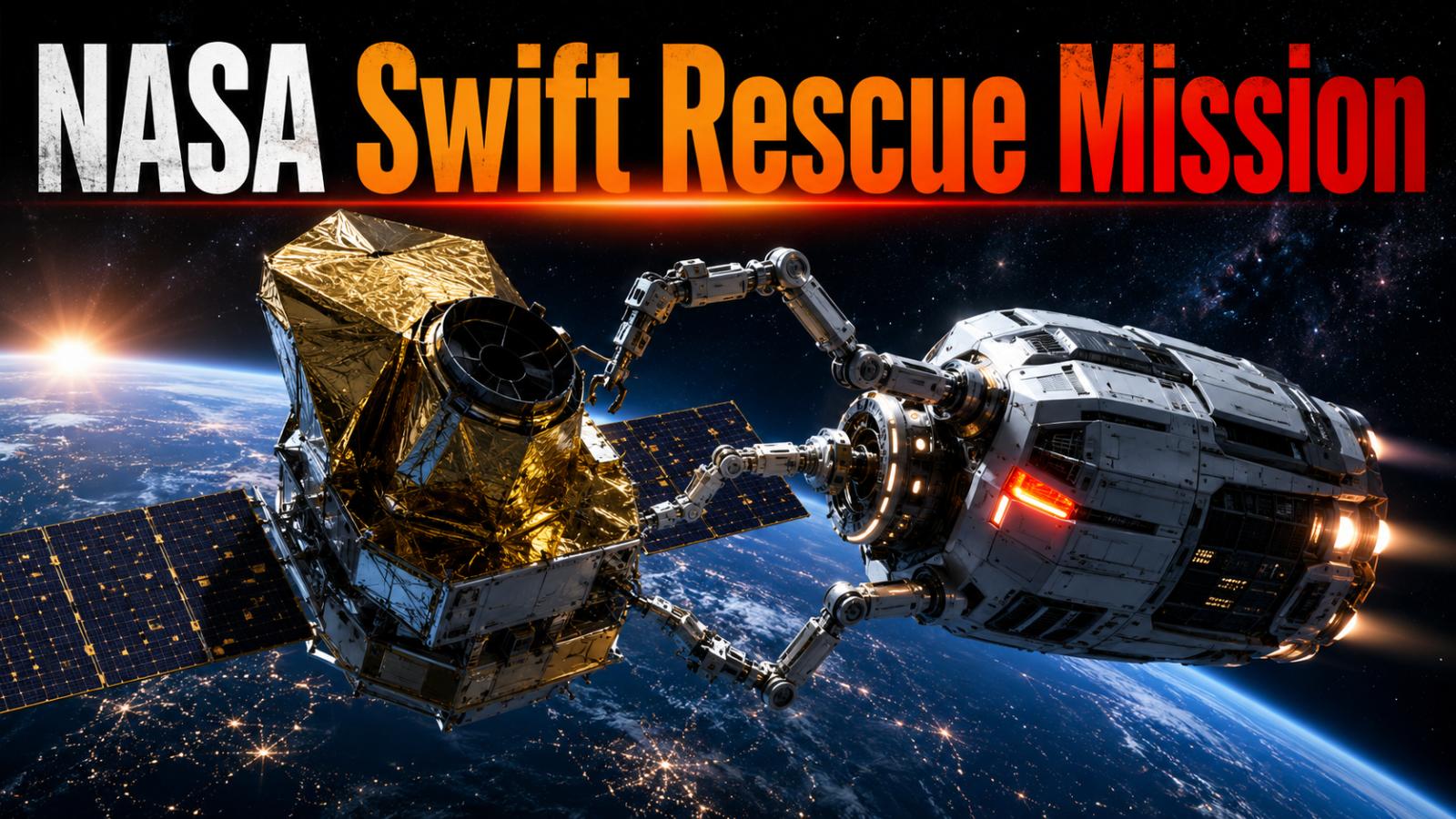
NASA prepares rescue mission for Swift
NASA is preparing a $30 million robotic mission to prevent the Neil Gehrels Swift Observatory from re-entering Earth’s atmosphere after two decades of service in space. The agency has described the effort as a race against time and gravity, as the aging telescope continues to lose altitude because of orbital decay.
The mission will be led by Katalyst Space Technologies, a startup developing a three-armed spacecraft called Link. The spacecraft is expected to launch from an atoll in the Marshall Islands aboard an aircraft-launched Pegasus rocket. After reaching orbit, Link will spend about a month pursuing the Swift Observatory before attempting to attach to it and mechanically push it into a higher, more stable orbit.
If successful, the orbit boost could extend Swift’s operational life by five to 10 years. Katalyst Space CEO Ghonhee Lee said the mission would demonstrate a new type of American space robot capable of servicing valuable observatories already in orbit. The effort could also show how future spacecraft may help protect other major NASA assets that face similar risks.
Telescope faces orbital decay threat
Swift was launched in 2004 and has played a major role in studying gamma-ray bursts, among the most powerful and luminous explosions in the universe. The telescope is often described as a first responder for space astronomy because it can quickly detect these bursts and reposition itself within 20 to 75 seconds to observe the fading afterglow. That rapid response capability makes it different from larger observatories such as Hubble and the James Webb Space Telescope.
The threat to Swift has increased as recent solar activity expanded Earth’s outer atmosphere. That expansion creates more atmospheric drag on spacecraft in low Earth orbit, causing Swift to sink faster than expected. Its altitude has reportedly dropped from about 600 kilometers to around 370 kilometers, raising concerns that it could be lost by the end of 2026 without intervention.
Swift originally cost about $250 million to develop and launch, while its lifetime operating cost has reached around $500 million. NASA spent about $6 million to operate the telescope in fiscal year 2024, with planned reductions in future years. The rescue mission may offer a cheaper way to preserve a working scientific asset while testing technology that could later support other observatories, including Hubble.