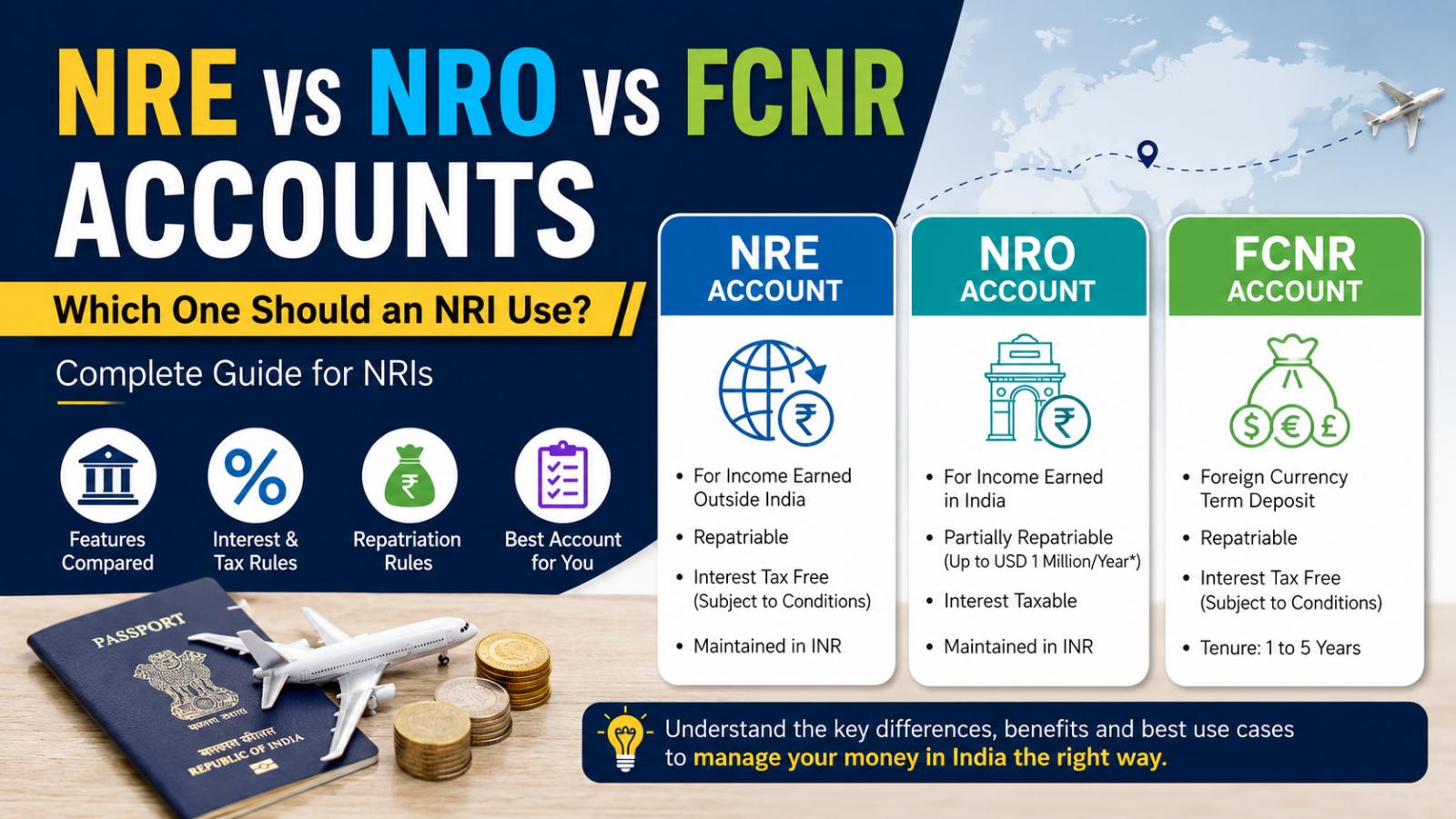
This guide explains NRE, NRO and FCNR accounts in plain English, compares tax and repatriation rules, shows where overseas and Indian income should go, and gives realistic account combinations for salaried NRIs, landlords, investors and families.
Last reviewed: July 18, 2026
The first banking question most new NRIs ask sounds simple:
“Which Indian account should I use now?”
The confusing answer is that there may not be one account that does everything.
Your overseas salary, Indian rental income, emergency savings and long-term foreign-currency deposits serve different purposes. Putting all of them into one account can make taxes, withdrawals and overseas transfers harder to understand.
This guide explains NRE vs NRO vs FCNR accounts without banking jargon.
Bank-account conversion is only one part of becoming an NRI. Follow our complete NRI checklist after moving abroad to update your taxes, PAN, Aadhaar, investments, insurance and property records.
The Quick Answer
- Use an NRE account mainly for money earned abroad that you want to hold in Indian rupees.
- Use an NRO account mainly to receive and manage income arising in India.
- Use an FCNR account when you want an eligible term deposit to remain in a permitted foreign currency.
Many NRIs need both an NRE and an NRO account. FCNR is an additional option, not necessarily a replacement for either.
Before arranging these accounts, complete the broader NRI checklist after moving abroad, covering tax status, investments, Aadhaar, PAN, insurance and property records.
NRE Account: For Repatriable Rupee Funds
NRE stands for Non-Resident External account.
It is maintained in Indian rupees, although money may be sent from abroad in another currency and converted by the bank.
An NRE account may suit you when:
- You earn money abroad
- You want to remit part of that income to India
- You want the funds to remain generally repatriable
- You need rupees for family expenses or investments
- You are comfortable with rupee exchange-rate movement
RBI guidance treats NRE funds as repatriable. Interest on a qualifying NRE account continues to receive tax exemption under the Income Tax Act, 2025 when the individual satisfies the applicable FEMA and RBI conditions.
The important currency point
An NRE account is a rupee account.
Suppose you send USD 10,000 to India. The bank converts it into rupees. When you later send the money abroad, the rupee balance is converted back into the destination currency.
Your final foreign-currency value can therefore rise or fall because of exchange rates.
The account is repatriable, but that does not mean it is protected from currency movement.
NRO Account: For Managing Indian Income
NRO stands for Non-Resident Ordinary account.
It is also maintained in Indian rupees, but it is commonly used to manage income received in India.
Typical NRO receipts include:
- Rental income
- Pension
- Interest
- Dividends
- Sale proceeds
- Local reimbursements
- Other legitimate Indian dues
RBI guidance permits inward remittances and legitimate Indian dues to be credited to an NRO account. Interest earned in an NRO account is taxable.
Can money be transferred abroad from an NRO account?
Current income may generally be remitted subject to applicable tax and banking documentation.
Eligible NRI and OCI account holders may also remit qualifying NRO balances and other eligible assets up to USD 1 million per financial year, subject to the conditions under FEMA regulations and the authorised bank’s documentation process.
This does not mean every NRO balance can be transferred instantly. The bank may ask for tax certificates, declarations, source-of-funds documents or professional certification.
FCNR Account: For Foreign-Currency Term Deposits
FCNR stands for Foreign Currency Non-Resident Bank account.
Unlike NRE and NRO accounts, an FCNR account is maintained as a term deposit in an eligible foreign currency rather than as a regular rupee savings account.
RBI guidance provides for FCNR deposits with terms of not less than one year and not more than five years. The funds are generally repatriable, and qualifying income receives the applicable exemption available to eligible non-resident deposits.
An FCNR deposit may suit you when:
- You do not want to immediately convert the principal into rupees
- You are saving for a future expense in the same foreign currency
- You want to reduce rupee exchange-rate exposure
- You can keep the money in a term deposit
- You understand premature-withdrawal conditions
FCNR is not an everyday transaction account. It is primarily a deposit product.
NRE vs NRO vs FCNR Comparison
| Feature | NRE Account | NRO Account | FCNR Account |
|---|---|---|---|
| Currency | Indian rupees | Indian rupees | Permitted foreign currency |
| Common purpose | Overseas income sent to India | Income and payments arising in India | Foreign-currency term savings |
| Account type | Savings, current or deposit options | Savings, current or deposit options | Term deposit |
| Repatriation | Generally repatriable | Subject to applicable rules and documentation | Generally repatriable |
| Interest tax in India | Exempt when eligibility conditions are met | Taxable | Exempt when eligibility conditions are met |
| Currency exposure | Rupee exchange-rate risk | Rupee exchange-rate risk | Principal remains in chosen foreign currency |
| Best suited for | Overseas earnings converted to rupees | Rent, pension and other Indian receipts | Medium- or long-term foreign-currency deposits |
Which Account Combination Is Best?
Salaried NRI With No Indian Income
A common arrangement is:
- NRE account for money remitted to India
- FCNR deposit for a portion of foreign-currency savings, when appropriate
An NRO account may still be required if Indian income arises later or a resident account must be redesignated.
NRI Who Owns Rental Property in India
A practical arrangement may be:
- NRO account for rent and property expenses
- NRE account for overseas earnings sent to India
- Separate records for tax deducted, repairs and municipal payments
Do not mix rental records with unrelated family transfers when clear documentation is possible.
NRI Supporting Parents in India
An NRE account can be useful for funds sent from abroad and spent in India.
Ensure that account operation, mandates and powers of attorney are structured correctly. Giving someone access should not mean giving unlimited authority.
NRI Saving for a Future Overseas Expense
When the future expense will be in dollars, pounds or another eligible foreign currency, converting all savings into rupees may create avoidable exchange-rate uncertainty.
An FCNR deposit may be worth evaluating, subject to interest rates, tenure and withdrawal conditions.
NRI With Both Indian and Overseas Income
This is where separate accounts become especially useful:
- Overseas income → NRE route
- Indian income → NRO route
- Selected foreign-currency savings → FCNR deposit
Separation creates a clearer transaction trail.
Can an NRI Continue Using a Resident Savings Account?
A resident Indian who becomes a person resident outside India should inform the bank. RBI’s current guidance says the existing resident account should be redesignated as an NRO account when the individual becomes resident outside India under the applicable framework.
Do not assume that an account is compliant merely because net banking and UPI still work.
Ask the bank to confirm the correct conversion process.
Common NRI Account Mistakes
Sending Indian Rent Into the Wrong Account Without Records
Keep the income source identifiable. This helps with tax reporting and future remittance documentation.
Assuming “Repatriable” Means “No Paperwork”
Repatriation describes whether funds may be transferred, not whether every transfer is instant or document-free.
Choosing FCNR Only Because the Interest Rate Looks Attractive
Consider the deposit currency, tenure, premature-withdrawal terms and where you will eventually spend the money.
Forgetting to Update Fixed Deposits and Joint Accounts
Converting one savings account does not necessarily correct every connected deposit or relationship.
Treating NRE Tax Exemption as Permanent
The exemption depends on continuing to satisfy the relevant status and account conditions. Review the account when you return to India or your circumstances change.
A Simple Decision Test
Ask three questions about the money:
Where was it earned?
Abroad or in India?
In which currency will I eventually spend it?
Rupees or foreign currency?
Will I need to transfer it outside India later?
Immediately, eventually or probably never?
The answers usually indicate the appropriate starting point:
- Overseas income needed in India → Consider NRE
- Indian income and local receipts → Consider NRO
- Foreign-currency savings for a future foreign-currency goal → Consider FCNR
The right structure is not the account with the most attractive advertisement.
It is the structure that preserves a clear source of funds, matches the currency of your future needs and avoids unnecessary compliance confusion.
Reader Question: Which NRI account rule did you find most confusing when you first moved abroad? Share it below—your question may help improve this guide for another family.
Editorial Note: Bank procedures, interest rates, documentation and tax treatment can vary according to account holder status and transaction circumstances. Confirm important decisions with an authorised bank and qualified tax professional.