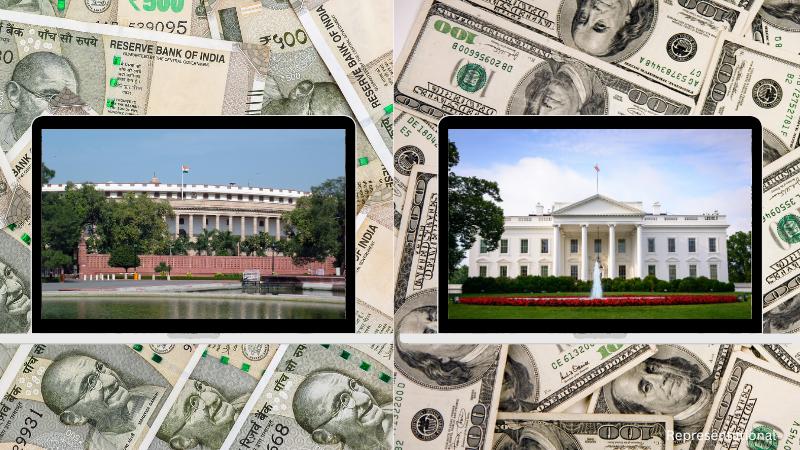
The White House has indicated that the United States may adjust President Donald Trump’s recently announced 50 percent tariff on Indian goods if foreign governments respond with retaliatory measures. The statement underscores a willingness by the administration to take a flexible approach to trade policy, balancing the desire to maintain pressure with the need to protect US economic interests. Officials noted that any potential revision would aim to preserve the intended economic impact of the tariff while avoiding an escalation that could harm broader trade relations.
The announcement came shortly after President Trump increased pressure on India over its continued purchase of Russian oil. In a warning delivered the previous day, he stated that additional tariffs could be imposed within 24 hours if India did not alter its energy sourcing from Russia. The president’s remarks reflect growing tension between the two countries over trade and geopolitical alignment, particularly in the context of ongoing international disputes involving Russia.
The 50 percent tariff order, which marks one of the most significant recent trade measures against India, is part of a broader strategy to address what the administration views as imbalanced trade relationships. India is a major exporter to the US, supplying a wide range of goods including textiles, machinery, chemicals, and electronics. Increasing tariffs on these products is intended to encourage domestic production and put pressure on foreign partners to reconsider certain trade and policy decisions.
However, trade analysts have warned that such steep tariff increases could prompt swift retaliation from affected countries, potentially leading to a trade standoff. India has previously responded to tariff hikes by imposing its own duties on American products, and a similar move in this instance could escalate the situation. By signaling the possibility of revising the tariff order, the administration appears to be leaving room for negotiation while still maintaining a firm stance.
The position suggests that while the 50 percent tariff is a strong opening measure, it is not an entirely fixed policy. Flexibility could allow the US to adjust its economic strategy if retaliatory steps begin to threaten broader trade stability or negatively impact key American industries. This balancing act between assertiveness and adaptability reflects a strategic approach to protecting national economic interests without unnecessarily provoking long-term trade disputes.
As the situation develops, much will depend on India’s response to both the tariff and the warning over Russian oil imports. If tensions escalate, revisions to the policy may come sooner rather than later. For now, the statement serves as a clear signal to both domestic and international audiences that the US is prepared to act decisively while still retaining the option to recalibrate its trade tactics in the face of global pushback.
The announcement came shortly after President Trump increased pressure on India over its continued purchase of Russian oil. In a warning delivered the previous day, he stated that additional tariffs could be imposed within 24 hours if India did not alter its energy sourcing from Russia. The president’s remarks reflect growing tension between the two countries over trade and geopolitical alignment, particularly in the context of ongoing international disputes involving Russia.
The 50 percent tariff order, which marks one of the most significant recent trade measures against India, is part of a broader strategy to address what the administration views as imbalanced trade relationships. India is a major exporter to the US, supplying a wide range of goods including textiles, machinery, chemicals, and electronics. Increasing tariffs on these products is intended to encourage domestic production and put pressure on foreign partners to reconsider certain trade and policy decisions.
However, trade analysts have warned that such steep tariff increases could prompt swift retaliation from affected countries, potentially leading to a trade standoff. India has previously responded to tariff hikes by imposing its own duties on American products, and a similar move in this instance could escalate the situation. By signaling the possibility of revising the tariff order, the administration appears to be leaving room for negotiation while still maintaining a firm stance.
The position suggests that while the 50 percent tariff is a strong opening measure, it is not an entirely fixed policy. Flexibility could allow the US to adjust its economic strategy if retaliatory steps begin to threaten broader trade stability or negatively impact key American industries. This balancing act between assertiveness and adaptability reflects a strategic approach to protecting national economic interests without unnecessarily provoking long-term trade disputes.
As the situation develops, much will depend on India’s response to both the tariff and the warning over Russian oil imports. If tensions escalate, revisions to the policy may come sooner rather than later. For now, the statement serves as a clear signal to both domestic and international audiences that the US is prepared to act decisively while still retaining the option to recalibrate its trade tactics in the face of global pushback.