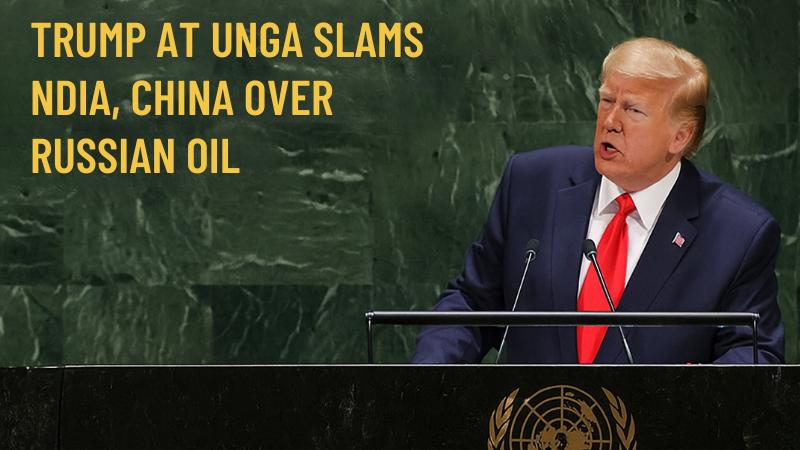
Addressing the 80th session of the United Nations General Assembly in New York on September 23, 2025, United States President Donald Trump launched a sharp attack on India, China, and even some NATO allies. In a strongly worded speech, Trump alleged that both New Delhi and Beijing are the “primary funders” of the ongoing Russian war in Ukraine through their continued purchase of Russian oil. He claimed that these energy imports were a major reason why Moscow had been able to sustain its military campaign.
The remarks came alongside Trump’s announcement of an additional 25 percent tariff on Indian goods as a penalty for its Russian oil imports. With this step, the total levies imposed on India by the United States now stand at 50 percent, among the highest imposed on any country by Washington. The decision is expected to put considerable strain on India-US trade relations at a time when both sides are also seeking closer defense cooperation. Trump insisted that such punitive measures were necessary to stop financial flows to Russia and to force countries to align with American sanctions policy.
During his address, Trump demanded that European allies, including NATO member states, should immediately halt all purchases of Russian oil and gas. He expressed frustration that even some of the closest Western partners of the United States had not yet cut their dependence on Russian energy supplies. According to Trump, this undercut the global campaign against Moscow and weakened the collective pressure intended to stop the war. He described the situation as “embarrassing” for those countries and said that unless they ceased all energy transactions with Russia, international unity on Ukraine would remain ineffective.
Trump reiterated his longstanding claim of being a peacemaker and went on to declare that he had ended what he described as “unendable wars,” including conflicts involving India and Pakistan. His remarks again revived his controversial assertions that his personal diplomacy had played a decisive role in calming tensions in South Asia, a claim that India has officially and repeatedly denied. The former comments had earlier triggered sharp reactions in New Delhi, with Indian officials insisting that such statements did not reflect the reality of regional diplomacy.
Continuing his attack on the global body, Trump mocked the United Nations itself, suggesting that it had consistently failed in its core mission of conflict resolution. He argued that while the UN has immense potential, it had delivered little beyond symbolic statements. “The UN has such tremendous potential, but it is not even coming close to living up to that potential,” he said. He dismissed the organization’s record as “empty words” that do not resolve wars and insisted that only decisive action could make a difference in global conflicts.
In an almost personal aside, Trump also referred to ongoing discussions about him being a candidate for the Nobel Peace Prize. While he remarked that “everyone says I should get the Nobel Peace Prize,” he insisted that he did not care about such recognition, claiming instead that his focus was solely on saving lives and bringing peace. Nevertheless, his tone suggested that international recognition for his self-declared peace efforts remained an issue he wanted the world to take seriously.
Trump’s address came at a moment when world leaders at the UN were largely focused on the humanitarian crisis in Gaza and the urgent appeals for Palestinian recognition. However, his speech redirected attention toward the conflict in Ukraine and the broader implications of global energy trade. By directly blaming India, China, and NATO countries for indirectly sustaining the war through energy imports, Trump set the stage for renewed debates on how sanctions should be enforced and whether countries outside the Western bloc can or should be compelled to follow US directives.
The speech is expected to spark sharp responses from both India and China, which have defended their purchases of Russian oil as essential for energy security and economic stability. Analysts predict that the 25 percent tariff hike on Indian exports will deepen trade tensions and potentially invite retaliatory measures from New Delhi. Similarly, European nations, many of which remain dependent on Russian gas supplies, may reject Trump’s demands as impractical given their domestic energy requirements.
In the broader context, Trump’s remarks at the UNGA highlight the intersection of geopolitics, energy security, and international diplomacy. By placing India and China at the center of his critique, while also pressuring NATO allies, he underscored his administration’s uncompromising stance on Russian sanctions. Whether this approach leads to greater isolation of Russia or further divisions within the international community remains to be seen, but Trump’s words ensured that the debate over who is funding the war in Ukraine will dominate headlines well beyond the General Assembly.