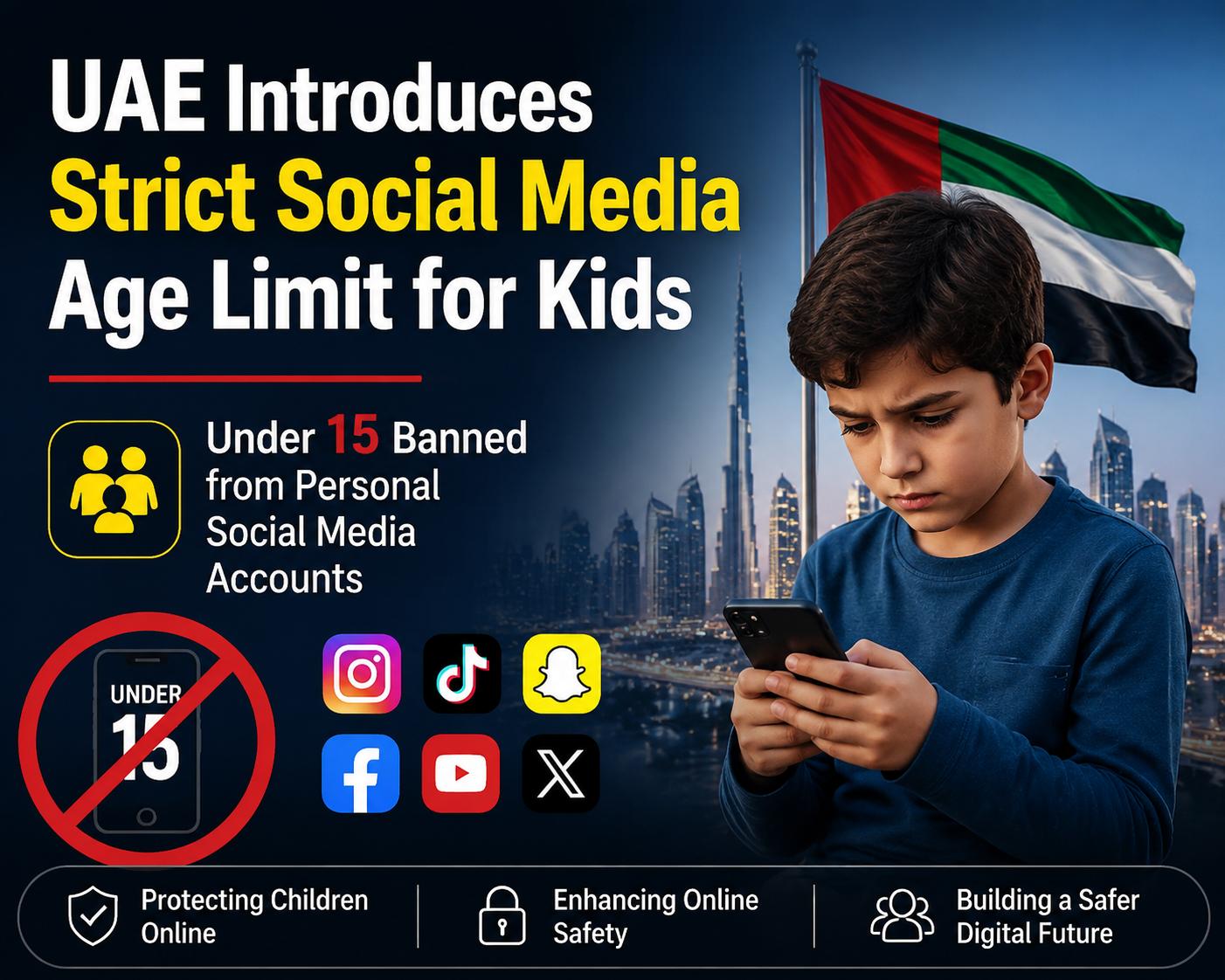
The United Arab Emirates has announced new restrictions preventing children under the age of 15 from creating, using or operating personal accounts on social media platforms. The measure is part of a broader effort to strengthen online safety and reduce children’s exposure to cyberbullying, harmful material, privacy risks and contact with unknown users.
Under the cabinet resolution, social media companies operating in the UAE will receive a 12-month compliance period. Platforms that fail to follow the rules could face warnings, administrative penalties or partial or complete blocking within the country.
What the UAE’s New Social Media Rules Include
The minimum age for operating a personal social media account will be set at 15. Children below that age will not only be prohibited from creating accounts but will also be restricted from accessing major interactive features.
According to the UAE’s official news agency, WAM, under-15 users will not be permitted to publish posts, leave comments, share content, participate in public groups, join open channels or access large-scale interactive spaces.
The restrictions appear to focus on personal and publicly interactive social media use rather than all forms of online communication. Further regulatory guidance may clarify how the rules will apply to educational platforms, child-focused services and private messaging applications.
Platforms Required to Identify Underage Accounts
Social media companies will be responsible for monitoring accounts and disabling those found to belong to children below the permitted age.
The UAE’s media and telecommunications regulators will be authorised to take enforcement action against platforms that do not introduce effective age-control systems. Available measures could include formal warnings, financial or administrative penalties, and restrictions on access to non-compliant services.
The resolution places much of the responsibility on technology companies rather than children or parents. However, the effectiveness of the policy will depend heavily on how platforms verify users’ ages without collecting excessive personal data.
Why Governments Are Restricting Children’s Social Media Use
Concerns about children’s use of social media have increased worldwide. Governments and child-safety organisations frequently point to cyberbullying, harmful content, online predators, addictive design features and privacy risks as major areas of concern.
Social platforms can offer educational, social and creative benefits, but younger users may be less prepared to recognise manipulation, misinformation or unsafe interactions. Features such as algorithmic recommendations, endless scrolling, public comments and direct contact from strangers have intensified calls for stronger safeguards.
The UAE has not provided a detailed public assessment of every factor behind the decision, but the measure reflects a wider international shift toward stricter age limits and greater accountability for technology companies.
Australia’s Under-16 Social Media Restrictions
Australia introduced a nationwide minimum-age framework requiring major social media platforms to take reasonable steps to prevent children under 16 from holding accounts. The policy does not allow parental consent to override the age requirement.
The Australian rules cover several major social and video-sharing platforms. Companies that fail to implement adequate protections can face substantial financial penalties.
Educational, communication and child-focused services may remain outside the scope of the restrictions, depending on how each platform is classified. Age-assurance methods can include age estimation and other verification systems, but governments have also stressed that users should not be forced to rely only on government-issued identification.
Britain Considers Broader Online Safety Controls
Britain has also been considering stronger restrictions on children’s access to social media and other interactive online services. Proposed measures have included tighter age controls, limits on strangers contacting children, stronger protections on livestreaming platforms and scrutiny of features designed to keep users continuously engaged.
Messaging and educational services could be treated differently from public social media platforms. The central policy question is whether children should be able to interact freely with unknown adults online without safeguards comparable to those expected in offline environments.
Unlike a simple account ban, broader regulation of gaming, livestreaming and recommendation systems would require governments to define which services qualify as social media and which features create the greatest risks.
Age Verification and Privacy Remain Major Challenges
Enforcing minimum-age rules is complicated because children can enter false birth dates or access platforms through shared devices and accounts. Technology companies may use facial age estimation, video checks, account activity analysis or identity documents to determine whether users meet the required age.
Each method raises concerns. Weak systems can be bypassed, while intrusive systems may require users to provide sensitive personal information. Regulators will therefore need to balance child protection with privacy, data security and access to legitimate educational resources.
Platforms will also need clear appeal processes for users who are incorrectly classified as underage.
What Happens Next
Social media companies operating in the UAE now have 12 months to adjust their policies, technology and age-assurance systems. Regulators are expected to issue further implementation details during the compliance period.
The UAE’s decision adds momentum to a growing international debate over whether age limits alone can protect children online. Restrictions may reduce exposure to certain risks, but they will not replace parental guidance, digital literacy, effective moderation and stronger platform design standards.
The success of the policy will ultimately depend on consistent enforcement, privacy-conscious age verification and clear distinctions between harmful public interaction and legitimate educational or communication services.