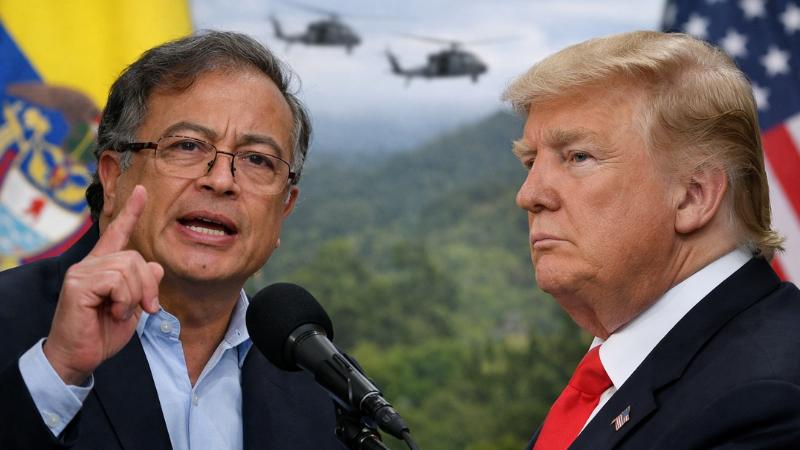
Colombian President Gustavo Petro has firmly rejected accusations and threats made by US President Donald Trump, following remarks in which Trump alleged that Petro was linked to drug trafficking and suggested he could be targeted in a United States operation. The exchange has further strained diplomatic relations between the two countries and prompted a strong public response from Colombia’s head of state.
In a series of posts published on social media platform X on Sunday, Petro dismissed Trump’s claims as unfounded and defamatory. He stressed that Colombia’s judicial system operates independently of the executive branch and noted that his name has never appeared in any judicial files related to drug trafficking. Petro said Colombia’s courts, which he described as largely overseen by opposition forces, provide a clear and documented record of individuals involved in the cocaine trade.
Petro stated that over more than five decades of judicial investigations into drug trafficking, no evidence has ever linked him to such activities. He accused Trump of speaking without proper knowledge and called on him to stop making what he described as slanderous statements. Petro added that threatening a Latin American president with a history rooted in armed struggle and later in a democratic peace process demonstrated a lack of respect for Colombia’s political journey.
The Colombian leader also criticized US Secretary of State Marco Rubio, who has echoed Trump’s remarks. Petro said such statements misrepresent Colombia and Latin America as a whole, arguing that the region should not be portrayed as a source of criminality. He urged US leaders to respect Latin American history and understand its long-standing struggles for democracy and freedom.
Petro emphasized that Latin America’s history spans tens of thousands of years and should not be reduced to narratives focused solely on drug trafficking. He said he had studied US history in order to better understand the country and expected similar efforts in return. According to Petro, labeling democratic movements and political leaders as criminals undermines mutual respect and constructive dialogue between nations.
In another message, Petro issued a warning against potential US military action in Colombia. He cautioned that bombing operations carried out without accurate intelligence could result in the deaths of civilians, including children. He added that targeting rural communities could reignite armed conflict, pushing thousands of guerrilla fighters back into mountainous regions and reversing years of efforts toward peace.
Petro also warned that any attempt to arrest or remove a democratically elected Colombian president would provoke widespread public unrest. He said such actions could trigger what he described as a powerful popular response, reflecting deep support among large sections of the population.
Trump’s initial remarks, which sparked the exchange, included accusations that Petro was connected to drug trafficking networks and suggestions that Colombia’s leadership posed a threat linked to the cocaine trade. These comments have intensified political tensions and raised concerns about the future of Colombia-US relations, particularly in areas of security cooperation and regional stability.
The public dispute highlights broader challenges in diplomatic engagement between the United States and Latin American governments, especially regarding approaches to drug trafficking, military intervention, and national sovereignty. Petro’s response underscores Colombia’s insistence on respect for its institutions, its democratic mandate, and its ongoing efforts to address violence and illicit trade through legal and political means rather than external force.