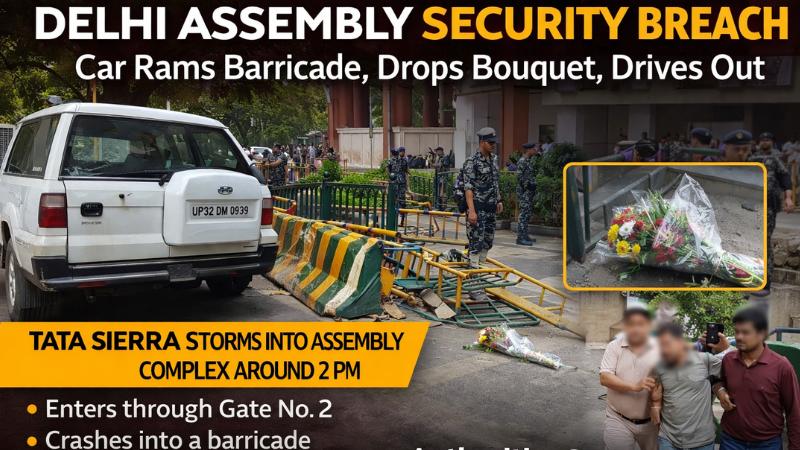
A major security breach occurred at the Delhi Legislative Assembly when an unidentified car, a Tata Sierra with a Uttar Pradesh registration number, rammed through an iron barricade and gained access to the highly secured premises. The incident took place on Monday, April 6, 2026, at around 2 pm and sent shockwaves through the assembly complex.
The vehicle entered the Delhi Assembly through Gate No. 2, an access point typically guarded by CRPF personnel, and remained inside the premises for approximately five minutes. During this time, the driver briefly stepped out of the car, placed a bouquet near the porch outside the office of Speaker Vijender Gupta, and then fled through the same gate. Authorities have since confirmed that no suspicious objects were found in the bouquet left behind.
The breach exposed significant security gaps within the assembly complex. Despite the high-security measures, including CRPF personnel stationed at the entry points, the car was able to enter and exit without any immediate interception. Authorities are currently reviewing the incident and questioning assembly staff to understand how the vehicle was able to navigate the assembly grounds with little resistance.
Eyewitnesses recounted hearing a loud thud as the vehicle broke through the gate, which was followed by a commotion among onlookers. "We were standing here, near the grip area above, and saw a white car break through the gate and speed away," said one eyewitness. Another added, "Everyone gathered around when we heard the sound. It was clear that the gate had been broken."
The audacious breach has raised questions about the security protocols in place, especially considering that the vehicle was able to exit the same gate after creating a significant disturbance inside. Sources suggest that the assembly is reviewing its access points and strengthening monitoring mechanisms to prevent future breaches.
This incident has underscored the need for tighter security measures at critical government locations, especially with the involvement of high-profile personnel and sensitive legislative work. Authorities are expected to implement more rigorous checks and review emergency response protocols to avoid any potential threats in the future.