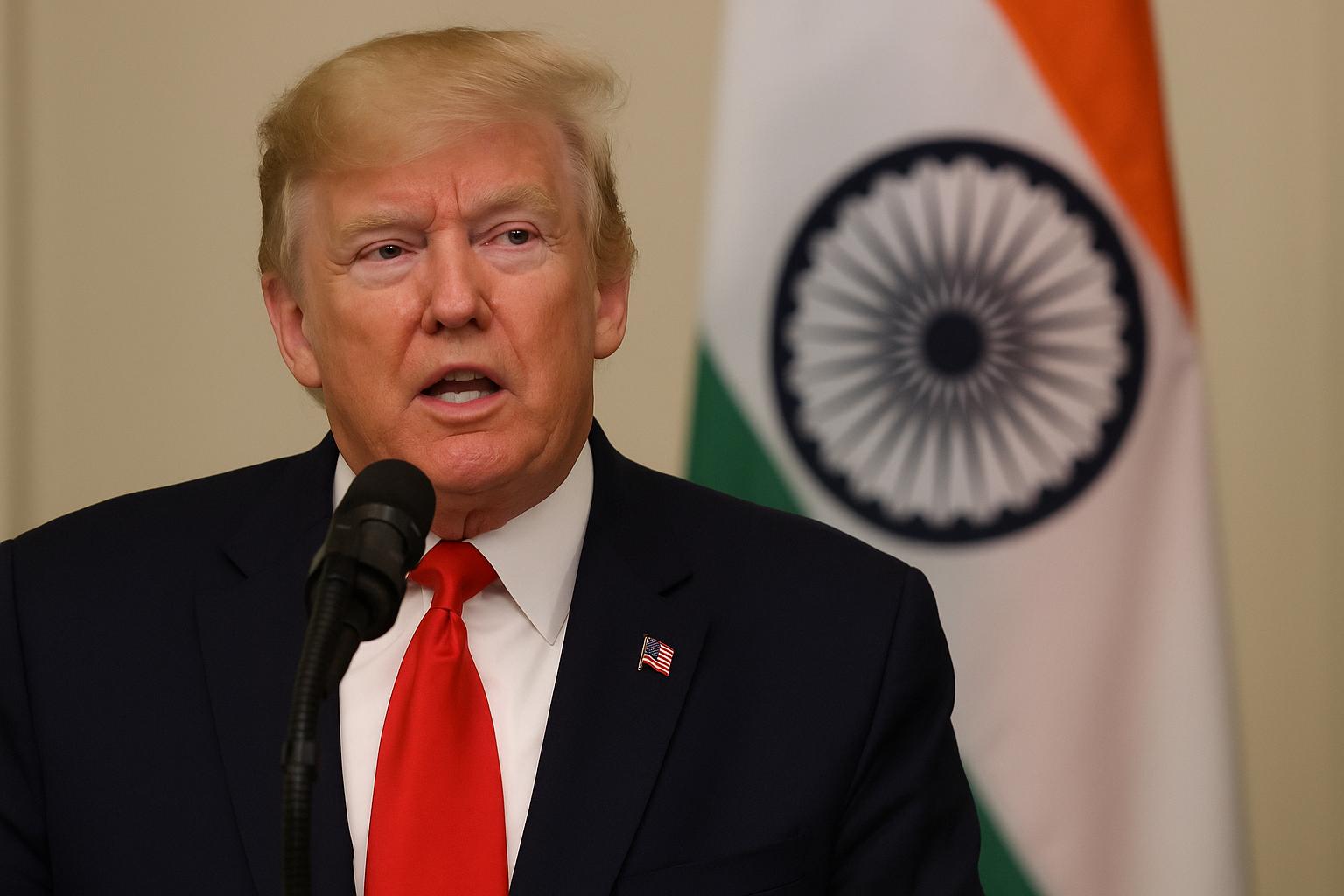
Washington — U.S. President Donald Trump reiterated on Friday that India will no longer buy oil from Russia, asserting that the South Asian nation has already begun reducing its dependence on Moscow’s energy supplies. Speaking at the White House during a meeting with Ukrainian President Volodymyr Zelenskyy, Trump said the move reflects a broader international effort to isolate Russia economically over its invasion of Ukraine.
“India will not be buying oil from Russia,” Trump declared during the press briefing. “They’ve already deescalated. The process can’t be done immediately, but it’s going to be over with soon.” His remarks underscored the administration’s strategy of using both diplomatic channels and economic pressure to weaken Russia’s financial capacity to sustain its war.
The U.S. president has consistently argued that Western and allied nations should halt the purchase of Russian energy in order to starve the Kremlin’s war machine. Trump has also said he could bring an end to the war in Ukraine through what he calls a mix of “diplomacy and tariffs,” if North Atlantic Treaty Organization (NATO) members agreed to cease buying Russian oil and gas.
At the same time, Trump expressed sympathy for certain European nations still dependent on Russian crude, specifically referencing Hungary. “Hungary is sort of stuck because they have one pipeline that’s been there for years and years,” he said. “They’re inland—they don’t have a sea. It’s very hard for them to get oil. I understand it.”
However, Trump’s comments about India’s oil policy came under scrutiny in New Delhi. India’s Ministry of External Affairs (MEA) swiftly responded to earlier similar remarks by clarifying that there had been “no conversation” between Prime Minister Narendra Modi and President Trump regarding oil imports on the day in question. The MEA spokesperson reaffirmed that India’s approach to energy procurement remains focused on securing reliable and affordable supplies for domestic consumers.
“India’s consistent priority has been to safeguard the interests of the Indian consumer in a volatile energy scenario,” the MEA said in its statement. “Our import policies are guided by the twin goals of stable energy prices and secured supplies.”
Currently, Russia remains India’s top crude oil supplier, providing nearly one-third of its total imports. India’s refiners have benefited from discounted Russian oil since the imposition of Western sanctions following the 2022 invasion of Ukraine. Despite U.S. pressure, India has maintained that its purchases are within the framework of global market norms and do not violate international sanctions.
Industry reports suggest that while India’s Russian oil imports have fluctuated in recent months, the variations are largely driven by changing price dynamics, transportation costs, and discount margins rather than political decisions. Analysts note that India’s energy demand continues to grow rapidly, requiring a diversified import strategy that includes both traditional and emerging suppliers.
Trump’s renewed pressure on India coincides with ongoing U.S.-India trade negotiations aimed at expanding bilateral cooperation while addressing disputes on tariffs and market access. Washington has repeatedly urged New Delhi to align more closely with Western sanctions regimes, while India has emphasized the need for strategic autonomy in its foreign policy.
The remarks also come at a delicate moment in global energy diplomacy, as Western nations seek to balance economic sanctions on Russia with the stability of oil markets. A sudden reduction in Russian energy exports could disrupt global supply chains, increase fuel prices, and strain economies already battling inflation.
Trump’s comments highlight his administration’s continued focus on using economic levers to influence international conflicts. His insistence that India halt purchases of Russian crude appears intended to strengthen the collective impact of sanctions while signaling U.S. expectations of greater cooperation from key global partners.
For India, however, the issue remains one of pragmatism. Officials maintain that the country’s long-term energy security cannot be compromised, and any transition away from Russian oil must occur in a manner that protects domestic interests. As one Indian energy analyst observed, “India will continue to engage with all partners to ensure stable and affordable energy supplies — political rhetoric aside, that’s the reality of a growing economy.”
As the geopolitical landscape evolves, both Washington and New Delhi are expected to continue balancing strategic alignment with national priorities. For now, Trump’s remarks serve as a reminder of the complex intersection between global diplomacy, energy security, and the shifting dynamics of power in a world still reshaped by war and sanctions.