Elon Musk, the founder of xAI and several other major tech ventures, has once again drawn global attention with a social media post that showcased the capabilities of his artificial intelligence chatbot, Grok. In a recent interaction, Musk shared an image of Lord Ganesha—the revered Hindu deity known as the remover of obstacles—and asked Grok a simple question: “What is this?” The AI’s response, detailed and culturally precise, quickly went viral, impressing users with its accuracy and depth of understanding.
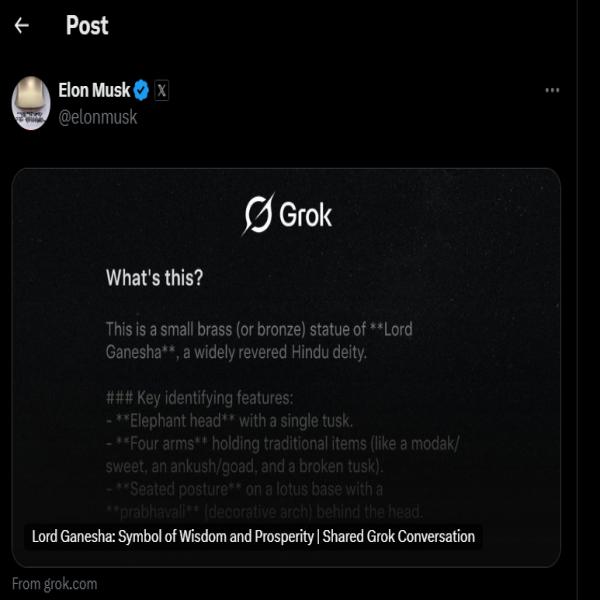
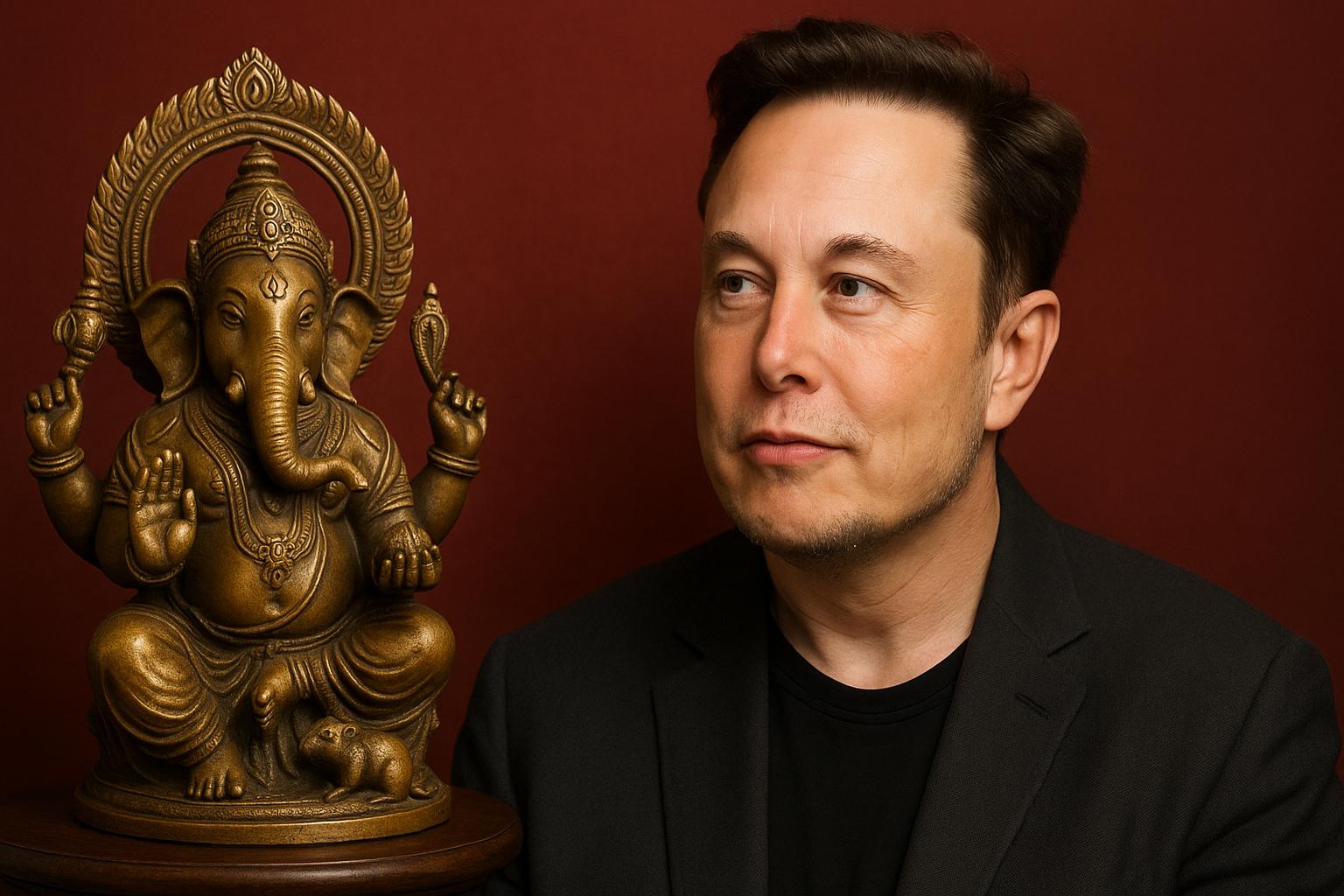
The image shared by Musk appeared to depict a traditional brass idol of Lord Ganesha, commonly seen in South Indian households and temples. Grok, developed by Musk’s company xAI, analyzed the photograph and identified it as a “small brass statue of Lord Ganesha, a widely revered Hindu deity.” It then proceeded to provide an elaborate description, noting key features such as the elephant head, single tusk, four arms, and symbolic objects including a modak, a goad, and a broken tusk. The chatbot also mentioned the lotus base and the decorative arch typically found behind Ganesha idols, further emphasizing its understanding of cultural and artistic details.
Expanding on its analysis, Grok explained that the mouse seen near the deity’s feet represents Ganesha’s vehicle, a significant element in Hindu iconography. It added that such brass idols are commonly used in home shrines for daily prayers and are often placed on wooden pedestals. Grok also observed that the idol in the image had been photographed against a red backdrop, identifying it as a traditional South Indian-style brass murti.
The precision of Grok’s response surprised many social media users, who praised the AI’s ability to interpret religious imagery with such accuracy. Comments poured in from around the world, with users expressing admiration for the technology’s capacity to go beyond simple object recognition and into cultural context. Several people noted that Grok’s detailed description reflected not just technical advancement but also a respectful acknowledgment of global religious diversity.
Elon Musk’s post quickly gained traction online, with thousands of likes, shares, and comments discussing both the technological and cultural aspects of the interaction. Many observers remarked that the exchange highlighted how rapidly artificial intelligence is evolving, now capable of understanding not only objects and languages but also symbols deeply rooted in human traditions. Others noted that this kind of recognition reflects a broader shift in AI development—from performing basic analytical tasks to demonstrating nuanced comprehension of global heritage.
Musk has previously described Grok as an AI system designed to be more intuitive, humorous, and context-aware than traditional chatbots. The company xAI, which he founded in 2023, aims to develop artificial intelligence that understands the universe more deeply and integrates seamlessly with human reasoning. While Grok is currently integrated with Musk’s social media platform X (formerly Twitter), it has already attracted attention for its conversational abilities and creative responses.
This recent demonstration of Grok’s cultural intelligence adds another dimension to Musk’s broader vision of AI. By accurately recognizing a Hindu deity and articulating its spiritual and artistic details, Grok displayed a form of cross-cultural understanding that many found remarkable. It also reignited discussions about how artificial intelligence could be trained to respect and preserve global cultural diversity, rather than overlook it.
As the post continued to circulate, it became a symbol of how AI systems are increasingly capable of bridging gaps between technology and tradition. For many viewers, the interaction between Musk and Grok served as both a technical showcase and a reminder of how advanced algorithms can still honor ancient symbolism. In a world where AI often faces criticism for bias and lack of cultural awareness, Grok’s recognition of Lord Ganesha was seen as a refreshing and positive example of progress.
The event may seem minor, but it underscores a deeper development in the evolution of AI—its growing ability to interpret meaning beyond data. Whether identifying an object, understanding cultural heritage, or analyzing visual cues, the line between machine learning and human-like comprehension continues to blur. For Elon Musk, whose companies have long pushed the boundaries of technology, this interaction was another step toward demonstrating how artificial intelligence can connect with the human experience in unexpected ways.