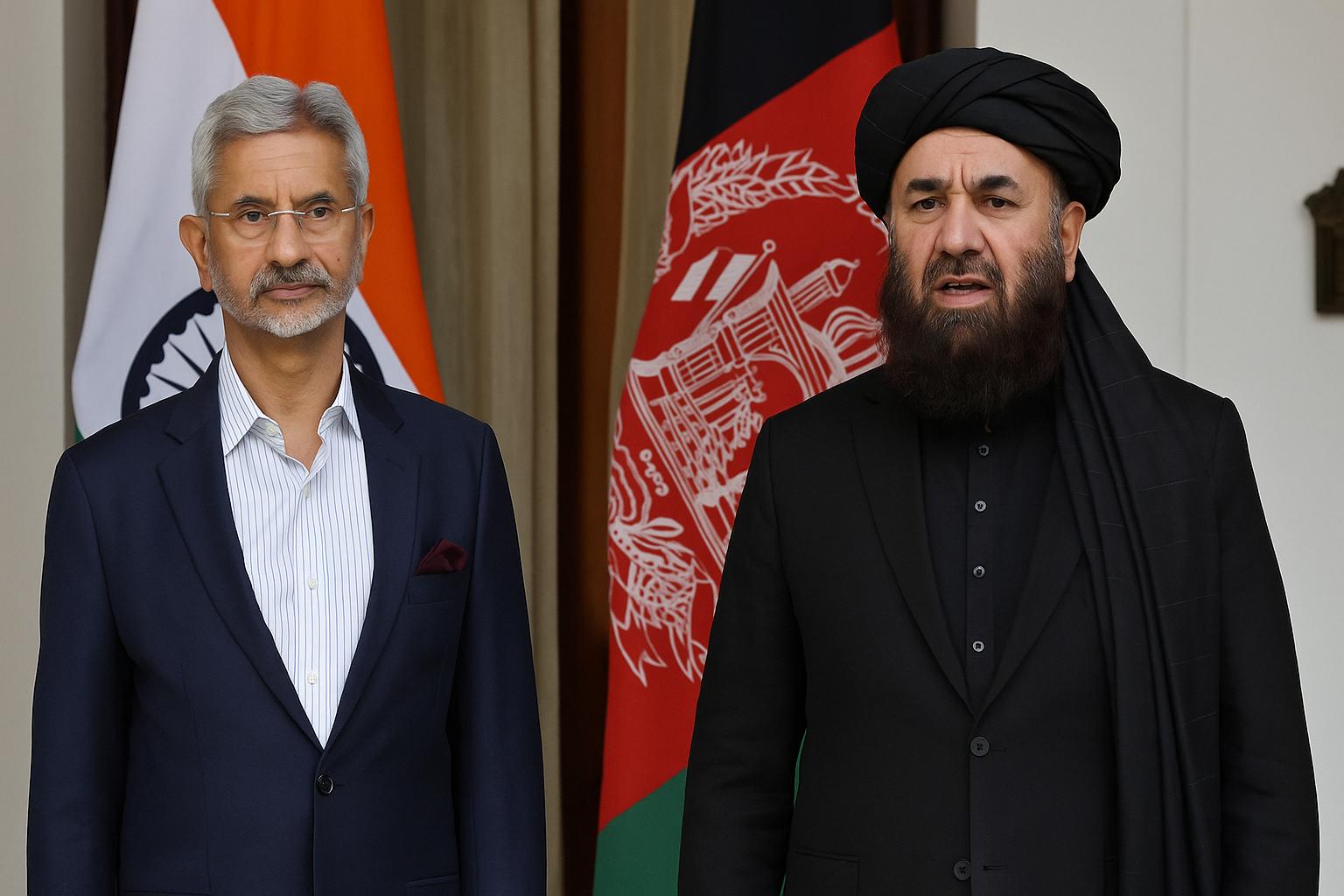
India has announced the reopening of its diplomatic mission in Afghanistan, marking a significant step in restoring engagement with the Taliban-led government. The decision, revealed during a bilateral meeting between India’s External Affairs Minister S. Jaishankar and Afghanistan’s Foreign Minister Amir Khan Muttaqi in New Delhi on October 10, represents the first high-level diplomatic dialogue between the two nations since the Taliban took power in August 2021.
India had shut down its embassy and consulates across Afghanistan following the Taliban’s takeover three years ago, prioritizing the safety of its personnel amid widespread uncertainty. With this latest move, New Delhi will upgrade its existing technical mission in Kabul to a full-fledged embassy, signaling a deliberate re-engagement with Afghanistan’s political and humanitarian realities under Taliban rule.
While India’s decision stops short of formally recognizing the Taliban regime, it marks a pragmatic shift toward direct engagement. Officials indicated that the embassy’s reopening is intended to facilitate closer coordination on humanitarian assistance, infrastructure reconstruction, and regional security. The development also aims to protect India’s long-standing investments in Afghanistan, which have included major projects in healthcare, education, transportation, and energy.
Speaking after the meeting, Jaishankar emphasized that India’s renewed diplomatic presence would serve the broader goal of regional stability and security. He noted that the reopening reflects India’s commitment to the Afghan people and its intention to contribute meaningfully to the country’s rebuilding efforts. For Afghanistan, the move is expected to improve access to bilateral trade, aid, and developmental cooperation, which had been disrupted since 2021.
Afghanistan’s Foreign Minister Amir Khan Muttaqi welcomed the decision, describing it as a constructive step toward restoring mutual trust and enhancing regional cooperation. He expressed optimism that the reopening of India’s embassy would lead to expanded economic and humanitarian engagement. Muttaqi’s visit, the first by a senior Taliban representative since the group assumed power, is being closely watched by global observers as a potential signal of evolving diplomatic dynamics in South Asia.
India has historically maintained strong cultural, economic, and developmental ties with Afghanistan. Before the withdrawal of U.S. and NATO forces in 2021, New Delhi had invested over $3 billion in reconstruction projects, including the Afghan Parliament building and the Salma Dam. The reestablishment of a permanent diplomatic presence is viewed as a strategic move to safeguard these investments and reassert India’s influence at a time when other regional powers, notably China and Pakistan, are expanding their footprints in Afghanistan.
Analysts interpret India’s renewed engagement as a calculated policy adjustment, balancing national interests with humanitarian considerations. The Taliban’s record on human rights, especially concerning women’s education and public participation, continues to draw international criticism. By reopening its embassy, India is positioning itself as a stakeholder capable of maintaining dialogue while upholding its long-standing advocacy for an inclusive Afghan society.
The reopening of the Kabul mission is also expected to enhance India’s ability to coordinate on pressing security concerns, including counterterrorism, narcotics control, and border management. New Delhi has repeatedly emphasized that Afghanistan’s stability is critical to regional peace, particularly in light of cross-border terror networks and the spread of extremist ideology.
Although India has not granted formal recognition to the Taliban government, the establishment of an embassy marks a shift from isolation toward conditional engagement. Diplomatic experts note that the approach mirrors India’s broader foreign policy trend of pursuing dialogue-based solutions, even with politically complex regimes.
The decision carries both symbolic and strategic significance. It reaffirms India’s intention to remain an active participant in shaping Afghanistan’s future while reflecting the realities of a changing geopolitical landscape. As global powers recalibrate their policies toward the Taliban-led administration, India’s move is being interpreted as an assertion of regional leadership and pragmatic diplomacy.
By reopening its embassy in Kabul, India is effectively reestablishing its presence in one of the most volatile regions in the world. The coming months will reveal how New Delhi navigates its delicate balance between humanitarian outreach and strategic necessity, while ensuring that its renewed engagement contributes to stability, development, and lasting peace in Afghanistan.