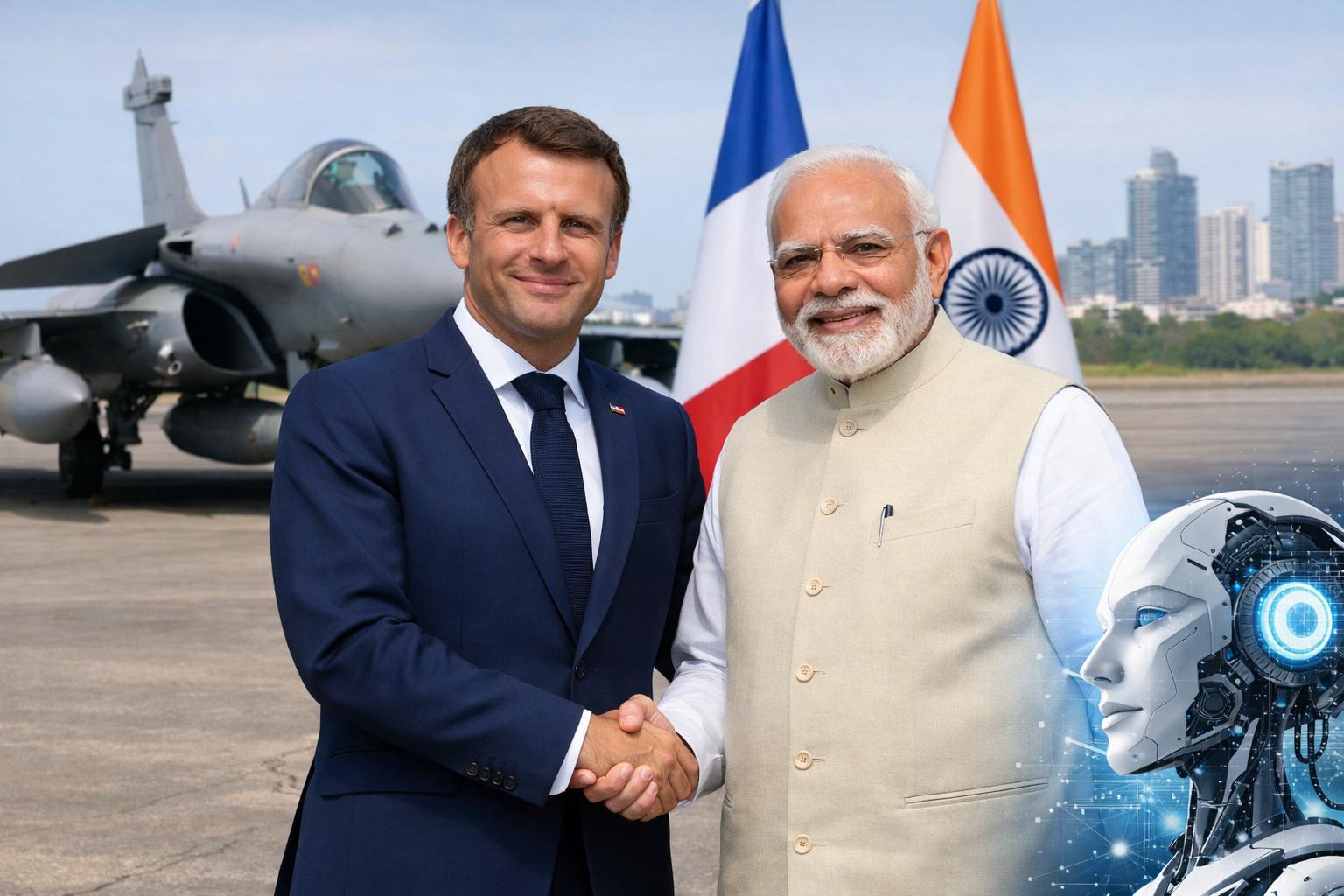
Macron, accompanied by his wife Brigitte Macron, was scheduled to arrive in Mumbai around midnight on Monday. This marks his fourth visit to India since assuming office in 2017. The French leader will meet Prime Minister Narendra Modi later on Tuesday before heading to New Delhi to participate in a two-day artificial intelligence summit on Wednesday and Thursday, where AICooperation is expected to feature prominently.
The visit follows New Delhi’s recent confirmation that it plans to place a major order for Rafale jets, signalling a deepening defence partnership between the two nations. Talks are expected to include a possible contract for 114 additional aircraft from Dassault Aviation, a move that would significantly expand India’s existing fleet. An Indian defence ministry statement last week indicated that the proposed purchase had received approval in principle, with the majority of the aircraft expected to be manufactured domestically as part of India’s push to boost local defence production.
Although officials have not publicly confirmed the exact number of jets, defence sources in New Delhi suggest that negotiations are centred on 114 fighters. Analysts say the deal could be worth around €30 billion, potentially making it one of the largest MilitaryProcurement agreements in India’s history and a defining moment for bilateral ties. If finalised, the new order would complement the 36 Rafale jets acquired for the Indian Air Force in 2016 and the 26 aircraft ordered for naval operations.
Beyond defence, Macron and Modi are also scheduled to jointly inaugurate India’s first helicopter final assembly line via videoconference from Mumbai. The facility, located in Vemagal near Bengaluru, is a joint venture between Tata Group and Airbus and will manufacture the Airbus H125, the company’s best-selling single-engine helicopter. The project highlights expanding industrial cooperation and France’s growing economic footprint in India.
France has emerged as a key partner for India over the past decade, particularly as New Delhi works to diversify its defence suppliers and reduce reliance on Russia. Officials from both countries say the current visit aims to further broaden cooperation into emerging sectors, including artificial intelligence, advanced manufacturing, and aerospace.
The discussions are also expected to touch on wider geopolitical issues, including global economic uncertainty, China’s regional influence, and evolving trade dynamics following the recent EUIndiaTrade agreement. Bilateral trade between the two nations currently stands at approximately €15 billion annually, driven largely by aerospace and defence sectors, while French foreign direct investment in India is estimated at nearly €13 billion.
Diplomatic observers note that the personal rapport between Macron and Modi could help accelerate progress on pending agreements. However, differences remain on certain international issues, including India’s continued purchase of Russian oil following Moscow’s 2022 invasion of Ukraine.
Despite these complexities, both governments have signalled optimism that the visit will further cement their long-standing strategic ties and open new avenues for cooperation in technology, defence, and economic engagement.