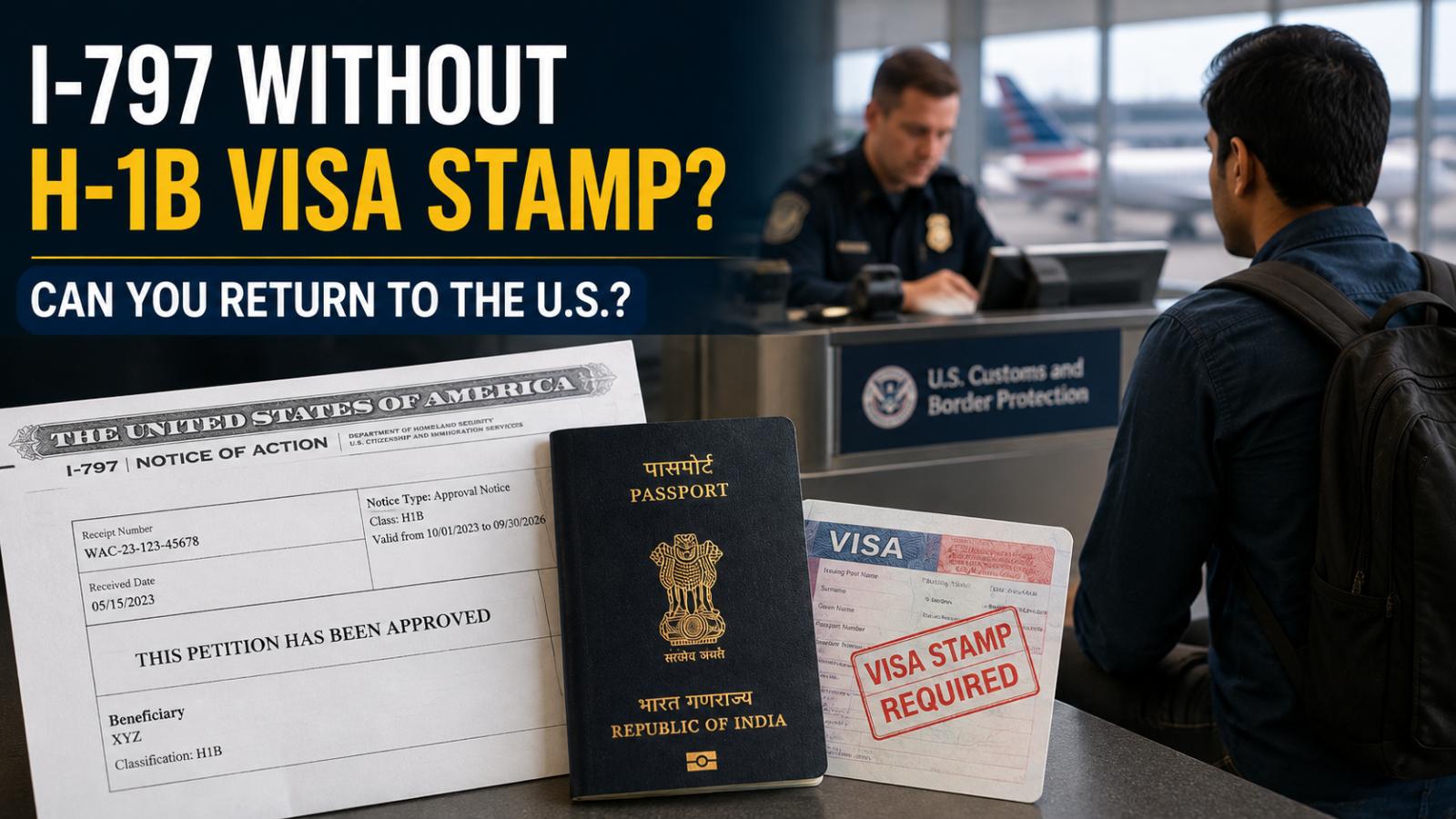
An approved Form I-797 confirms an H-1B petition but normally does not replace the visa needed to return to the United States after travel abroad. H-1B workers should understand the roles of the visa stamp, I-797 and I-94, along with the narrow automatic revalidation exception.
An H-1B worker may have a valid employment approval extending for months or years but still face a problem after leaving the United States: Form I-797 is not itself an H-1B visa.
For workers who travel to India without a valid H-1B visa stamp, that distinction can determine whether they can board a flight and seek readmission to the United States.
Workers who are unsure whether an approval notice is enough for travel can read our guide on I-797 without an H-1B visa stamp.
What does an approved I-797 actually mean?
Form I-797 is USCIS' notice showing that an H-1B petition has been approved. It establishes the approved petition and its validity period, but it does not function as a visa placed in a passport.
USCIS guidance says H-1B travelers should carry a valid, unexpired I-797, a valid passport and a valid H-1B visa stamp when returning to the United States.
That means someone in India with an approved I-797 but no valid H-1B visa generally still needs to complete the visa process before normal return travel.
Applicants waiting for a visa appointment should also understand whether an approved petition alone permits travel. Read our guide on returning to the U.S. with I-797 but no H-1B visa stamp.
Why doesn't the I-797 replace the visa stamp?
The two documents serve different purposes.
The I-797 relates to USCIS approval of the employer's H-1B petition. The H-1B visa stamp, issued through the State Department, permits the traveler to seek admission at a U.S. port of entry during its validity.
Even a valid visa does not guarantee entry. U.S. Customs and Border Protection makes the final decision on admission and authorized stay when the traveler arrives.
For H-1B visa applications, the State Department lists the petition receipt number from Form I-129 or I-797 among the required information, along with a passport, DS-160 confirmation and other applicable documents.
Is there any exception for an expired H-1B visa?
Form I-797 is important for the H-1B visa process, but it does not automatically replace a visa for international travel. Read our explainer on whether I-797 alone is enough to return to the U.S.
A narrow provision known as automatic visa revalidation can allow certain nonimmigrants with expired visas to seek reentry after qualifying trips of 30 days or less to Canada or Mexico, provided they meet the applicable requirements.
Among the restrictions, travelers generally cannot use automatic revalidation if they applied for a new visa during the trip.
This exception normally does not help an H-1B worker who traveled to India, because travel to India falls outside the qualifying Canada-Mexico itinerary.
Before considering third-country stamping, applicants should understand the difference between petition approval and the visa needed for travel. See our guide on I-797 and H-1B visa stamp requirements.
What should an H-1B worker stranded in India do?
A worker without a valid H-1B visa should first confirm the validity of the approved petition, complete the applicable visa application requirements and secure a consular appointment.
If normal appointments are unavailable and there is a genuine urgent circumstance, the applicant can review the official expedited-appointment process rather than assuming the I-797 permits return travel.
Employers should also be informed about delays, particularly when the employee cannot resume work in the United States as planned. Complex cases involving previous refusals, status violations or other immigration issues may require case-specific legal advice.
The key distinction is straightforward: an approved H-1B petition establishes the underlying employment authorization, while the visa and CBP admission process govern the worker's return after international travel.