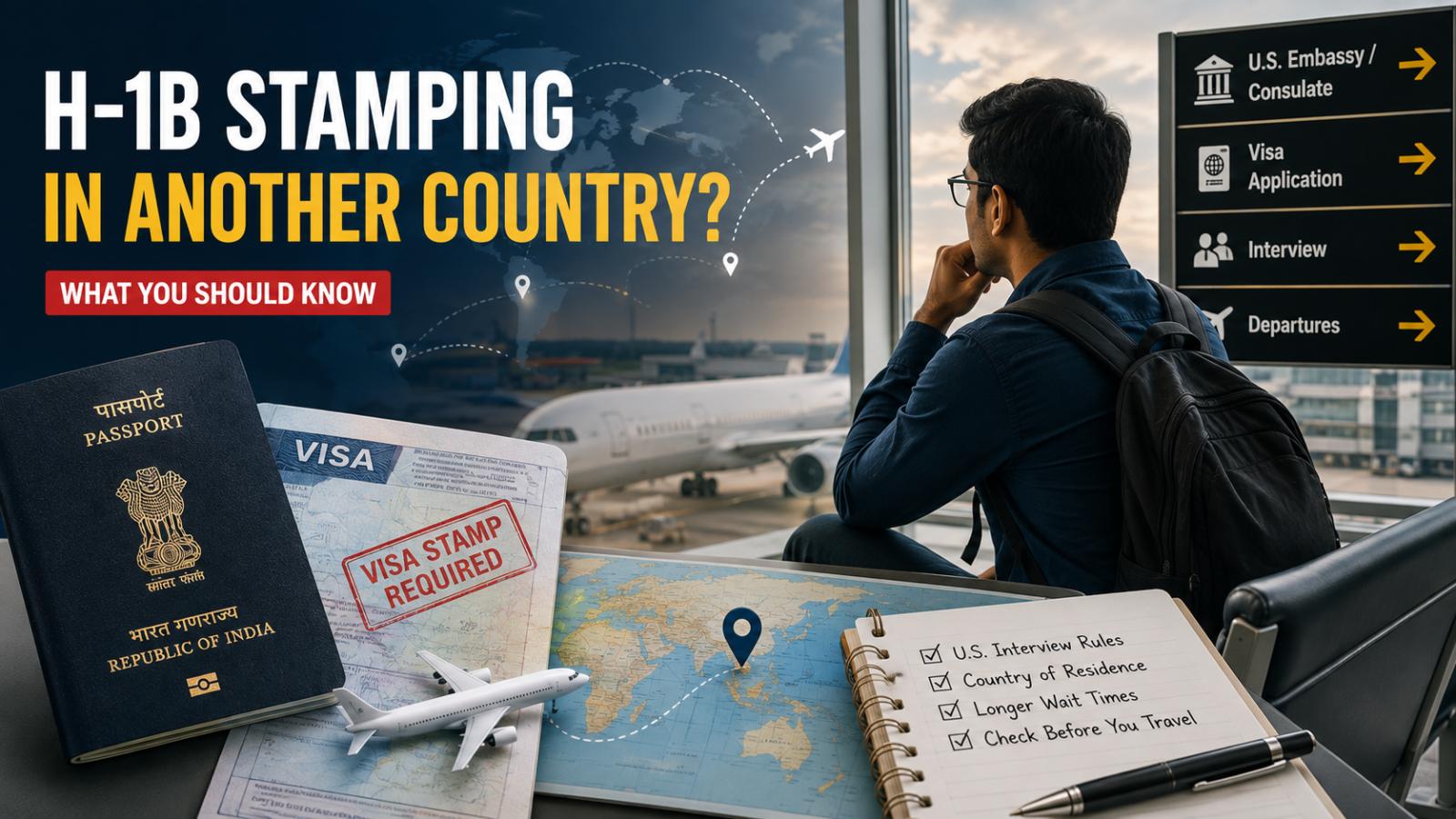
H-1B workers considering visa stamping outside India now face stricter U.S. guidance. Since July 15, 2026, nonimmigrant applicants should interview in their country of nationality or residence, while third-country applicants may face longer waits and greater difficulty qualifying.
H-1B workers who cannot find convenient visa appointments in India sometimes consider traveling to another country for visa stamping. That strategy, commonly called third-country stamping, has become significantly less straightforward under updated U.S. Department of State guidance.
Applicants considering another country for stamping should first understand the current rules for H-1B visa stamping outside India.
On July 15, 2026, the State Department said nonimmigrant visa applicants should schedule their visa interviews at a U.S. Embassy or Consulate in their country of nationality or residence. The guidance took effect immediately.
What changed for third-country H-1B stamping?
Under the updated policy, an Indian citizen who normally lives in India is generally expected to apply in India. A person who legally resides in another country may apply there based on residence, but the applicant must be able to demonstrate that residence.
The guidance does not say that every application outside the country of nationality or residence is automatically prohibited. However, the State Department warns that applicants applying elsewhere may find it more difficult to qualify for the visa.
Could appointment waits be longer abroad?
Yes. The State Department specifically says applicants seeking interviews outside their country of nationality or residence should expect significantly longer appointment waits.
Some applicants look abroad when appointments are difficult to find, but they should first review the current rules for H-1B stamping in another country.
Application fees paid at another post are also nonrefundable and cannot be transferred if plans change. Applicants should therefore avoid booking international flights or accommodation solely on the assumption that another U.S. consulate will provide faster H-1B processing.
What should H-1B applicants verify first?
Workers who cannot secure an appointment in India may also want to understand the current rules for getting H-1B visa stamping in another country.
Before selecting any consulate, applicants should review that embassy or consulate's current visa procedures and operating status.
For an H-1B interview, State Department guidance lists core documents including a valid passport, DS-160 confirmation page, applicable fee receipt and the petition receipt number from Form I-129 or Form I-797. A consular post may request additional documentation.
Are there exceptions to the new rule?
The July 15 guidance says rare exceptions may be made for humanitarian or medical emergencies or foreign-policy reasons. These are exceptions rather than a general alternative for workers trying to find faster appointments.
If an emergency appointment is not available, applicants may consider other locations, but should understand the risks of third-country H-1B visa stamping.
For an H-1B worker stranded in India, securing an appointment in India and monitoring official availability is now generally more consistent with current State Department guidance than traveling to another country solely for stamping. Anyone considering third-country processing should first confirm the post's rules and consider case-specific advice before paying fees or making international travel arrangements.