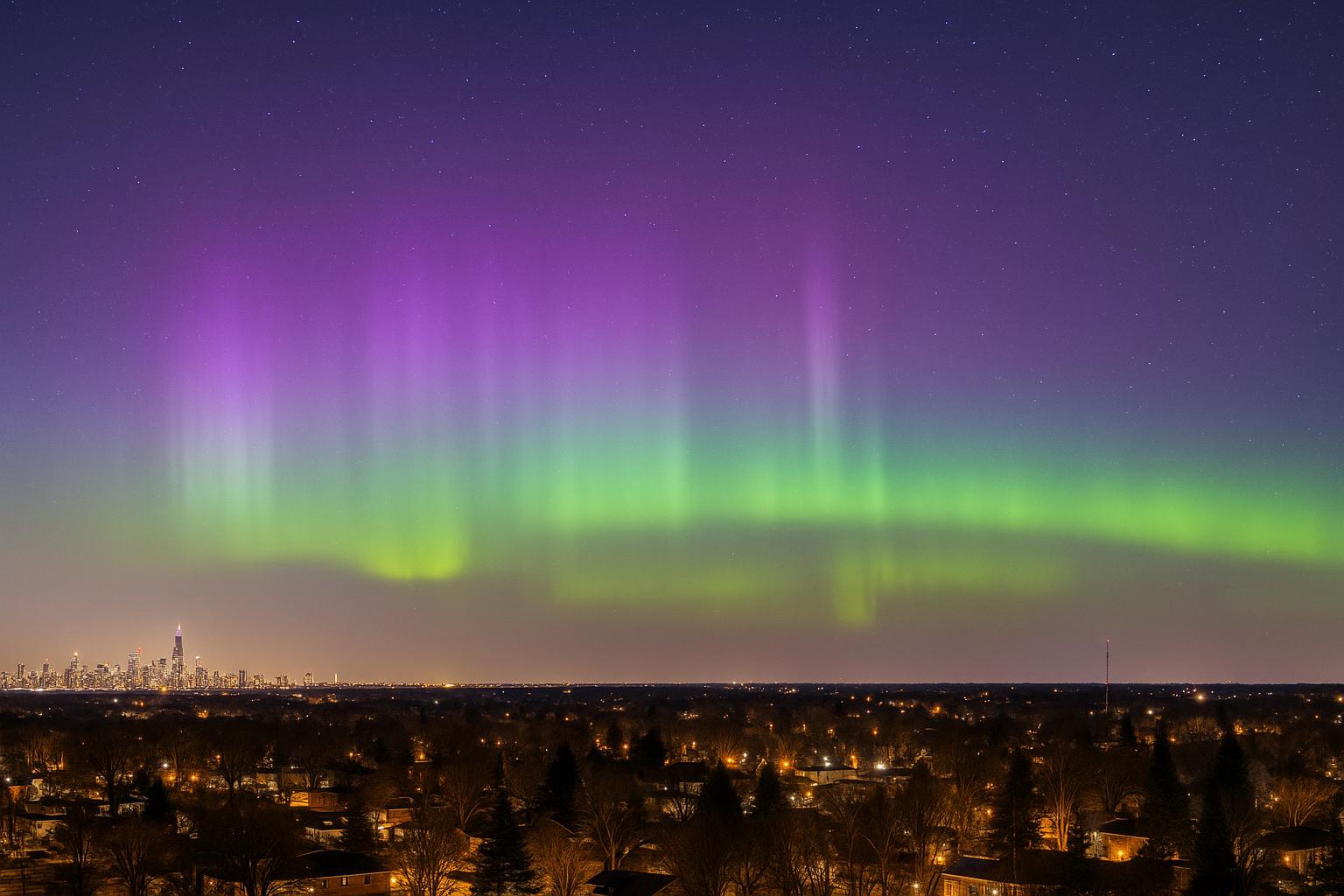
On Tuesday night, residents throughout the Chicago metropolitan area were treated to a rare celestial display as the multi-hued ribbons of the aurora borealis lit up the sky following a powerful solar flare. From the heart of the city to suburban neighbourhoods, witnesses described vivid shades of pink, purple, green and yellow drifting across the horizon, signalling the arrival of an energetic stream of solar particles.
Meteorologists and space-weather experts attribute the spectacle to a coronal mass ejection (CME) released by the Sun, accompanied by the strongest solar flare of the year, which sent charged particles hurtling toward Earth’s magnetosphere. As those particles collided with Earth’s upper atmosphere, particularly in the regions influenced by the planet’s magnetic field, they excited oxygen and nitrogen atoms and caused the familiar glow of the northern lights.
According to officials with the local storm team, the display began in earnest shortly after sunset, with some of the most striking views emerging in including Chicago, Cary, Downers Grove, Gilberts, Wilmette and Wheaton, as well as downstate in Stark County and near Annawan. The visuals extended along a broad viewing line that cut across central Illinois and into Indiana. Early Wednesday morning, one of the meteorologists on duty observed that the aurora was still clearly visible at approximately 5:15 a.m., looking eastward from New Trier High School in Winnetka.
The area’s sky watchers have good reason to remain alert: data from the NOAA Space Weather Prediction Center (SWPC) indicate a spike in geomagnetic activity between approximately 9 a.m. and noon on Wednesday, the time when the next wave of the CME is expected to impact Earth. While this phase occurs during daylight hours, meteorologists caution that the aurora may still present itself again in the evening, provided the sky is clear and one moves away from city lights.
The forecast suggests that the southern-most viewing line for Wednesday night will shift further north than Tuesday’s path, meaning the aurora may be more prominent in northern Illinois and into Wisconsin, rather than directly over the Chicago metro. Observers are therefore encouraged to look northward between roughly 6 p.m. and 7 p.m. local time, if conditions allow.
To understand why this phenomenon happened at latitudes as far south as Chicago, it helps to review the underlying science. Auroras occur when high-energy charged particles from solar winds or CMEs interact with Earth’s magnetosphere, and are guided by magnetic field lines toward the poles. As they collide with gases in the upper atmosphere, the gases become excited and release light. During times of heightened solar activity—such as when the Sun is near its peak in the roughly 11-year solar cycle—the likelihood of such auroras increases, as more frequent flares and CMEs send larger volumes of energy toward Earth.
The recent solar event has produced both beauty and caution. While the vibrant display delighted stargazers across the region, space-weather analysts note that substantial geomagnetic storms can also pose risks to technology infrastructure, including satellites, power grids and communications systems. At the same time, the fact that auroras were visible at mid-latitudes underscores the intensity of the solar flare and the accompanying ejection of plasma.
For Chicago-area residents hoping for a repeat, the key will be to watch the skies, plan for conditions away from light-polluted zones, and keep in mind that the most vivid activity may occur closer to dusk or during the early evening hours, before light from the rising sun diminishes visibility. Clear skies and an unobstructed view facing toward the northern horizon will improve the chances of spotting the phenomenon.
In summary, a potent solar flare and subsequent CME delivered a dramatic auroral show across the Chicago region, offering a rare opportunity for many observers to enjoy a spectacle typically reserved for higher latitudes. With geomagnetic activity still elevated, there remains a strong possibility that the aurora may make another appearance Wednesday night under favourable conditions.