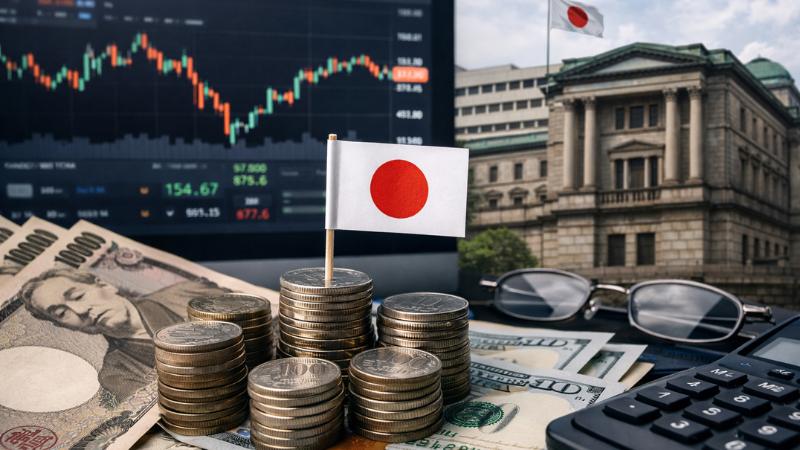
Japan’s central bank on Thursday began its final policy meeting of the year, with markets widely expecting a further increase in benchmark interest rates as officials continue the gradual shift away from years of ultra-loose monetary policy. The decision, scheduled to be announced on Friday, could mark the highest borrowing costs Japan has seen in three decades, underscoring the Bank of Japan’s determination to normalize policy amid persistent inflation pressures.
Market pricing suggests a strong likelihood of action, with data indicating an overwhelming probability that policymakers will lift rates to around 0.75 percent. Such a move would take interest rates to their highest level since 1995 and reinforce the central bank’s resolve to curb inflation that has exceeded its target for more than three and a half years. Inflation has now remained above the BOJ’s goal for 43 consecutive months, strengthening the case for continued tightening despite concerns over economic momentum.
A rate increase is expected to support the yen, which has remained under pressure against the U.S. dollar for much of the past year. A firmer currency would help reduce imported inflation, but higher borrowing costs also risk further slowing an economy that is already showing signs of strain. Revised national accounts data released recently showed that Japan’s economy contracted more sharply than previously estimated in the third quarter, shrinking 0.6 percent from the prior quarter and 2.3 percent on an annualized basis.
With a policy move largely anticipated, attention has shifted to the central bank’s post-meeting communication. Investors are expected to closely scrutinize guidance on the future path of interest rates, particularly any discussion of the so-called neutral or terminal rate that neither stimulates nor restrains economic growth. Bank of Japan Governor Kazuo Ueda has acknowledged the difficulty of identifying this level, noting that estimates currently fall within a wide range between 1 percent and 2.5 percent.
Ueda has previously told lawmakers that policymakers must steer monetary policy without a precise understanding of where the neutral rate lies, even as efforts continue to refine those estimates. Analysts believe updated projections or further commentary could be provided following the current meeting, potentially offering markets clearer insight into how far the central bank intends to go.
The pace of future rate increases remains a key point of debate. Japan began its policy normalization last year by ending the negative interest rate regime that had been in place since 2016, and officials have consistently emphasized a cautious, data-dependent approach. While some market participants anticipate another hike by mid-2026, others believe the next move could come later in the year, depending on economic conditions and currency developments.
There are also broader risks to the normalization path, including the possibility of a slowdown in the United States and heightened regional tensions. Still, analysts suggest that only a significant external shock would be enough to derail the Bank of Japan’s current trajectory.
Currency markets are also sensitive to any direct references to yen weakness. The yen has traded in a range of roughly 154 to 157 per dollar since November, having depreciated further following political changes earlier in the autumn. Although the central bank has not explicitly targeted the exchange rate, any strong remarks on currency movements could be interpreted as a signal that policymakers are drawing a line against further depreciation.
Higher interest rates also have implications for Japan’s public finances. Rising yields are expected to push up borrowing costs for the government at a time when fiscal stimulus is being used to support growth. Yields on 10-year Japanese government bonds have climbed to near 18-year highs, and further increases could significantly raise debt servicing costs over the coming years. Despite these pressures, analysts expect the yen to remain within a broad range in the year ahead, balancing monetary policy tightening against fiscal and economic constraints.